


As mentioned in our last post, we have been running this blog for about two years now. It wasn't too long after we started the blog that we registered our own domain name. The contract was for two years, so it I knew that the time to renew was coming up. Still I was surprised to get a letter that appeared to be from some government agency asking me to send in my money for my renewal. Then I read the fine print.
When I got this letter, I did some research. If you Google "Domain Registry of America," by the 5th hit you will see sites talking about this scam. Basically, their letter is worded such that, if you don't read carefully, it is easy to think you are required to pay them to keep your domain. In reality, by sending the form back to them with money, you are transferring your domain to them. There are two problems with this. First off, it is a sneaky way to steal another company's customers. Second, if I were to switch, I would end of paying 4 times more every year.
Scams really bother me. I think is is why I have written up so many of them over the last two years. Still, the thing that got me about this one was the way they presented themselves. The letter I got in the mail looked like government document. The font, boxy layout, and American flag under the logo all add to this effect. The back side of the letter is filled with the smallest text I have ever had sent to me. It is so small as to be on the edge of readable and makes my eyes hurt after a short time. If you read close, the letter does say on the front "Domain name holders are not obligated to renew their domain name withe their current Registrar or with the Domain Registry of America. Review our prices and decide for yourself." I am glad they put this on the letter. Still, I only caught this on my second read through of the letter. It is certainly not the letter's theme.
The Domain Registry of America uses underhanded tactics to try and steal customers from other companies. The Better Business Bereau has given them an F because of a large number of complaints filed against the company and their failure to resolve them. The Internet has a lot to offer and I am glad to we have our own domain. So, if you are looking to get a domain or renew one your already have, take your time, do your research, and read carefully before you hand over any money.
June 28, 2011
June 20, 2011
Happy Birthday to Us!
Yesterday marked the two year anniversary of Scientifica Phenomena! A lot has happened since last year, in the world and on our blog.
In the World
In the World
- More severe earthquakes have occurred worldwide, particularly in Japan and New Zealand leading to such ideas as the Supermoon.
- Aliens were found... or not.
- Nuclear power is under debate once more, after the Fukushima power plant failure.
- We attended a TEDx conference.
On the Blog
- We've made 48 new posts, bringing us up to over 200.
- We've had 10,881 unique visitors, totaling approximately 19,315 over the list of the blog.
- We've been linked to be Cracked.com, as well as several other blogs and websites.
- We've added several new features, including a better search, buttons to our Facebook, Twitter, and RSS feeds, our blogroll, a contact us form, and are in progress of adding new pages and updating our existing ones.
- I began writing for another blog, Teen Skepchick, about science, skepticism, feminism, and teen issues. I'm part of an awesome team there as well, so go check them out too.
Our last year started to put us out into the blogosphere. We hope to continue to be a useful resource, and plan to continue on for a third year, and beyond. If you have any comments, suggestions, ideas for new thing we can do or things we could do better, or questions about science or skeptical topics, please share. We love hearing from you! Also, as we said last year, we encourage to you write your own blog if you feel you have something to say. Blogging's an awesome way to learn new things, hone your language skills, and get feedback about your ideas. Both myself and my co-writer, Carver, are continually learning new things from this project, both about ourselves and the world around us. We'll continue to share those things with you.
June 13, 2011
Classifying Occlupanids
Biologists and paleontologists are tasked with a major challenge: looking that the diversity of life, and classifying it into groups based on morphology and genetics, in an attempt to determine what is related to what. While the details of this process, known as taxonomy, can be quite complex, it can theoretically be applied to anything. For instance, the little plastic things used to hold bread bags shut.
The purpose of the Holotypic Occlupanid Research Group is to classify occlupanids based on body shape, color, "teeth", markings, and several other characteristics. They have currently identified 6 main body plans, each of which constitutes an order on the Linnaean classification system, and have nearly 40 distinct species in the class "Occlupana". They also keep track of mutations and mysteries, although none are currently displayed on the site. The "researchers" have also concluded that all occlupanids are parasitic, and are uniformly composed of a stiff, but flexible plastic.
Now, this venture sounds quite silly: what's the point of classifying the bread bag thingies? In itself, probably not much. But it's a great introduction to how scientists classify real organisms. The class "Occlupana" is defined by several plesiomorphies, or ancestral characteristics: the parasitism, the plastic body, and the single "mouth". Orders, genera, and species are defined by synapomorphies, shared derived characteristics. For example, the species Pseudopalpis hayesi is defined by its green-blue color, its similarity to toxodentids (another order of occlupanid), and the fact it is only found on Thomas' English Muffins bags. This is similar to how a dinosaur fossil would be identified as a new species, although the list of characteristics studied would be much more complex.
I recommend taking some time to explore the website; it has details about how the occlupanids are discovered and classified, which serves as a great introduction to how real organisms are identified. They also have a call for contributions; if you want to explore the process of taxonomy in a hands-on, but fun way, this is a neat outlet to do so. This is a wonderful simplification of a very complex, important, and fascinating part of scientific research.
Cross-posted on Teen Skepchick
The purpose of the Holotypic Occlupanid Research Group is to classify occlupanids based on body shape, color, "teeth", markings, and several other characteristics. They have currently identified 6 main body plans, each of which constitutes an order on the Linnaean classification system, and have nearly 40 distinct species in the class "Occlupana". They also keep track of mutations and mysteries, although none are currently displayed on the site. The "researchers" have also concluded that all occlupanids are parasitic, and are uniformly composed of a stiff, but flexible plastic.
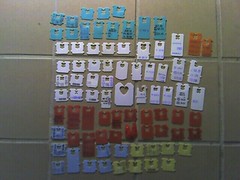 |
| The Occlupanid Collection by Laser Burners, on Flickr |
I recommend taking some time to explore the website; it has details about how the occlupanids are discovered and classified, which serves as a great introduction to how real organisms are identified. They also have a call for contributions; if you want to explore the process of taxonomy in a hands-on, but fun way, this is a neat outlet to do so. This is a wonderful simplification of a very complex, important, and fascinating part of scientific research.
Cross-posted on Teen Skepchick
May 31, 2011
Reindeer See in Ultraviolet

"We discovered that reindeer can not only see ultraviolet light but they can also make sense of the image to find food and stay safe," said lead researcher Professor Glen Jeffery of the University College London (UCL). "Humans and almost all other mammals could never do this as our lenses just don't let UV through into the eye. In conditions where there is a lot of UV - when surrounded by snow, for example - it can be damaging to our eyes. In the process of blocking UV light from reaching the retina, our cornea and lens absorb its damaging energy and can be temporarily burned. The front of the eye becomes cloudy and so we call this snow blindness. Although this is normally reversible and plays a vital role to protect our sensitive retinas from potential damage, it is very painful."
 |
| Image Credit:Erik Christensen Image shared via Creative Commons and Wikimedia Commons |
I have always wondered what it might be like to be able to see in some of those other parts of the spectrum. Reindeer are literally seeing the world in a way only accessible to us through the use of special ultraviolet cameras. This gives them an advantage in spotting predators and finding food in an environment that makes us nearly blind. Studying this could possibly give us in ways of protecting our own eyes form ultraviolet radiation or a myriad of other potential applications we can speculate on. It is impossible to know exactly what future technology this will bring about, if any. Still it is research like this, the research that surprises us and makes us think, that pushes science forward.
May 25, 2011
Happy Towel Day!

But, you may ask, why towel day? Remember, “The Hitch Hiker’s Guide to the Galaxy has a few things to say on the subject of towels. A towel, it says, is about the most massively useful thing an interstellar hitchhiker can have. Partly it has great practical value… More importantly, a towel has immense psychological value… What the strag will think is that any man who can hitch the length and breadth of the galaxy, rough it, slum it, struggle against terrible odds, win through, and still knows where his towel is is clearly a man to be reckoned with."
So grab your towel and remember, Don’t Panic!
More on Towel Day
Subscribe to:
Posts (Atom)