Causes


free debate


Showing posts with label Scientific Process. Show all posts

September 23, 2011

Particles Travelling Faster than the Speed of Light: Not So Fast

"No testimony is sufficient to establish a miracle, unless the testimony be of such a kind, that its falsehood would be more miraculous than the fact which it endeavors to establish." -David Hume
The Internet is a-buzz as scientists from CERN research facilities in Gran Sasso National Laboratory, Italy are saying they have been observing neutrinos traveling faster than the speed of light. Neutrinos are low mass particles that can literally pass through light years of lead without interacting. These scientists are claiming that the particles arrived at the detector 60 nanoseconds faster than they should have at the speed of light. That may not sound like much, but the scientists running the project say their measurements are accurate to within 10 nanoseconds. So, if true what would this mean?

The speed of light as a cosmic speed limit is fundamental to Einstein's theory of relativity. Relativity is one of the most successful theories in all of physics. Undermining the speed of light as a cosmic speed limit undermines the foundation of much of relativity. I'm not going to go into all the detials here but if you want a better understanding I recommend Why does E=mc2? (And Why Should We Care?) by Brian Cox and Jeff Forshaw.

For me, it comes down to the David Hume quote above. As far as physics are concerned, this is a miracle. Could it be true, but before we accept it the evidence should be overwhelming. Right now we have a very interesting result. Also, I have to say these scientists are doing awesome work. This is not some crank on YouTube saying he proved Einstein wrong. I am really interested to see what happens as labs around the world try and replicate this effect. If the result is due to some error, we still learn something new; if not, physicists are going to have some serious work to do.
July 27, 2011

Summer Intro to Paleo: Prospecting

Over this summer, I am teaching a six-week introduction to paleontology course to several interns at the paleontology lab I work at. As an experiment, I've been recording the classes as well, and uploading them for the viewing pleasure of everyone. Here is the first installment of that series:


June 13, 2011

Classifying Occlupanids

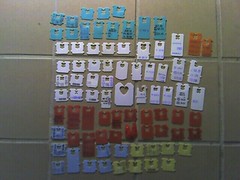
Biologists and paleontologists are tasked with a major challenge: looking that the diversity of life, and classifying it into groups based on morphology and genetics, in an attempt to determine what is related to what. While the details of this process, known as taxonomy, can be quite complex, it can theoretically be applied to anything. For instance, the little plastic things used to hold bread bags shut.

The purpose of the Holotypic Occlupanid Research Group is to classify occlupanids based on body shape, color, "teeth", markings, and several other characteristics. They have currently identified 6 main body plans, each of which constitutes an order on the Linnaean classification system, and have nearly 40 distinct species in the class "Occlupana".  They also keep track of mutations and mysteries, although none are currently displayed on the site. The "researchers" have also concluded that all occlupanids are parasitic, and are uniformly composed of a stiff, but flexible plastic.

The Occlupanid Collection:
The Occlupanid Collection
by Laser Burners, on Flickr
Now, this venture sounds quite silly: what's the point of classifying the bread bag thingies? In itself, probably not much. But it's a great introduction to how scientists classify real organisms. The class "Occlupana" is defined by several plesiomorphies, or ancestral characteristics: the parasitism, the plastic body, and the single "mouth". Orders, genera, and species are defined by synapomorphies, shared derived characteristics. For example, the species Pseudopalpis hayesi is defined by its green-blue color, its similarity to toxodentids (another order of occlupanid), and the fact it is only found on Thomas' English Muffins bags. This is similar to how a dinosaur fossil would be identified as a new species, although the list of characteristics studied would be much more complex.

I recommend taking some time to explore the website; it has details about how the occlupanids are discovered and classified, which serves as a great introduction to how real organisms are identified. They also have a call for contributions; if you want to explore the process of taxonomy in a hands-on, but fun way, this is a neat outlet to do so. This is a wonderful simplification of a very complex, important, and fascinating part of scientific research.

Cross-posted on Teen Skepchick

February 22, 2010

What is Science? (Flaws of the Mind)

One of things that is of great interest to scientists and skeptics alike is how we fool ourselves. We like to think of our mind as a type of recorder that takes in what we experience and feel. In many ways, this is not a bad analogy, but it is easy for us fall victim to the faults of this recorder. These are faults that we need to be aware of if we want to avoid them

If you ever have any doubts that our minds can be fooled, see a magic trick. The entire profession of magic and illusion takes advantage of these faults. This video by psychologist Richard Wiseman is a great example.


This video is a great example of how easy it is for our brains to fall prey to illusions. This could be the cause of many UFO and ghost sightings. Think of times in your own life where you might have thought you saw something, but it turned out to be something else.

Science is very aware of this fact, this is why there are standards for the evidence it will accept. Anecdotal evidence is the most obviously affected, and is not considered any more than a starting point for scientific inquiry. One method that is used for correcting this is the requirement that a test be repeatable. For any result you come up with, someone halfway around the world should be able to repeat under the same conditions. Paranormal researchers often complain that they are being picked on by mainstream researchers. There is a lot that goes into this, deserving a post all to its own. The bottom line is that they have never developed a replicable experiment, showing any psychic ability or connection of any kind.

Whenever we look at the world, we need to be careful when deciding what is true. This doesn't mean that we can't trust anything we see, but we need to give any sight that appears miraculous careful consideration. The fact that our minds can be tricked is something we must be careful never to forget, but we shouldn't let it stop us in our quest to explore reality.

February 15, 2010

Bad Science: The Argument From Final Consequences

In many of the articles I read supporting non-scientific ideas or in informal debates, one extremely common logical fallacy I run across is the argument from final consequences. I see it often enough that I think it deserves it own post so you can try to avoid this logical pitfall.

There are two main ways this fallacy is usually presented, but both share a common trait. They basically invert cause and effect. One way this is done is to say that if someone benefited from X, that person caused X. You can imagine in a murder investigation that if someone benefited highly from the death, they will be a suspect. The fallacy is to say that because they benefited, they must have caused it. Motivation is separate from actually committing the crime. There is a reality to the world that coincidences happen. Everyone, and in particular politicians, will try to capitalize on these coincidences, but that doesn't mean they caused them.

The other way this fallacy often comes up is to say the implications of an idea determine its truth. An example is 'Fairies must exist, because that would make the world more interesting.' Whether or not they would make the world more interesting is completely irrelevant to the question of their existence. This is the equivalent of arguing that gravity can't exist, because flying is fun. One of the most common contexts you will hear this agreement is that evolution must be wrong because otherwise life has no meaning and their would be no morality.

I should mention again that just because someone uses bad logic to defend their point, doesn't mean that their conclusion is wrong. All it means is that particular argument does not support that conclusion. I have heard people on both sides of different issues make poor logical arguments, so you need to evaluate each argument on its own merits. Bad logic should however, serve as a red flag to see if any of their other arguments hold up to strong scrutiny.

January 11, 2010

SETI vs. UFOlogy: A Look at the Nature of Science

Are we alone in the universe? It is a great question and one that I think everyone is interested in. As with many big questions, there are different ways of approaching it. This makes it a wonderful topic for looking at the differences between science and pseudoscience.

SETI, the Search for ExtraTerrestrial Intelligence, is a private group who is trying to scientifically find evidence of other life in the universe. They use radio telescopes to look for signals that might be sent from extraterrestrials. When SETI detects a signal they think could be from some sort of alien intelligence, they first try to falsify their results. They check if it could have been caused by some radio emitter on the earth, or some known astronomical object. They have other scientists check their results by looking to see if they find the same signal. In their own FAQ, SETI explains this perfectly.
In the past, there were several unexplained and intriguing signals detected in SETI experiments. Perhaps the most famous of these was the "Wow" signal picked up at the Ohio State Radio Observatory in 1977. However, none of these signals was ever detected again, and for scientists that's not good enough to claim success and boogie off to Stockholm to collect a Nobel Prize. You wouldn't believe cold fusion unless researchers other than the discoverers could duplicate it in their labs. The same is true of extraterrestrial signals: they are credible only when they can be found more than once.
 The other side of the coin is the UFOlogists. While some sites try to be scientific, they miss some key components. First, the whole premise of their argument is flawed. They are taking photos and anecdotal reports of unknown objects, and using those as evidence. I wrote just recently why this doesn't work. Briefly, if you have an unknown it is simply that, an unknown, not evidence. UFOlogists also will ignore alternative explanations that contradict their interpretation of the evidence. For example, they will ignore the idea that a video or photo could have been faked. Instead, they make unsupported statements like, "They can't all be fakes." There is also the tendency to portray scientists as "dogmatic." To anyone who works in science or with scientists, this claim is ridiculous. Scientists love new ideas that challenge what we think is true. Those ideas, however, must meet the standard of evidence.

In his Cosmos series, Carl Sagan made a great point in regard to UFOs. He said, "What counts is not what sounds plausible, not what we'd like to believe, not what one or two witnesses claim, but only what is supported by hard evidence, rigorously and skeptically examined." We all want there to be a easy cure for all illness, but that doesn't make it real.

When you encounter a claim ask which model the claimant is following. Many cases are not going to be straightforward, but their are some clues you can look our for. Is the claimant putting their evidence out to scientists to examine, or makes excuses as to why scientists don't support them. Do they try and prove their own claim wrong, or do they ignore the arguments made against them. I hope that one day (preferably within my lifetime) we find life somewhere beyond our little planet. This is a proposition that excites all of us. It is interesting how people can take such different approaches to solving the same problem. Science is the tried and tested method for exploring the world, whether or not it gives us the answer we want.

Go SETI!

December 14, 2009

What is Science? (Using Unknowns to Prove a Point)

Carl Sagan famously said, “Absence of evidence is not evidence of absence." On the flip side, proponents of a nonscientific idea will sometimes invoke a lack of evidence as proof of something. Evidence is a tricky thing, and a lack of evidence can easily fool many people.

A absence of evidence is often cited in the debate regarding the existence of other life in the universe. We have never received signals from ET and, while there have been tantalizing hints of life on Mars, nothing has even come close to being confirmed. So with no evidence, are we forced to just admit that we are the only lifeforms in the universe? No, we have just begun to scratch the surface of looking for life beyond the Earth. Just because we don't have evidence yet doesn't mean we won't find it.

This idea can be taken too far. Just as we have a absence of evidence for life on other worlds, we also have a absence of evidence for unicorns. It is logically impossible to prove a negative (like unicorns don't exist) so are we forced to accept them as equal possibilites? In science, we can assess the plausibility of a claim. It is highly plausible that there is life outside the Earth that we have yet to find considering how little of the universe we have explored. We have however, explored a vast majority of the land mass of the Earth and have yet to find unicorns. While there is nothing intrinsically impossible about a horse evolving a horn, we just haven't found it in our explorations. So, while a absence of evidence may not be evidence of absence, we can still use current knowledge to judge the likelihood of different claims.

The other way people try to use the gaps in our knowledge is to prove claims. This is known as the argument from ignorance. In my experience, this is one of the most common logical fallacies. The basic argument goes because we don't understand X, Y is true. This is often invoked with quantum mechanics. People will make arguments to the effect that because we don't understand the quantum world, psychics really have powers. The same argument could have been used only a few centuries ago to say because we don't understand flight, humans can fly by flapping their arms. You can't use our lack of understanding to prove anything.

It is not hard to find people on the internet and in real life committing both forms of this flawed logic. Whenever you encounter a claim, make sure you ask yourself if they are using unknowns to make their arguments. Are they asserting someone is true because we don't understand something? When it comes down to it, a lack of evidence is evidence for nothing.

October 26, 2009

Why Creationism is Not Science

Here in the U.S., there is a huge debate in school boards and courtrooms as to whether or not creationism/creation science/intelligent design (yes, they are all the same thing), should be taught in science class. Creationism is a ideology. It is based on a religious view that ignores new evidence. Science, on the other hand is a process by which evidence is evaluated and conclusions are held only as long as the evidence supports them. So, even at the most basic level, science and creationism are two completely separate ways of thinking about the world.

Science is taught in schools because it it a powerful tool in exploring the world. Again, let me stress that science is not a set of conclusions, but a process. Science does, however, recognize that some ideas are better than others at explaining the available data. For example, the germ theory of disease best explains how some illness is transfered between different people. In fact, there is so much data to support this theory that it is accepted as the scientific consensus. These are the ideas we teach in a science class, ideas well supported by evidence. By and large, I don't think anyone objects to teaching science in schools, except when it contradicts their own ideology.

Just to be clear, I am not going to address the creationist arguments like flood geology and irreducible complexity here. I think that has been done exceptionably well all over the Internet, including at Talkorigins.org (which is a site I highly recommend). I just want to explain why their ideas are not science.

First of all, falsifiability is a basic requirement of a scientific idea. I have written about this before, but to recap: for an idea to be scientifically legitimate, there has to be a way to prove it false. Religious ideas, like creationism, are designed so that no matter what is observed, belief can be maintained. This alone is enough reason why creationism, in any of its various forms, can not be considered a scientific idea.

Second, creationism is not a single belief. Creationists (although intelligent design proponents will sometimes leave this out) often argue that creationism should be taught side-by-side with evolution; giving both sides equal time. This assumes that there is one form of creationism, when in reality there are as many different forms of creationism as there are religions. This was comicality pointed out in a letter to the Kansas School Board of Education. This letter says that alternative views of creation should be taught, including the belief that the universe was created by a Flying Spaghetti Monster. This is what started the Church of the Flying Spaghetti Monster, if you were wondering. If you want to teach creationism, you have to decide which one.

The reason I write this today is because of a recent article in the Telegraph. This article suggests that a more accurate translation of the Judeo-Christian bible reads "In the beginning, God separated the Heaven and the Earth," not "In the beginning God created the Heaven and the Earth." This brings up a huge point.  One of the major differences between science and religion is that science always adjusts to new evidence.  I would however, be shocked if die-hard creationists even give this new evidence a passing glance. Their beliefs are more important than the evidence that may contradict them, and this is justified through faith.

My goal is not to impose my beliefs on anyone else.  Science is a strict and rigorous process.  For any idea to pass as scientific, you have to build a scientifically valid hypothesis, and then come up with the evidence.  Creationists have tried to skip this step. They are trying to use pressure on school boards and lawsuits to push their way into the science class.  Science class is not for teaching ideologies. It is for exactly what the name implies: teaching science.

August 8, 2009

What is Science? (Occam's Razor)

Occam's Razor is usually presented as "the simplest answer is usually right". Occam's Razor is a great tool for evaluating different claims, but this everyday statement is a little oversimplified. It was the medieval monk William of Ockham who said "plurality should not be posited without necessity." The best way of putting Occam's Razor might be "the idea that adds the least new assumptions is most likely to be true." There are a few different ways to think of this principle.
One way it is often used to remove unnecessary elements of an idea. A good example of this is the origin of life. We don't fully understand how the organic soup of the primordial Earth formed the first life (although we are getting closer). People have proposed the hypothesis that a alien species planted life on the Earth. To accept this hypothesis, we have to add the assumptions of the alien race, their knowledge of our planet, and we still have the problem of how they originated. Because of this, Occam's Razor would have us chose that it was a chemical process that gave rise to life. Occam's Razor is not evidence or proof for an idea, but it can tell us which is more likely to be correct.
Occam's Razor is also used incorrectly by many pseudoscientists, like ufologists. They say that the simplest answer to all of the blurry photos, crop circles, and anecdotal reports is that there are aliens visiting our planet. The mistake they make is that we can explain these things without making any new assumptions about our universe (for example people have admitted to hoaxing crop circles). The ufologists claim requires us again to add the existence of an alien race that is visiting the earth, a very large assumption.
If one idea is supported by more evidence then another, go with the evidence. If the evidence is equal, Occam's Razor is the tool of choice to decide which idea is more likely.

August 4, 2009

POP: Preparation

From out in the field, the next step is actually getting the fossils prepared for research or display. There are a lot of different techniques for preparation, depending on what type of fossil is being worked on.

Leaves and Invertebrates
Leaf fossils and invertebrates are often not removed fully from the rock, as they are too fragile. Instead, small air scribes are used to carefully remove rock from around the fossil. This reveals intricate structures in the fossils: veination in leaves, stripes on insects, spines on trilobites.
Sometimes, acids and other chemicals are used to prepare the fossils as well. This technique has to be very delicate, however, so as not to errode the fossils along with the rocks.
Fossil cystoids, before and after preparation
Vertebrates
Most vertebrates are prepared out of the rocks entirely, though not all. Fish fossils, particularly, are often left in the matrix, as was the famous Archaeopteryx specimen. Small air scribes, dental picks, water, acetone glues, and a lot of patience are generally the tools of choice. Preparators have to work slowly, so as not to damage the bone. In fact, it takes about 300-500% more time to prepare a fossil than it does to take it out of the field in the first place. Every bit of exposed bone has to be carefully reinforced with superglues, as well, so it doesn't crumble away. It's a tedious process, but a necessary one. Without preparation, not one fossil could be studied or put on display in a museum.
A saber-toothed cat skull, before and after preparation

For more information, visit the DMNS Follow a Fossil site, and read the preparation section.
Image credit: Marc Behrendt Preparation

August 3, 2009

What is Science? (Self Correction)

Science is not a stagnant thing.  It is constantly changing and correcting itself.  Science is better seen a process of getting information than as a body of information.  One of the hallmarks of science is this self correction.  In science, no idea is above being challenged or immune from criticism.

Pseudoscientists often present scientists as trying to maintain the status quo.  In reality, the opposite is often true.  If a physicist could collect evidence that gravity was not the curving of space but something else, they would become one of the most famous physicists of our time.  The reason that this is done so rarely is that in science, you have to have the evidence.  Well-accepted theories have lots of evidence behind them, and in order to overturn them you would need more evidence than supports the original claim.

One field where ideas are constantly being overturned is medicine.  New drugs are studied rigorously to demonstrate effectiveness and safety.  After years of study, the drug can be approved by the FDA.  Once the drug is approved, people continue to test it.  If at any point the drug is show to be unsafe the FDA will pull it from the market.  Good doctors will prescribe treatments that have been shown to work with minimal side effects.  If new risks are discovered they stop prescribing the treatment.  These are both really good things.

Another good example is the Piltdown Man hoax.  This was a forged fossil of a early human ancestor.  The fossil reflected what paleoanthropologists at the time thought our evolutionary ancestors would look like.  Because of this, the scientific community of the time did not suspect a hoax.  Over time more real fossils were found and Piltdown Man became an anomaly.  As it became more of an exception it started to be ignored until finally it was revealed as a hoax.  For more on Piltdown Man, see Talk Origins.com.

It was Carl Sagan who said "In science it often happens that scientists say, "You know that's a really good argument; my position is mistaken," and then they actually change their minds and you never hear that old view from them again. They really do it. It doesn't happen as often as it should, because scientists are human and change is sometimes painful. But it happens every day."  It is sometimes hard to admit that you are wrong, but if we don't we never move forward.  Science is always striving to move forward, and therefore always correcting itself.

August 1, 2009

What is Science? (The Burden of Proof)

Pseudoscientists often say, "You can't prove I'm wrong; therefore, I'm right."  The mistake that they are making is where they place the burden of proof.  In the American court system (I know that it is different in other countries), you are considered "innocent until proven guilty."  This means that it is the job of the prosecutor to prove the defendant guilty.  Another way to say this is that the burden of proof is on the prosecutor.  In science, the burden of proof works in a similar way.

If I purpose a new hypothesis, say that flying unicorns exist, it is my job to prove it.  The burden of proof is always on the person proposing the new idea.  This is done for two reasons.  If it was the job of scientists to disprove every claim that came their way, they would never have time to do anything else.  The other problem is that vague claims like the one above are logically impossible to disprove.  All you can say is that they are extremely unlikely to exist.  On the other hand proving that flying unicorns exist would be quite easy, all I have to do is find one that can be studied.  If you hear a wacky idea, ask for evidence.  Don't let them wiggle out of that by asking you, or anyone else, to prove them wrong.

July 20, 2009

POP Extra: Out in the Field


I've been a little out of touch for the past couple of weeks, and so haven't been able to post. However, it's been worth it: I've been out working in the field. And since I just got back, I thought I'd share my two cents about what goes on out in the middle of nowhere. So, in no particular order, here are my tips, laws, and memories of paleontology out in the field.

  • "A clean quarry is a happy quarry": I swear, this maxim is drilled brutally into every person going out into the field. It doesn't matter if you are in a leaf quarry, and dinosaur quarry, or even just out searching for ammonites laying on the ground. Every mentor I've had in the field has mentioned this repetitively. What this means in that, if you make sure there is not a lot of rock debris around the area you are working, you are less likely to damage a fossil. It has been a useful piece of advise. But after the 500 billionth time hearing it, it becomes a little annoying. Even this year, at my 8th field season at this quarry I've been at for the past couple weeks, my supervisor still repeated that at least 5 times.

  • Murphy's Law: While not a really a paleontology-exclusive law, it does seem to apply. At pretty much any quarry, when you have to dump a bucket of dirt and rocks down the hill, the wind will invariably change directions to blow as much as possible into your face. This year was easily the worst for everything that could go wrong, going wrong, though. When I arrived at the house used by the workers at this quarry, the sink exploded, the Internet did not exist, the quarry money could not be access, and the shelter tarps for on the hill had been misplaced. I lost about 2 days of field work, simply because absolutely everything went wrong. However, once all the problems were solved, the work itself went without a flaw. I suppose the cosmic balance had to be restored, as we had had too much bad luck in a row.

  • Animal Encounters: One thing about being outside, in the middle of nowhere, working on dinosaur bones, is that you do run into animals. Some of these are friendly, and become quarry mascots: small brown lizards, marmots, hummingbirds, butterflies.... Others are much less welcome. Scorpions, snakes, and gigantic wasps and bumblebees in the quarry are among the most concerning animal encounters I've had during my time in the field.

  • Field Conditions: Another thing about being in the middle of nowhere is weather. It's generally about 100+ degrees out on the rocks. One particularly memorable day, it was over 140 degrees fahrenheit. My little thermometer broke, and my solid sunscreen melted all over the inside of my backpack. Up until that point, I wasn't aware that sunscreen could melt.

  • Patience is a virtue: If you aren't patient, than paleontology isn't for you. I spend hours sitting in the same position, dilligently working very hard rock away from the bones. It can be rather tedious, and it's hard to see progress. However, at a point, that work makes it possible to remove the bone. Seeing the empty space left behind is one of the most rewarding experiences out in the field, even more than discovering new bone. After all, a new discovery means the headache of recording and then attempting to remove it. Taking a bone out means it is no longer an immediate problem. Eventually, it has to be prepared in the museum, but it is currently out of the way.

It probably sounds, at this point, like field work isn't much fun. However, my experiences have always been a lot of fun. Paleontologists are great people to work with, and are often very funny. I recommend, if you are interested, looking into opportunities through your local museum, or online with things like Dig for a Day.


As my mentor says, paleontology is a sort of affliction. It's not a field that pays well, and definitely isn't many people's cup of tea. For those of us bitten by the paleo bug, though, it is a wonderful experience, and a field of science that we just can't get free of.

POP: Collection

Once you have a field site, (as described in Getting Started) then you can get into the fun stuff: collecting the fossils. Collection is sometimes a very simple process, and a fossil is removed from the field in an afternoon. Other times, it is very challenging, taking years to complete.

In general, invertebrate and plant fossils fall under the first category. Invertebrates like ammonites, bacculites, clams, crabs, etc., can errode out of shales and be simply picked up off of the ground. They can also be found in limestones. Often times, if you take a rock hammer to a piece of limestone in a fossil-rich formation, you can find fragments of clams or other invertebrates inside.
Leaf fossils are found in a similar way. Paleobotanists determine a probable leaf site, then create a quarry with pickaxes, until leaves start appearing in the rocks. Then, using primarily rock hammers, they begin cracking open slabs of rock, looking for the fossils. These are then wrapped snugly in toilet paper, and put in cardboard flats to be transported.

Dinosaurs, and some mammals. tend to be much more difficult to collect. These larger creatures are preserved in the rocks, like other fossils, but are composed of many individual bones. These may cracked or distorted by the pressure of the earth and millions of years. Sometimes, the animals will be fully articulated; other times, multiple animals will be found jumbled up in a bone bed. The bones are also too fragile to be extracted with rock hammers and chisels, generally; dental picks and pneumatic equipment are more commonly the tools of choice. It takes hours to days of work to get a single bone ready for removal, assuming there are no complications (such as another bone being directly beneath it). Then, the bone has to be protected in a plaster cast before it can be removed. Eventually, though, a cast is ready to be popped out and taken out of the quarry.

Once fossils are collected, some dissappear into private collections. Many, however, go to a museum, where they are prepared for research or display.

For more information about how fossils are collected, visit the Denver Museum of Nature and Science website, and read the "Excavation" section.

July 2, 2009

POP: Getting Started

Now that I've discussed the principles of paleontology, let's really take a look at the processes of doing paleontology.

There are quite a few steps between discovering a fossil and getting it in a museum. In fact, there are quite a few steps before a researcher can even go out and find a fossil. First, they need an idea of where to look. By understanding the geology of an area, paleontologists can predict what fossils might be found in what layers. The Morrison formation in Colorado, for example, is full of dinosaurs and fossil footprints. The Pierre shale, on the other had, has mostly ocean invertebrates like clams and crabs, as it was deposited when Colorado was covered by an inland sea. There is no point in look for fossil leaves in a basalt, for instance: basalt is the remains of an ancient lava flow. However, fossil leaves are often found in mudstones, especially when there are coal layers, as these are the remains of ancient peat bogs. So, paleontologists need a good understanding of the geology in the area before even heading out the the field.

Another important step, though not the most interesting one, is getting land permission and grants. Without money and the permission to dig on a plot of land, it doesn't matter if there is a perfectly preserved Tyrannosaurus family- a scientist can't go excavate it. Thus, grant writing to get the funding, and getting permission to collect, are big steps before heading out to the field.

Prospecting itself occurs when the paleontologists actually get out to the field. This process varies a lot. Sometimes, they arrive at a site and the fossils are right there. This happens a lot at construction zones. When crews find fossils where they are excavating, they often call an expert at a museum about it. A wonderful fossil leaf site outside of Castle Rock, Colorado, was found this way. However, with these sites, there is a big time deadline. Construction is on a schedule, so any work on the site by paleontologists has to be quick, and may not remove all the site has to offer. There is a Tyrannosaurus with an address for this reason; the house had to be built, so most of the dinosaur was left in the ground.
Other times, museum experts get a tip from someone that fossils are found in an area. A kid might bring in ammonites from his dad's ranch, for instance, or a hiker might show up with a chunk of dinosaur bone she found on public land. These tips let paleontologists investigate a particular site of interest, without having to search around for it so much. This is probably the most common method of finding fossil sites.
A third method is true prospecting. I've only seen this used for invertebrates and leaves before. Basically, scientists go to an area with the formation they expect to find fossils in. They find a site that looks promising, then search the rocks for fossil traces. There might be bellumnites littering the ground in one area, which can then be collected. For leaves, there might be just one rock, initially, with a part of a leaf on it. Paleobotanists then take pickaxes to the wall, discovering a cache of leaves hidden for millions of years in the rock.

Regardless of how a site is found, the researchers can then move on to excavation.

For more information on how fossil sites are found, take a look at this site, created by the Denver Museum of Nature and Science.

June 30, 2009

POP: Introduction

Thus far, here at Scientifica Phenomena, we've talked a lot about the latest scientific discoveries. However, we haven't been talking as much about how those discoveries are made. Obviously, "science" is a ridiculously broad term, and we can't cover every branch between the two of us. However, since I have a good familiarity one branch of science, I decided I'd share that knowledge in a Processes of Paleontology (POP) series.

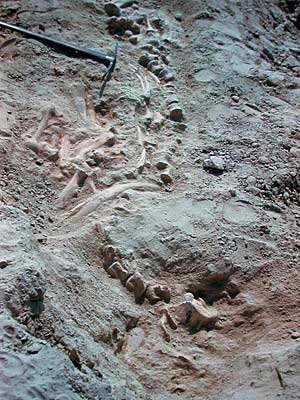
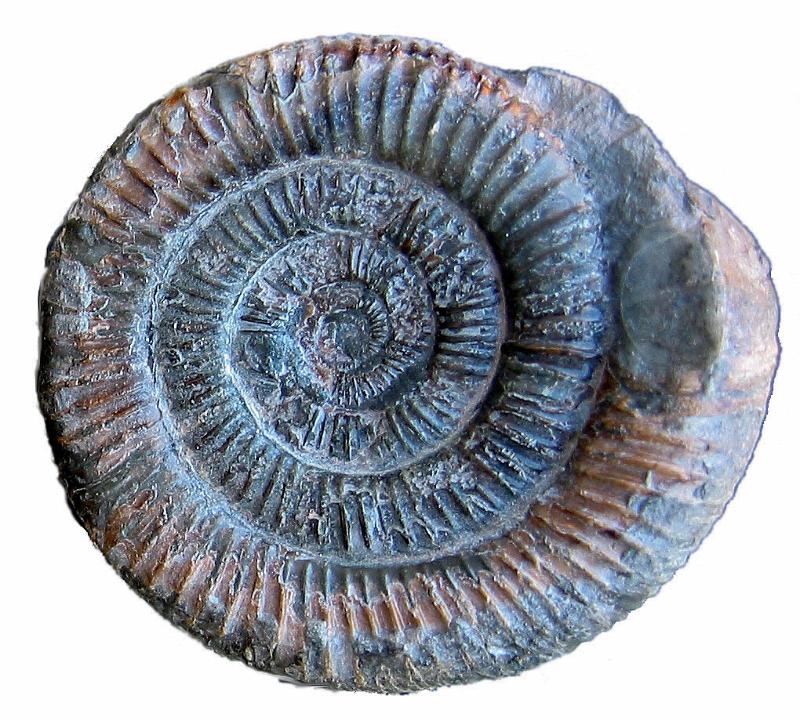
Before I can discuss how a paleontological discovery is made, though, I want to establish some principles of paleontology. Paleontology is defined as "The study of forms of life existing in prehistoric or geologic times, as represented by fossils of plants, animals, and other organisms." More precisely, paleontology looks at the organisms that existed on our planet in the far past, before the Holocene Epoch (see the time scale above). The line between paleontology and paleoanthropology, archaeology, and anthropology gets a little fuzzy within the past 100,000 years or so, but any life before that time falls under the category of paleontology. Obviously, dinosaurs are part of paleontology, but only a small part. Trilobites, ammonites, xiphactinus fish, insects, fossil leaves, tracks, worm burrows in the rock.... these fossilized remains of ancient life, and numerous more, are all part of paleontology.


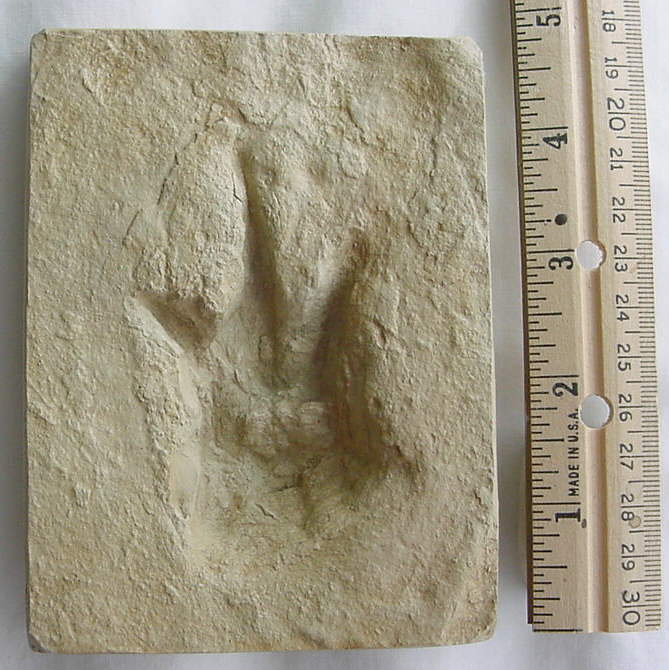
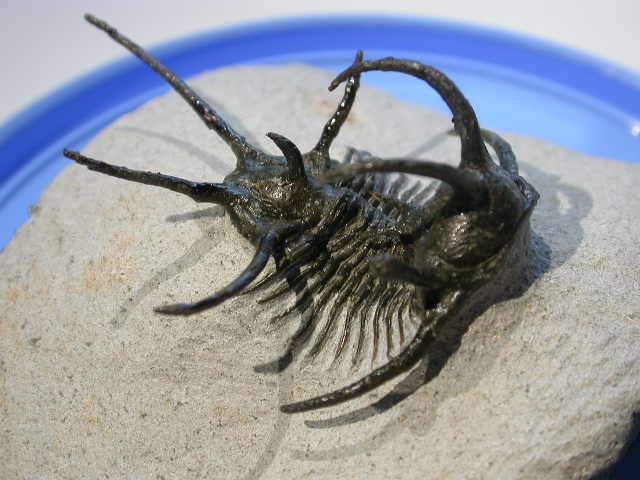
All of what paleontologists study is based on fossils. These can either be the direct remains of creatures, called organic fossils, or just traces of these creatures, called trace fossils. All of the images above are different fossils. From left to right, they are a Tyrannosaurus rex skeleton (an organic fossil), a therapod track (a trace fossil), a trilobite (an organic fossil), and a branch with leaves on it (an organic fossil). Despite the diversity, they were all preserved over hundreds of millions of years in similar ways. The organism died in some sort of sediment, like a lake bottom, a swamp, or an ocean floor. More sediment fell on top of it, covering it. In general, this process was very quick, to eliminate predation and severe decomposition. As this solidified into rock, whatever remained of the organism became trapped. Minerals permeated the rock with water, replacing the original organic matter with stone. There are other types of fossilization as well, but this type is the most common.

For more information on fossilization, check out this website. It has a pretty thorough description of most types of fossilization.

For more information on paleontology in general, visit the USGS website.