


>
Impressed yet? These invertebrates are some of my favorite living animals, and are a fascinating study in how evolution works. We still barely understand extremophiles of this sort, and there's a lot more research to be done. If you are interested in learning more, there are some resources below the break.
Showing posts with label Ecology. Show all posts
Showing posts with label Ecology. Show all posts
February 6, 2012
The Extreme Tardigrade
Most extremophiles are bacteria, living in places like the deep-sea hydrothermal vents, sulfuric hot pools, oxygenless layers in the ocean, and other environments that are deadly to every other form of life. But there are a few extremophile animals, such as the tardigrade.
January 17, 2012
Scientific Unknowns: What is Life Redux
 |
| Image Credit: JFantasy via Wikimedia Commons |

This all started when Edward Trifonov, a biologist at the University of Haifa Isreal, proposed a three word definition of life. To quote from the article by Carl Zimmer on Txchnologist...
Trifanov analyzed the linguistic structure of 150 definitions of life, grouping similar words into categories. He found that he could sum up what they all have in common in three words. Life, Trifonov declares, is simply self-reproduction with variations.In his article, Zimmer does acknowledge that there is a considerable amount of criticism but he mostly focuses on what this definition might be missing, metabolism, information and so on. I was interested, though, when I read a critical piece by Sean Carroll asking if reproduction should even be a part of our definition. He says...
...the idea of reproduction looms large in many people’s definitions of life. But I don’t think it really belongs. If you built an organism from scratch, that was as complicated and organic and lifelike as any living thing currently walking this Earth, except that it had no reproductive capacity, it would be silly to exclude it from “life” just because it was non-reproducing. Even worse, I realized that I myself wouldn’t even qualify as alive under Trifonov’s definition, since I don’t have kids and don’t plan on having any.
 |
| 3 Legged dog on the right Photo Credit: Jon Hurd via Wikimedia Commons |

So what is life? I certainly don't have an answer. Right now we have a sample size of one*. Until we find life somewhere else in the universe, I wouldn't expect any real agreement on this deceptively simple question.
*After all, every living thing we have found on the Earth shares a common ancestor.
June 13, 2011
Classifying Occlupanids
Biologists and paleontologists are tasked with a major challenge: looking that the diversity of life, and classifying it into groups based on morphology and genetics, in an attempt to determine what is related to what. While the details of this process, known as taxonomy, can be quite complex, it can theoretically be applied to anything. For instance, the little plastic things used to hold bread bags shut.
The purpose of the Holotypic Occlupanid Research Group is to classify occlupanids based on body shape, color, "teeth", markings, and several other characteristics. They have currently identified 6 main body plans, each of which constitutes an order on the Linnaean classification system, and have nearly 40 distinct species in the class "Occlupana". They also keep track of mutations and mysteries, although none are currently displayed on the site. The "researchers" have also concluded that all occlupanids are parasitic, and are uniformly composed of a stiff, but flexible plastic.
Now, this venture sounds quite silly: what's the point of classifying the bread bag thingies? In itself, probably not much. But it's a great introduction to how scientists classify real organisms. The class "Occlupana" is defined by several plesiomorphies, or ancestral characteristics: the parasitism, the plastic body, and the single "mouth". Orders, genera, and species are defined by synapomorphies, shared derived characteristics. For example, the species Pseudopalpis hayesi is defined by its green-blue color, its similarity to toxodentids (another order of occlupanid), and the fact it is only found on Thomas' English Muffins bags. This is similar to how a dinosaur fossil would be identified as a new species, although the list of characteristics studied would be much more complex.
I recommend taking some time to explore the website; it has details about how the occlupanids are discovered and classified, which serves as a great introduction to how real organisms are identified. They also have a call for contributions; if you want to explore the process of taxonomy in a hands-on, but fun way, this is a neat outlet to do so. This is a wonderful simplification of a very complex, important, and fascinating part of scientific research.
Cross-posted on Teen Skepchick
The purpose of the Holotypic Occlupanid Research Group is to classify occlupanids based on body shape, color, "teeth", markings, and several other characteristics. They have currently identified 6 main body plans, each of which constitutes an order on the Linnaean classification system, and have nearly 40 distinct species in the class "Occlupana". They also keep track of mutations and mysteries, although none are currently displayed on the site. The "researchers" have also concluded that all occlupanids are parasitic, and are uniformly composed of a stiff, but flexible plastic.
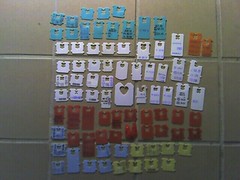 |
| The Occlupanid Collection by Laser Burners, on Flickr |
I recommend taking some time to explore the website; it has details about how the occlupanids are discovered and classified, which serves as a great introduction to how real organisms are identified. They also have a call for contributions; if you want to explore the process of taxonomy in a hands-on, but fun way, this is a neat outlet to do so. This is a wonderful simplification of a very complex, important, and fascinating part of scientific research.
Cross-posted on Teen Skepchick
May 31, 2011
Reindeer See in Ultraviolet

"We discovered that reindeer can not only see ultraviolet light but they can also make sense of the image to find food and stay safe," said lead researcher Professor Glen Jeffery of the University College London (UCL). "Humans and almost all other mammals could never do this as our lenses just don't let UV through into the eye. In conditions where there is a lot of UV - when surrounded by snow, for example - it can be damaging to our eyes. In the process of blocking UV light from reaching the retina, our cornea and lens absorb its damaging energy and can be temporarily burned. The front of the eye becomes cloudy and so we call this snow blindness. Although this is normally reversible and plays a vital role to protect our sensitive retinas from potential damage, it is very painful."
 |
| Image Credit:Erik Christensen Image shared via Creative Commons and Wikimedia Commons |
I have always wondered what it might be like to be able to see in some of those other parts of the spectrum. Reindeer are literally seeing the world in a way only accessible to us through the use of special ultraviolet cameras. This gives them an advantage in spotting predators and finding food in an environment that makes us nearly blind. Studying this could possibly give us in ways of protecting our own eyes form ultraviolet radiation or a myriad of other potential applications we can speculate on. It is impossible to know exactly what future technology this will bring about, if any. Still it is research like this, the research that surprises us and makes us think, that pushes science forward.
February 18, 2011
Frog Teeth
 |
| (c) National Geographic |
However, a new analysis of the frog species Gastrotheca guentheri suggests that, in some cases, lost traits can return. This species is the only one, of the over 6000 described species of frog, to have teeth on the lower and upper jaws. Most frogs only have tiny teeth on the upper jaw, if at all. In fact, based on genetic data, the frog lineage lost teeth over 200 million years ago. So, where did this species get them?
According to the study lead by John Weins of Stony Brook University, G. guentheri redeveloped complex lower teeth about 10 million years ago. It makes sense, with the animal's diet: the frog is carnivorous, and having teeth helps to catch prey. However, this is the only species to evolve this solution to the problem. Most other carnivorous frogs instead develop bony pegs on the lower jaw, rather than true teeth. The case of G. guentheri seems to be in violation of Dollo's law. One possibility that the paper suggested was that there could be a loophole. Most frogs do still develop upper teeth; this species could have just transposed that development onto the lower jaw as well. They would not have had to completely re-evolve true teeth. Still, though, this unusual adaptation is a bit of a mystery. This species is clearly off of the lineage that lost bottom teeth. There are far more common solutions than redeveloping true teeth. It's certainly an interesting evolutionary quirk, and provides new paths for more research into the mechanisms driving evolution.
Source- National Geographic: Frogs Evolve Teeth - Again
For more details, view the original publication.
February 4, 2010
A New Idea on the Origin of Life
We don't know how life first appeared on Planet Earth. It is perhaps the biggest scientific unknown. If we knew how life developed, then we could a) find it more easily and b) create simple bacterium ourselves, allowing us to really watch the early evolution of life. Unfortunately, there is pretty much no record of the very first life forms, as there are few, if any, rocks around from 4+ billion years ago. There are still many theories as to the origin of life, however, including a brand new one.
The most commonly accepted hypothesis of how life first came into being is a "primordial soup." In early tide pools and muddy puddles, there would have been amino acids floating about. These are the building blocks of proteins, which in turn are the building block that make life possible. We have found asteroids with amino acids on them, so a "soup" of them on early Earth is certainly not out of the question. These amino acids could have just bumped around, randomly sticking to each other as sunlight beamed down, gradually building into simple, prokaryotic bacteria. Others have suggested that lightning could spark amino acids into life. In fact, most ideas on how life first appeared are variations on this "primordial soup" concept.
New research, however, suggests that there just isn't enough energy to explain how life began in such a soup. Instead, they propose that deep sea vents were where life first showed up. The team found an interesting composition of chemicals on some of these vents: a membrane, with a gradient of protons. This is basically the same mechanism that organic cells use, in a process known as "chemiosmosis." Every organism, from the simplest bacterium to an oak tree to us, uses chemiosmosis. Therefore, the team suggests that it was a feature present in the first common ancestor, from which everything else developed, and which it first learned at the geothermal vents at the bottom of the sea. It's an interesting idea, and one that makes a lot of logical sense. Perhaps, with more research along these lines, we can finally find the answer to how life began.
The most commonly accepted hypothesis of how life first came into being is a "primordial soup." In early tide pools and muddy puddles, there would have been amino acids floating about. These are the building blocks of proteins, which in turn are the building block that make life possible. We have found asteroids with amino acids on them, so a "soup" of them on early Earth is certainly not out of the question. These amino acids could have just bumped around, randomly sticking to each other as sunlight beamed down, gradually building into simple, prokaryotic bacteria. Others have suggested that lightning could spark amino acids into life. In fact, most ideas on how life first appeared are variations on this "primordial soup" concept.
New research, however, suggests that there just isn't enough energy to explain how life began in such a soup. Instead, they propose that deep sea vents were where life first showed up. The team found an interesting composition of chemicals on some of these vents: a membrane, with a gradient of protons. This is basically the same mechanism that organic cells use, in a process known as "chemiosmosis." Every organism, from the simplest bacterium to an oak tree to us, uses chemiosmosis. Therefore, the team suggests that it was a feature present in the first common ancestor, from which everything else developed, and which it first learned at the geothermal vents at the bottom of the sea. It's an interesting idea, and one that makes a lot of logical sense. Perhaps, with more research along these lines, we can finally find the answer to how life began.
January 13, 2010
Sea Slug Going Green
 It's pretty common knowledge that plants use chlorophyll to turn sunlight into energy. It's what gives them their green color. Animals typically don't have chlorophyll, and so need to consume plants or other animals to gain the energy necessary to survive. (A few single cell plankton produce chlorophyll, but they barely meet the definition of an animal) A newly discovered sea slug has learned how to cut out the middleman. According to Sidney Pierce, the biologist who discovered these creatures, they can steal the chloroplasts from algae, as well as the genetic material needed to make chlorophyll.
This is possibly one of the coolest discoveries I've seen in marine biology, along with the tool-using octopus. Scientists knew that organisms could swap genetic material; bacteria do it all the time. However, the fact that this sea slug can steal the genes to make chlorophyll so successfully is remarkable. Baby sea slugs are born with the ability to produce chlorophyll, although not the ability to produce chloroplast that allow them to use the chlorophyll. It's a very neat evolutionary adaptation. The sea slugs have integrated one of the traits that make plants so successful. How, scientists have no idea. There is no known mechanism that lets the DNA transfer like this. It's another area to be further researched.
Source: Live Science- Surprising Sea Slug is Half-Plant, Half-Animal
December 16, 2009
Mobile Home for an Octopus
Tool usage was once considered to be one of the key features separating us from other animals. However, recently we have discovered that most primates, some birds, and a few other mammals use tools as well. And now, for the first time, we have found an invertebrate using tools. The best way to describe this is simply to watch:
These octopi, Amphioctopus marginatus, are using the coconut shells are a protective home. Now, you might think that this is similar to what hermit crabs do. After all, they are also an invertebrate which uses discarded shells to protect themselves. However, a hermit crab's shell is more like a hat for us: just put it on and forget about it. The coconut shells of these octopi are much different. As you could see in the video above, the creatures hold the shells under their bodies and "run" along the sea floor. They also go through an elaborate process to put two coconut halves together, completely encasing themselves. Far more effort than simply putting on a shell and forgetting about it.
The adaptations that life on this planet have come up with are pretty incredible. We've just scratched the surface in learning about our fellow creatures on this planet. More research is certain to reveal even more amazing behaviors.
For more information, visit National Geographic.
The adaptations that life on this planet have come up with are pretty incredible. We've just scratched the surface in learning about our fellow creatures on this planet. More research is certain to reveal even more amazing behaviors.
For more information, visit National Geographic.
September 4, 2009
Googling Extinctions
If I had to hazard a guess, most of you reading this right now have used Google. In fact, maybe you found us using Google. You've probably noticed as well that Google has a system for ranking the pages for a search. This algorithm is very useful for finding what you're looking for on the web. For ecologists, a very similar algorithm is now being used to rank food webs.
 The idea behind the ecological Page Rank algorithm isn't all that different from the Internet one. Online, Google says a page is important if other important pages link to it. The ecologists put in a series of species (instead of websites), then use the equation to determine which species is most important to the ecosystem. It's a simple idea, but a very important one for deciding how to protect the natural environments.
Even better, this new application of a useful algorithm may trigger similar developments for network-related sciences: gene regulation, for instance, or protein interaction. Basically, any process that works on a "web" could make use of the Page Rank algorithm to determine the key elements. Who knew that the math behind Google would reach out beyond the realms of the Internet?
Credit: Science Daily- Web Page Ranking Algorithm Detects Critical Species in Ecosystems

Even better, this new application of a useful algorithm may trigger similar developments for network-related sciences: gene regulation, for instance, or protein interaction. Basically, any process that works on a "web" could make use of the Page Rank algorithm to determine the key elements. Who knew that the math behind Google would reach out beyond the realms of the Internet?
Credit: Science Daily- Web Page Ranking Algorithm Detects Critical Species in Ecosystems
August 16, 2009
Zombie Ants
A new scientific study has proven the existence of mind-control and zombies!
Ok, not exactly. However, a new study suggests that a fungus does take over the bodies of ants. This weird parasite, Ophiocordyceps unilateralis, infects carpenter ants. The ant doesn't immediately die, though. Instead, the fungus controls it, causing it to travel to the ideal location for the fungus to grow. The ant crawls up understory plants, and clamps onto the underside of a low leaf. The ant then dies here, and the fungus continues to feed on the body, preserving only the exoskeleton and the mouthparts. After a few days, it erupts from the corpse, revealing a stroma. Spores are released from this, floating down to infect other ants.
 Though the scientists aren't sure how, the fungus have very precise control over these "zombie" ants. The team found that the infected ants were, almost exclusively, clamped to the undersides of leaves 25 cm from the ground, on the northwest side of the plant. The conditions in that place are optimal for the fungal growth.
The precision with which the fungus takes over the carpenter ants is a bit disturbing. Scientists are still investigating, to try and understand how exactly it turns unsuspecting ants into zombies. It's a very specialized skill, and a fascinating one.
Credit: Science Daily- Parasite Causes Zombie Ants to Die in an Ideal Spot
Ok, not exactly. However, a new study suggests that a fungus does take over the bodies of ants. This weird parasite, Ophiocordyceps unilateralis, infects carpenter ants. The ant doesn't immediately die, though. Instead, the fungus controls it, causing it to travel to the ideal location for the fungus to grow. The ant crawls up understory plants, and clamps onto the underside of a low leaf. The ant then dies here, and the fungus continues to feed on the body, preserving only the exoskeleton and the mouthparts. After a few days, it erupts from the corpse, revealing a stroma. Spores are released from this, floating down to infect other ants.
Though the scientists aren't sure how, the fungus have very precise control over these "zombie" ants. The team found that the infected ants were, almost exclusively, clamped to the undersides of leaves 25 cm from the ground, on the northwest side of the plant. The conditions in that place are optimal for the fungal growth.The precision with which the fungus takes over the carpenter ants is a bit disturbing. Scientists are still investigating, to try and understand how exactly it turns unsuspecting ants into zombies. It's a very specialized skill, and a fascinating one.
Credit: Science Daily- Parasite Causes Zombie Ants to Die in an Ideal Spot
August 12, 2009
Talking Dolphins
When people talk, we tend to use short words as much as possible. For instance, I've never heard anyone say, "May I have permission to obtain a dessert composed of milk, sugar, and several additional ingredients?" However, "Can I go get an ice cream?" is a very common question at my house. This rule of communication is known as the law of brevity. Both the listener and the speaker want to put in as little effort to get the point across. As it turns out, dolphins also use the law of brevity when they communicate.
Dolphins use about 30 non-verbal behaviors to communicate. In a recent study, ecologists David Lusseau and Ramon Ferrer-i-Cancho broke up these behaviors into simple units. Jumping and turning are considered individual units. Butting heads, on the other hand, is made up of four units: both dolphins jumping, and then both dolphins using their heads. The team analyzed the behavior of the dolphins and determined that they used simple, one unit behaviors more frequently than the complex behaviors with more units.
This is the first time scientists have seen evidence of the law of brevity in non-human communication. However, with this evidence of it's use among dolphins, many suspect that it is common in other species as well. While it doesn't prove that another species is using language, it is one of the first steps to finding evidence of language outside of humans. And the possibilities that opens are staggering.
Credit: Discovery News- Dolphin Speak Relies on Brevity
Dolphins use about 30 non-verbal behaviors to communicate. In a recent study, ecologists David Lusseau and Ramon Ferrer-i-Cancho broke up these behaviors into simple units. Jumping and turning are considered individual units. Butting heads, on the other hand, is made up of four units: both dolphins jumping, and then both dolphins using their heads. The team analyzed the behavior of the dolphins and determined that they used simple, one unit behaviors more frequently than the complex behaviors with more units.
This is the first time scientists have seen evidence of the law of brevity in non-human communication. However, with this evidence of it's use among dolphins, many suspect that it is common in other species as well. While it doesn't prove that another species is using language, it is one of the first steps to finding evidence of language outside of humans. And the possibilities that opens are staggering.
Credit: Discovery News- Dolphin Speak Relies on Brevity
Subscribe to:
Posts (Atom)