Causes


free debate


Showing posts with label Geology. Show all posts

April 12, 2012

Adventures into Creationism: Russ Miller

As a college student, I spend most of my time doing math, physics, and more math. Every once and while, I am able to break free from the daily routine. Recently, when I did, what did I find but that a creationist, Russ Miller, was speaking on campus. I am huge promoter of hearing all sides of a debate, so I felt obliged to go. I went with a group of people who all are large supporters of science and reason, though I'm not sure we truly knew what we were getting ourselves into.

The talk started off with a local pastor introducing Mr. Miller and asking everyone to have an open mind. Not a bad start. Then Miller stepped up to the podium. He started by explaining how both creationism and "Darwinism" are both religious beliefs. In fact, from what I understood, by Mr. Miller's definition of a religious belief it is impossible not to have a religious belief. Of course, using such a broad definition fails to acknowledge that religious beliefs are not formed in the same way as scientific views. Religious views are centered on faith, while science works on constantly adjusting its views to fit the evidence at hand. To call them equivalent forms of knowledge does both a disservice.

What followed after that, I can really only describe as a maelstrom of bad evidence, bad arguments, and attacks on science. It would be impossible to recount every point he made and why it's wrong, so here are some highlights. He stated that fault lines are where the water shot out of the Earth at the start of Noah's flood. As if to try and top that, it was during this flood that all of the layers of strata that form such iconic beds as the Grand Canyon were laid down, all fossils formed, and all those sediments hardened into sandstone. After all this sandstone was formed, the Grand Canyon was cut out as the flood waters receded.

Next up was carbon 14 (C14). Carbon 14 is an unstable isotope of carbon with a half life that is about 5,730 years. C14 is used by scientists to date organic materials between about 11,000 and 50,000 years old. Russ postulated that after millions of years we should not expect any detectable amount of carbon 14 left in any samples we take and I think this is a good rule of thumb. Of course, nature is always a little more subtle and complex. The two main examples Mr. Miller used were carbon 14 in coal beds and in diamonds. As it turns out we do find noticeable amounts of C14 in some coal beds, particularly ones near large amounts of radioactive rocks. The reason these beds still have C14 in them is that as the surrounding rock decays the coal is bombarded by radiation producing the mysterious C14. For diamonds, the answer is actually is a little simpler. Usually only organic materials are tested for C14, so to even do this test they likely had to use higher temperatures to get the diamond to combust. Higher temperatures increases the amount of C14 you create just by testing a sample, in essence contaminating your result.

So after having bad philosophical arguments and using bad evidence to support his view of creation the next step was to attack legitimate science. His main focus was paleontology as it provides us with some of the most direct evidence of evolution. He explained how Piltdown man and Nebraska man were both hoaxes, a true statement. The problem is that he then didn't even pause to look at the myriad of hominid specimens that are not hoaxes. In an attempt to show how no species has ever evolved, he also made the claim that the famous (and awesome) transitional fossil Tiktaalik is really just a coelacanth. Personally I think the images of the two species are enough to show how ridiculous this is.
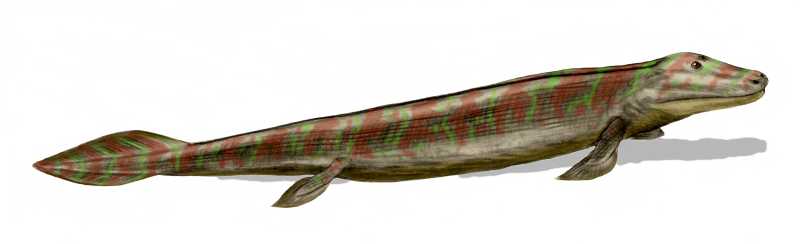
Tiktaalik
Image Credit: Nobu Tamura via Wikipedia
 Coelacanth
Image credit: Ballista via Wikipedia


To conclude his talk Mr. Miller simply reiterated his main points and walked off. There was no questions, no chance for clarification, or for dissenting opinions to be heard. This act alone I think encapsulated perfectly what Russ Miller was all about. He is not interested in engaging in a quest for the truth because he already has it. He wants to tell you what he thinks and if you disagree, well then he knows where you will go when you die. He uses the science when it is convenient and ignores it when its not.

Admitting you might be wrong is humility. Looking at the evidence that doesn't support your ideas is intellectual honestly. Taking questions after a talk is a sign of respect for your audience. Russ Miller's actions speak for themselves.

March 26, 2012

Rocks on Mars

Garden of the Gods
We know a lot about rocks, and the ways they react to wind, water, sunlight, heat, and other factors. Geologists can look at a strange rock formation, such as Colorado's Garden of the Gods, at tell you exactly what happened to create these odd structures. However, as with all science, there's always more to discover. The newest discovery is of a completely new kind of landform... on Mars.

This new kind of structure is called a periodic bedrock ridge. This sounds quite technical, but in reality, that is exactly what the structures look like: ridges in the bedrock at a regular (or periodic) distance from each other. In fact, it looks quite similar to sand dunes, at a first look. However, instead of being grains of sand blown into piles by the wind, they are tracks eroded by the wind into the bedrock. 

Periodic Bedrock Ridges
From Science Daily
David Montgomery, of the University of Washington, suggested that these features formed because the rock has bands of softer material within it, and that the erosion is of an unusual sort, that works perpendicular to the wind direction. The hypothesis is that the high speed winds on Mars are thrown into the air when they collide with a solid land formation, and that these periodic bedrock ridges form when the winds return to the surface. In order to visualize this, imagine driving a remote-control car. Jump it off a ramp, and onto a memory-foam type surface. The place where it impacts will have deeper tire tracks than anywhere else. That car is like the wind on Mars, and that impact point is where Montgomery and his team believe the ridges form.

This research is particularly interesting because there don't seem to be any analogs, to date, of this kind of feature on our own planet. On Earth, the presence of water means that very rarely will bedrock be eroded by wind alone. This difference means that we can understand not only Mars geology better, by utilizing these landforms to look at the beds in the Martian surface and figure out more about the geologic history of the planet, but also understand better how erosion works and parse out, here on Earth, the differences between different types of erosion, and the characteristics that separate one from another.

January 18, 2012

Dynamic Earth: Happy Birthday, Baby Island!

On Thursday, the first clear pictures of a new land mass were revealed. And here they are:
From Universe Today
This new deserted island is part of Zubair Island chain in the Red Sea. A large volcanic eruption in December pushed this new piece of land above the water's surface, and this is the first clear shot, free of clouds and volcanic ash plumes, of the island. Like most island chains, this one is a series of shield volcanoes, which form as the continental plate moves over a "hot spot" in the upper mantle. This new volcanic island, therefore, is most likely nowhere near done growing, however, so it will be a while before anyone visits this place. It's an awesome reminder, however, of how the surface of our planet continues to grow.

September 26, 2011

Summer Intro to Paleo: Preparation and Curation

Here's the third video in my summer introduction to paleontology course. This time, we look at how to do field work. If you haven't seen them, you can watch previous installments.


For Further Information:
http://www.dmns.org/main/minisites/fossil/vertprep.html
http://preparation.paleo.amnh.org/45/tools-equipment

Leave any questions or suggestions in the comments below!

August 1, 2011

Summer Intro to Paleo: Field Work

Here's the second video in my summer introduction to paleontology course. This time, we look at how to do field work. If you haven't seen them, you can watch previous installments.


For Further Information Links:
http://www.dmns.org/main/minisites/fossil/vertexc.html
http://www.museumoftherockies.org/Home/EXPLORE/Dinosaurs/LearnAboutDinosaurs/DiggingupDinosaurs/FossilExcavation/tabid/391/Default.aspx
http://www.wyodino.org/process/

Leave any questions or suggestions in the comments below!

Note: It may be a while before the next video is uploaded... I'm experimenting with a new way of recording these. The next installment, on lab work, should be in the next few weeks once I get that worked out.

July 27, 2011

Summer Intro to Paleo: Prospecting

Over this summer, I am teaching a six-week introduction to paleontology course to several interns at the paleontology lab I work at. As an experiment, I've been recording the classes as well, and uploading them for the viewing pleasure of everyone. Here is the first installment of that series:


July 25, 2011

Fossil or Not?

Identifying fossils is a more complicated task then you'd think. There are lots of different kinds of rocks, which can have their own unique patterns in them. Some of these patterns are the remains of ancient life; others are abiotic structures, chances of mineralization or later erosion that lead to pseudofossils. A reader emailed me a few weeks back with a question about some "fossils" he'd found.

While out hiking, he had found "some designs on rock that looked like fern frond fossils" or "like something bacteria have left." From just that description, I had some ideas about what these "fossils" could be, but asked for a photograph anyway. This is what he sent me:

"Fossil" from Nevada
This is actually a really, really common thing to find, so I recognized it right away. While these pretty, leaf-like designs look like ferns, they're actually not fossils at all. Instead, they are a type of pseudofossil, a manganese-oxide mineral stain. These stains almost always form this type of dendritic (tree- or fern-like pattern) in the bedding planes of the rock. They often occur in sandstone, as it does in the example above. For comparison, here is another examples of dendritic mineral stains.

From the Arkansas Geological Survey
While these aren't fossils, they're still cool. They form as water seeps through the sandstone. This water has dissolved minerals in it, including manganese or sulfides. As the water gets filtered through the pores in the rock, the minerals are left behind, precipitating into manganese oxide or pyrite (depending on the type of minerals dissolved in the water). The way these minerals crystallize, they form elegant branching dendrites along the bedding planes (lines within the rock, formed when the rock was deposited as parallel layers of sand) of the rock. In my own rock collection, I have quite a few dendrites, because they're one of the prettiest pseudofossils, and have such an interesting story behind their formation. 

Thanks to Claude A., for permission to use this example.

March 16, 2011

Dynamic Earth: Earthquakes, Tsunamis, Supermoons, and Japan

Tsunami Wave
from National Geographic
Earthquakes occur all the time; look at the USGS list of earthquakes in the past 8-30 days. There are a few hundred entries, most around a magnitude of 4 or 5. The plates that make up the Earth's crust move about constantly, so these minor tremors are quite common. A 4 on the Richter scale is strong enough to be felt, but not strong enough to cause much concern or damage. There are a couple thousand of these a year. Anything less than a 4 is a microquake; these are too weak to be felt, and are only recorded on local seismometers. Anything more than a 7 or 8 is a "great" earthquake. These are far less common; usually, there are only one or two great earthquakes per year. These earthquakes are the ones that cause trouble when they hit populated areas.

The earthquake that hit Japan last Friday was undeniably a great earthquake. It ranks as a 9.0 on the Richter scale, making it the 4th largest earthquake to occur in the past century. It caused a lot of damage, and in some places moved the crust by as much at 8 inches. Like the strong Chilean earthquake a year ago, it also shifted the Earth's axis slightly, shortening the day by about 2 microseconds (source). It also triggered a massive tsunami that hit Japan, Hawaii, and the US west coast, causing even more damage. Currently, Japan is still on alert as the Fukushima nuclear power plant threatens meltdown from damaged caused by the quake and tsunami. Evelyn, one of the Skepchicks, has been following this crisis with her father, a nuclear engineer, and has some great information up at her Georneys blog. It was truly a devastating quake, and needs to be seen to be truly understood.


This is a major natural disaster, and Japan need support and assistance from the rest of the world. What they do not need are a lot of pseudoscience explaining why the earthquake occurred or how recovery efforts should be run. One of the first pieces of nonsense was the supermoon idea. On March 19th, the moon will be closer to the Earth than at any other point during the year, and will also be full. Some astrologists claimed that this would increase the tidal forces to the point where the continental plates moved. This is simply wrong. First off, no matter where the Moon is in its procession and cycle, the tidal forces aren't strong enough to cause anything more than a microearthquake, if that. Second, the quake did not occur on the supermoon day; it occurred a week before, where the Moon is not at the minimum distance from the Earth, and when it has the weakest tidal forces in the monthly cycle. There is simply no way that the Moon had any causal effect on last Friday's earthquake.

The second, somewhat disturbing, piece of pseudoscience is the homeopathic groups distributing their medicines for nuclear radiation. Homeopathy, for those that don't know, is the concept of diluting a substance repeatedly, supposedly increasing the strength of the remedy each time it is diluted. (Mad Art Lab did an excellent job of illustrating the idea.) How this works for radiation, I don't know. These groups are trying to help, but are doing so with nonsense, and will likely cause more harm than good.

If you want to help the recovery efforts, first educate yourself; there is a lot of information available, both good and bad. If someone makes a claim about a natural disaster, check science sources, such as the USGS Earthquake page, to find out the facts, and sites like ScienceDaily and LiveScience to find out what the experts are saying, without as much of a media spin. Searching skeptical sites is also a way to sort the wheat from the chaff. Then, look into how you can help. There are some other groups doing real work. Doctors Without Borders and the Red Cross both do very good work, and are engaged in Japan right now. These groups provide shelter, real medicine, food, and materials to those affected by the disaster.

October 13, 2010

National Fossil Day!

The Thermopolis Archaeopteryx
One of the most amazing fossils ever found
Today marks the first annual National Fossil Day. Sponsored by the National Park Service and the American Geological Institute, this holiday of sorts is designed to promote the scientific and educational value of fossils. There's events going on nation-wide, sharing the wonder of fossils with the public and showing how they need to be protected and preserved, so that we can continue to learn from them and so that everyone can enjoy the wonder they create.

Paleontologist-in-Training
National Fossil Day is part of Earth Science Week, October 10-16. This year, the theme of Earth Science Week is Exploring Energy, a very important topic in today's world. A huge percentage of our energy comes from fossil fuels, such as oil, coal, and natural gas. These resources, just like any other fossil, took hundreds of millions of years to form, and will take hundreds of millions more to recharge. It's a sobering issue, that certainly needs attention.

So, take a look at Earth Science Week, National Fossil Day, and the USGS Energy Information. Go learn what a trilobite, a Tully Monster, a cycad, and a Protoceratops are. Visit your local natural history museum. And enjoy National Fossil Day!

June 21, 2010

Scientific Unknowns: Sailing Stones

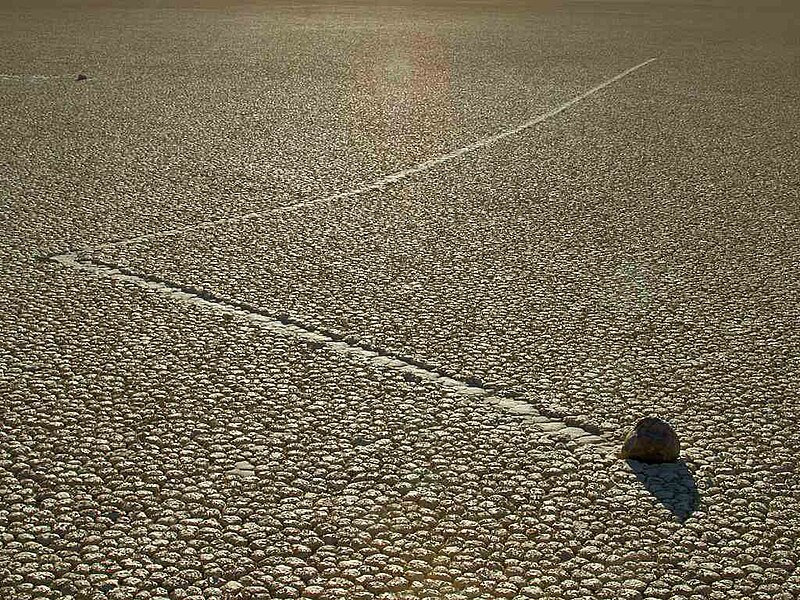
On the border of California and Nevada is area of unexplained activity: the Sailing Stones of Death Valley. These are a truly peculiar phenomenon: photographs show that, every once in a while, huge boulders in the Racetrack Playa slide across the ground. No one has ever directly observed this movement. It's a strange phenomenon, which hasn't been observed anywhere else on the planet. Thus, it has been a source of speculation, both scientific and not.

Two of the "Sailing Stones"
On the science side, there seem to be a couple main hypotheses. The most prominent of these is that, during the night, freezing temperatures cause any water in the ground to freeze, forming a thin layer of ice between the boulders and the ground. Strong winds may then push the stones around, leaving shallow trenches and trails behind. Another idea is that, instead of ice, slick, clay-based mud may serve as the lubricant between rock and earth. In either case, it is suggested that, under rare conditions, the force of the wind is strong enough to set the stones in motion, and then continues to propel them hundreds of yards. Variations on this idea have existed since the 1950s, but no one has yet been able to observe the movement of the stones, making a solid call impossible.

An example of a 90o turn by a Sailing Stone
Because the "Sailing Stone" phenomenon is so unusual, and really peculiar, there are also those who believe it has a paranormal or supernatural explanation. After all, how could wind alone, even on a slick surface, move boulders in excess of 250 pounds over hundreds of feet, sometimes even turning at 90o+ angles? Some hint that there are "unseen hands" at work on the Racetrack Playa. Others hint at some connection to Roswell Area 51, the holy site of UFOers and other supernatural conspiracy theorists. A few even suggest that the stones are alive, and move themselves around the valley.

The Sailing Stones are a really bizarre phenomena, and an incredibly rare one. Without more data, it's hard to say what causes their strange behavior. Some scientists have suggested training cameras and other recording equipment on this peculiar valley, in an attempt to actually see what's going on. Until then, though, the moving rocks of Death Valley remain a mysterious curiosity, just another example of how weird and amazing our world can be.


Sources and More Information
The first three articles provide paranormal/supernatural speculation. The last three are scientific articles about the Sailing Stones and the Racetrack Playa.


April 12, 2010

Venus May Still have Active Volcanoes

A Volcano on the Surface
Image Credit: NASA/JPL
I find Venus one of the most interesting places in our solar system because it is so hard to study. Venus is shrouded in an atmosphere 90 times thicker then ours, making the surface incredibly difficult to image. What images we do have are mainly from the early days of the space age. The European Space Agency launched the Venus Express Mission in 2005, and it has given us new insights into this mysterious planet. Still Venus is a place where we have lots of big questions with few answers. One of these questions for a long time has been if Venus is volcanically active. We have seen volcanoes on Venus's surface, but could they all be dormant?

Venus and Earth are about the same size. The heat in the Earths core that allows it to stay molten comes from when the planet originally formed, as well as the radioactive decay of elements. Since Venus should be made up of about the same stuff as the Earth, it is reasonable to assume that it also has a molten core. If there is a molten core that heat will want to escape, and it does so on the Earth via volcanoes. So what about Venus?

New data from Venus Express suggests that there may still be active volcanoes on the surface of Venus. Peeking through the clouds in infrared light, researchers looked for variations in the ground temperature. "The solidified lava flows, which radiate heat from the surface, seem hardly weathered. So we can conclude that they are younger than 2.5 million years old – and the majority are probably younger than 250,000 years," Jörn Helbert from the DLR Institute of Planetary Research. "In geological terms, this means that they are practically from the present day." This is not a slam dunk of Cytherean* volcanism though. There could be hot spots on the surface, without active volcanoes. So while this debate is certainly not over, this is an exciting new piece of the puzzle for scientists to look at.

*Cytherean, not Venusian, is the proper term for things related to the planet Venus. It also sounds cooler.

March 10, 2010

Expanding Earth "Theory": Going Against All Science

The proposed growth of the earth
going from bottom to top and showing
both hemispheres.
Image Credit: Michael Netzer
When I first came up with the idea of writing this post, I thought it was going to be a piece of cake.I would find some of the core claims being made by proponents of expanding earth "theory"*, break them apart, and then show the errors in their thought. As I started doing more and more research, I realized this was going to be impossible. Not because there aren't scientific responses to their claims, or even that their claims went beyond my knowledge of the subjects. No, the problem is in the sheer number of claims.

First, some quick background. From my research, expanding earth "theory" was first purposed in the late 1800's to explain the features and characteristics of the various continents (like how Africa and South America fit together). At the time, the idea was not well accepted, but was not considered crazy. This was still a few decades before Alfred Wegener purposed his idea of plate tectonics. Over time, we have gained an increasing understanding of how the earth works, to the point where plate tectonics is more or less a fact. In the last century, all of the new evidence has supported Wegener's theory, but some people are still trying to hang on to this failed idea.

As I mentioned before, if I tried to take their claims apart one by one this would quickly turn from a blog post into a book. Instead, I want to focus on some of the clues that should make you wonder if someone's ideas are based in reality.

The first big red flag is their dismissal of the scientific consensus. Could the scientific consensus be wrong? Sure. Saying that, though, we need to keep in mind that a scientific consensus is not something that is formed by a few guys at a bar. Many researchers, all trying to prove their own ideas over many years, work to see what model the evidence fits. Only after all this, and a repeated hashing of the evidence, is any consensus achieved. This happened very recently with the debate over what killed the dinosaurs. To think that you know better than the hundreds of geologists who study this stuff for a living, is simply arrogant. Neal Adams, maybe the most famous proponent of expanding earth theory, says that if he is right, "Everything, everything in science must change." At some point, as non-scientists, we have to step back as ask what is more plausible; that a loud comic book artist has come up with a revolutionary theory that does change all of science, or that the thousands of expert scientists worldwide understand their disciplines and the evidence for their models.

The other big clue is the use of what I have heard called "techno-babble." True scientists and science educators will often use a large vocabulary to try and explain confusing concepts. They use this vocabulary however, to try and be precise in their meaning. Scientific ideas can be inherently complex, so in explaining them the goal is to make them simpler. Proponents of non-scientific ideas will sometimes do the opposite. They will take a simple idea, and use complex language to explain it to make it sound more scientific. A perfect example of this can be found at www.expanding-earth.org. Near the bottom of the page there is a "Diagram of Omnidirectional Gravitational Pressure on exact center of any spherical body." This is a really complex way of saying, gravity pushes everything towards the center of mass. If the language is unnecessarily complex, it may be because they are trying to muddle a point instead of explaining it.

I recommend to anyone who wants to get experience looking into claims like this, look at these sites. See if you can find the flawed reasoning behind each argument. What evidence are they leaving out? If you have questions about a specific claim they are making, let us know and we can help you. We shouldn't just dismiss these ideas because they don't sound right or are unfamiliar. If we are going to dismiss them, it needs to be because there is no scientific support. In the end, nonsense dressed up with nice animations and fancy rhetoric, is still simply nonsense.

If you want to understand this issue better, I recommend you read the debate between Neal Adams and Stephen Novella, published at Neurologica.

*I cringe at the thought of calling it a theory in the scientific sense, and so found the quotation marks necessary.

March 8, 2010

Dynamic Earth: An Abundance of Earthquakes?

It's only the beginning of March, but 2010 already seems like a terrible year for earthquakes. First, on January 12, there was the 7.0 earthquake just off the coast of Haiti. Then Japan was hit with a 7.0 earthquake. Last Saturday, Chile was hit with an 8.8 earthquake, the fifth strongest ever recorded. And just today 5.9 earthquake occurred in Turkey. It's causing a lot of people to wonder, "What's going on?"

Despite the amount of news coverage for earthquakes all of a sudden, though, this year isn't really more severe than any other. Earthquakes are quite a common event. According to the USGS, there is a 100% chance of some magnitude of an earthquake occurring somewhere on planet Earth every day. 

The magnitude of the earthquakes occurring this year is not out of the ordinary, either. The annual number of earthquakes, also according to the USGS, is:


MagnitudeAverage Annually
              8 and higher             1 ¹
              7 - 7.9            17 ²
              6 - 6.9           134 ²
              5 - 5.9          1319 ²
              4 - 4.9         13,000
       (estimated)
              3 - 3.9        130,000
       (estimated)
              2 - 2.9       1,300,000
        (estimated)

¹ Based on observations since 1900.
² Based on observations since 1990.
The only thing that makes this year uncommon is how much damage to people earthquakes have done this year. Fortunately for us, most of the severe earthquakes don't hit populated areas. This year, that hasn't been the case. Over 200,000 people were killed in the Haitian earthquake, and thousands to millions more were affected. The Chilean earthquake killed around 200. It also affected the rotation of the entire planet, shortening the length of the day by 1.26 milliseconds. There are 57 confirmed deaths from the earthquake today in Turkey. This year is no worse than normal for earthquakes. It is only the impact of these earthquakes that is more noticeable than usual. The world is not shaking itself to bits; it's just moving, same as it always does.

Source: USGS Earthquakes
More information on earthquakes in general

February 10, 2010

Volcanic Lightning Show

Lightning and volcanoes are two of my personal favorite forces of nature. Both are capable of a lot of destruction, and are pretty unpredictable. A combination of the two would be terrifying, and spectacular. Perhaps something like this:


What is picture shows is a potentially new type of lightning, detected over the Redoubt Volcano in Alaska. The bolts you see are very small and very fast: each is only about a yard (3 feet) long and lasts only a couple milliseconds (for reference, a human eye blink lasts around 350 milliseconds). Even cooler, the lightning only occurs during the volcanic eruption. In fact, it is one of three types of volcanic lightning: these "tiny sparks", a "natural fireworks" (large, spectacular bolts), and an intermediate type, between the other two. The bigger bolts are caused when water and volcanic ash meet, causing a sudden thunderstorm. How the smaller sparks form, however, is still unknown. Now that they have been confirmed, researchers know how to look for them, and will be able to gain more data, which will in turn help us learn what causes this new volcanic lightning.

Source: National Geographic- New Lightning Type Found Over Volcano

January 14, 2010

Dynamic Earth: Haiti


I'm sure most of you have heard about the massive earthquake in Haiti by this point. It was a devastating quake. The first shock was a magnitude 7.0, out of a scale of 10. It has been followed by numerous aftershocks, ranging from 4.0 to nearly 6.0. In the face of such a distaster, it's easy to ask why the earthquake occurred. I've seen three such explanations. The first two of these are completely ridiculous.

The first is a rather bizarre idea this was not a natural earthquake, but rather a weather weapon aimed at Cuba that missed. It claims that the fact that there was a little earthquake in California (presumably a test of the weapon?) followed by a huge earthquake in Haiti is too suspicious, and not coincidence. (source: NowPublic News)

The second is given by Reverend Pat Robertson. He believe that this earthquake was punishment, for Haiti's pact with the devil.
“They were under the heel of the French, uh, you know Napoleon the 3rd and whatever, and they got together and swore a pact to the Devil. They said, 'We will serve you if you'll get us free from the French. True story. And so the Devil said, 'Okay, it's a deal.’ And, uh, they kicked the French out, you know, with Haitians revolted and got themselves free. But ever since they have been cursed by, by one thing after another, desperately poor. That island of Hispaniola is one island. It’s cut down the middle. On the one side is Haiti on the other side is the Dominican Republican. Dominican Republic is, is prosperous, healthy, full of resorts, etcetera. Haiti is in desperate poverty. Same island." (Source: ABC News)

Both of these explanations are uninformed, poorly articulated, and make the Haitian earthquake someone's fault. In fact, the Haitian earthquake was caused by a slip-strike fault, between the North American and Caribbean plates. These two plates slide along each other at a rate of 7 mm per year. Tension has been building up in the fault, and it finally snapped on Tuesday. Along with being a strong quake at magnitude 7, it's source was only about 6 miles down. This means that the crust could not absorb and diffuse the shock. The ground shook at Port-au-Prince for as much as a minute, which is very long for an earthquake. The fact that there is so much devastation, therefore, isn't a surprise. (source: USGS)

Right now, the people of Haiti don't need condemnation or conspiracy theories. There is no evidence whatsoever for a working weather missile even existing. Plus, earthquakes aren't weather; they're a geologic force. And, earthquakes happen frequently in California: the whole state is caught on the boundary between two of the largest pieces of the puzzle. Any supposed pact with Satan occurred in 1803. The people there today are not being punished for something 200 years ago. Condemning them, saying this is their own fault, is not going to help their condition at all.

Haiti is the poorest country in the Western Hemisphere; at least 80% of their population is below the poverty line. Disease is a major problem, and will only get worse with the destruction. Children there were literally living off of mud pies; now, food will be even harder to come by. (source: CIA World Factbook) And, while the earthquake itself killed over 100,000 people, many more will die if they don't get help. We live on an indifferent planet. It is neither benevolent or malicious. These natural events will occur whether people are  there or not. But when it does hit a populated area like Haiti, we, as a species capable of supporting one another, can help. Please donate to one of the organizations below, if you haven't done so already.

Support Doctors Without Borders in Haiti

More on earthquakes and plate tectonics.

November 6, 2009

Dynamic Earth: Tsumanis

When I first introduced plate tectonics, it sounded like a relatively boring force. It's kind of cool that the Earth's surface is made up of gigantic slabs, which move around and collide. But these slabs move at the same rate that fingernails grow. Even with the huge mass of each plate, you wouldn't expect things moving at 5 cm a year to do much. However, as demonstrated by earthquakes and some types of volcanoes, the slow-moving plates can have pretty devastating effects. Along with these, there's a third type of natural disaster often associated with plate tectonics. And this one comes by sea.

Tsunamis, also called tidal waves (although this is a misnomer) are some of the most impressive natural disasters, second only to volcanoes. They are a gigantic wave of water that crashes onto land. The 2004 tsunami in the Indian Ocean was over 50 ft tall (15 m) in some areas. This, like most tsunamis, was caused by an earthquake. A tsunami is basically a series of enormous ripples, when a large amount of water is displaced. In the deep ocean, tsunami waves are very small, barely enough to rock a boat. It is when they get to land that they become devastating. The column of water drags along the ocean bottom, while the top part continues to move quickly. This speed difference causes the tsunami to reach devastating heights. The animation below shows how this works.


Like I mentioned above, tsunamis are caused by displacement. Underwater earthquakes are the primary cause of these. However, large landslides into the ocean can also cause tsunamis. This occurred in Lituya Bay Alaska, in 1958 causing one of the largest tsunamis ever recorded. Geologists and oceanographers also predict that the next mega-tsunami will occur if volcanic activity causes a landslide in the Canary Islands. A good portion of the island would collapse into the ocean, sending a tsunami wave towards the east coast of the United States. Between that, and the Yellowstone caldera, there is not a lot of the United States that will be secure from natural disasters. Fortunately, these gigantic events are rare, and can be monitored using seismographs and other devices, so there will should be plenty of warning before a giant tsunami, or some other mega-disaster occurs.

September 17, 2009

Dynamic Earth: Volcanoes, Part 2


Volcanic eruptions are what make volcanoes exciting, and dangerous. There are a multitude of different types of eruptions, but I'll just cover some of the basic ones here. But before I can go into types, I should discuss why volcanoes erupt.

As I mentioned in Part 1, volcanoes form where molten rock from the mantle has bubbled up into the crust. This usually happens at subduction zones, but can occur elsewhere. For instance, the Hawaiian islands are located over a "hot spot" in the center of the Pacific Plate. There is a lot of pressure built up in these magma chambers, between the intense heat and the steam created by any water in the chamber. When this pressure reaches a critical point, the rock sealing the volcano breaks, causing an eruption.

There are a number of different types of volcanic eruptions, though they all occur this basic way. In no particular order, they are:
  • Hawaiian: This type of eruption occurs on relatively small cracks or at a main crater. They shoot jets of incandescent lava into the air. They are very impressive, but less dangerous than other types of eruptions.
  • Strombolian: This type of eruption, like the Hawaiian type, is very impressive. Clods of molten lava burst into the air, arcing down to the ground, where they run as fiery streams. These are less dangerous than other types of eruptions.
  • Phreatic: Also known as "steam-blast" eruptions. They occur when water and a magma chamber meet. The superheated water shoots out of the ground as steam, breaking off bits of rock and shooting them into the air. There is no lava involved in this type of eruption. These tend to be weak, though are occasionally quite explosive.
  • Peléan: Also known as Nuée Ardente or glowing cloud eruptions. These occur when a a plume of gas, dust, rock, and bits of molten lava shoot into the air, collapse back down, and roll down the side of the volcano in a fiery avalanche, known as a pyroclastic flow. These can be very devastating if they hit a populated area.
  • Vulcanian: In this types, a tall cloud of white ash and gas forms above the cone of the volcano. Little magma is released.
  • Vesuvian: This types of eruption is similar to the the Vulcanian types. A large amount of gas and ash is released, forming a massive, cauliflower shaped cloud. They can also have pyroclastic flows.
  • Plinian: These are the most powerful volcanic eruptions. They erupt violently, shooting gas, ash, and molten rock high into the air. The ash fallout can travel hundreds of miles from the volcano, and pyroclastic flows often occur as well.
As I mentioned earlier, there are also the eruptions of calderas (supervolcanoes), which do not fall into any of these categories. So far, there are no eye witness accounts of a caldera eruption, as one has not occured in human history. It would be similar to a plinian eruption, shooting debris, ash, and molten rock high into the atmosphere. It would be on a massive scale, though, easily 2500 times larger than the Mt. St. Helens eruption (also a plinian eruption). According to research, the last time the Yellowstone caldera erupted, it sent 600 cubic miles of material into the air, having world-wide effects. The ash in the atmosphere would temporarily cool global temperatures. Most of the Western United States would be severely impacted, and much of it totally destroyed. Fortunately, scientists believe that the Yellowstone caldera is currently at an equilibrium, and so probably will not go off in our lifetimes. Nevertheless, it is an area under constant monitor. For, while volcanic eruptions are spectacular, they are also deadly. There is still a lot to learn about their effects on life and on the Earth as a whole.

For more information on eruptions, visit Windows to the Universe, the USGS, and the Extreme Science/Extreme Earth webpage.

September 1, 2009

Dynamic Earth: Volcanoes, Part 1

Volcanoes are one of the showiest geological processes. Any kid can show you their baking-soda-and-vinegar volcano, and explain the eruption with great excitement. In reality, though, volcanoes are a little more complicated... and a lot less amusing.

A volcano forms over a magma chamber deep in the Earth's crust. These magma chambers are connected the mantle, a molten layer of the planet, beneath the crust. Often, these pools of molten rock form along active zones of plate tectonics. The best example of this is the Ring of Fire. All along the Pacific Plate is a rim of active volcanoes that form as the plate is melting as it subducts beneath continental plates.

There are really several distinct kinds of volcanoes. The most well-known, of course, is the classic cone-shaped volcano, called a strato-volcano or a composite volcano. These are the majestic, towering peaks, rising as much as 10,000 feet into the air. They are made up of alternative layers of cooled lava, ash, and rocks thrown out of the volcano in an eruption. Mt. St. Helens was a strato-volcano, as is Mt. Fuji.

Shield volcanoes are also relatively common. Unlike the mountain-like strato-volcanoes, shield volcanoes form a broad dome, composed primarily of lava flows. Shield volcanoes are not particularly explosive, making them the easiest, and safest, to study. The Hawaiian Islands are shield volcanoes, as is Olympus Mons on Mars.

Another type of volcano is the cinder cone. These are simple, small volcanoes, composed mostly of lava ejected in an eruption. A cinder cone has formed in the middle of Crater Lake.

Finally, there are supervolcanoes: calderas. At first glance, it is hard to see a caldera. This is because they are gigantic, covering hundreds to thousands of square miles. They form when a massive magma chamber forms in the Earth's crust. Pressure builds in it, eventually buckling the crust above it. This collapses in on itself, ejecting lava and debris across as much as half a continent. The best example of a caldera is the Yellowstone supervolcano, which covers 1500 square miles. If it were to collapse, the resulting eruption would devastate the western United States and Canada, and have effects world-wide. It would be about 8000 times bigger than Mt. St. Helens. Fortunately, scientists are monitoring it closely, and believe that the Yellowstone caldera has reached an equilibrium point, and isn't likely to erupt in our lifetime.

In the next part, I'll discuss more about volcanic eruptions, and the impacts those have on the planet.

For more information of volcanoes, check out Windows to the Universe. For more on supervolcanoes, look at the Discovery Channel website.

August 26, 2009

Dynamic Earth: Earthquakes

With a whole bunch of solid plates moving about on the Earth's surface, via plate tectonics, it isn't surprising that natural disasters often occur around plate boundaries. Earthquakes, in particular, are related to plate tectonics.

The boundary between two plates is a fault zone, and it is in these zones that earthquakes typically occur. There is a huge amount of friction that builds up on these fault lines, as the plates move against each other. The tension has to be released at some point, causing an earthquake (see image to right). To see what this is like, try this little experiment. Press your hands together tightly. Now, try to slide one forward. It is difficult to move, at first. At some point, though, your hand shoots out, as the pressure created by your arm is greater than the friction between your hands. This is exactly what happens on a fault line.
A prime example of a fault would be the San Andreas Fault, in California. This fault marks the boundary between the North American and Pacific plates. There has been tension building up in a section of this fault, near Los Angeles, for around 300 years. Because of this, it is possible that a newly discovered type of earthquake will hit is area, and soon. Supershear earthquakes are the geological equivalent of a sonic boom. They travel much faster than seismic waves were thought to be able to. They could be devastating, if they hit major cities like LA or San Francisco.

There is a lot more to earthquakes, and I'll try to elaborate further in another post. For now, though, check out TheTech for more about earthquakes in general.

Credit to New Scientist for information of supershear earthquakes, and to the TV show How the Earth Was Made.

August 6, 2009

Dynamic Earth: Plate Tectonics

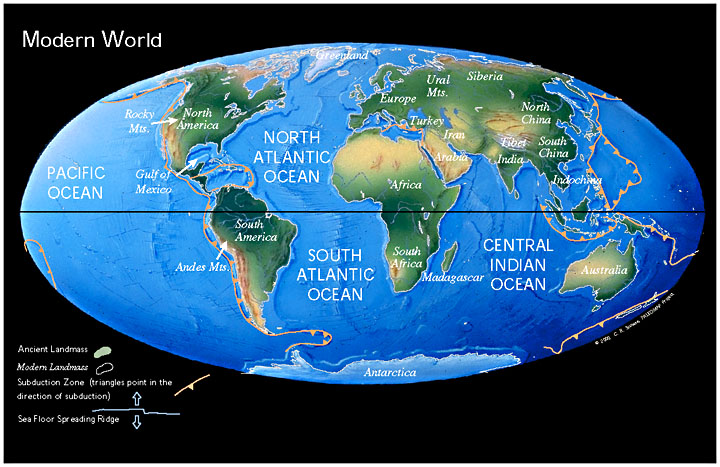
To understand many of the changes that occur on our planet, we have to understand the nature of the Earth's crust. The surface of our planet is not a solid mass; instead, it is divided up into plates. It's sort of like a big jigsaw puzzle, with each plate being a puzzle piece. However, these plates don't sit still. They move around, at a rate of around 5 cm per year (also the rate at which fingernails grow). And, because there isn't a lot of extra room, these plates collide. What happens next depends on what type of plate they are, and how they collide.

There are two different types of plates that make up the Earth's crust: continental crust, and oceanic crust. Oceanic crust is heavier than continental crust, so when the two collide head-on, the oceanic crust dives beneath the continental crust, in a process known as subduction. The oceanic crust melts as it enters the mantle. The magma formed, along with the way the continental crust is pushed upward, creates mountain ranges. This is occuring right now along the west coast of South America.

When oceanic and continental crust collide at angles, a different type of process can also occur. Transverse faults form where two plates are sliding along each other in opposite directions. One of the best examples of this is the San Andreas Fault in southern California. West of the fault, the state is on the Pacific plate, moving north, while east of the fault, it is on the North American plate, moving south. At some point, thousands or millions of years in the future, California will end up in Alaska. Right now, though, this transverse fault is a worry, as it is the reason California is so prone to earthquakes. But, more on that later.

Occasionally, continental crust collides with continental crust. In this case, one of the plates has to give, but niether wants to subduct. It ends up acting similar to a car collision, where the crust crumples as the two plates collide. A collision of this sort is occuring between India and Asia, and is creating the Himalaya mountains.

Finally, oceanic crust almost never collides with other oceanic crust. Instead, oceanic plates move away from each other. This creates a gap, through with magma from the mantle seeps up. The mid-oceanic ridges are actually the boundaries between oceanic plates!

A view of the plates on the modern Earth
There's a lot more to plate tectonics than I can fit into a post. So, for more information on how plate tectonics works, how it has affected the planet in the past, and how the Earth might look in the future, I recommend the Paleomap Project.