Causes


free debate


Showing posts with label Neuroscience. Show all posts

August 10, 2011

Turn on Your Brain


The other day, while working with some high school students, one of them turned to me and started a question, "You know how we only use 10% of our brains...?" I cut her off right there. If the assumption that we only use a small portion of our brains was a premise for her question, then the question couldn't possibly be valid.

The 10% myth is incredible pervasive, considering how silly it is upon further inspection. Have you ever heard a neurosurgeon say something like, "Oh, well, the tumor's in your inactive brain area, so we're not going to worry about it?" Of course not, because that's not how the brain works.

First of all, in proportion to body size, humans have the largest brains of any animal, with a 1-to-50 brain weight to body weight proportion. As with all physical characteristics, this was shaped by natural selection. We adapted to have higher intelligence, by having larger and larger cerebral cortexes, the region of the mind used for problem solving, language, and abstract thinking. The cost of this is that it uses a lot of energy. Humans have to eat a lot in order to power our big brains, or we'll die. If we only used 10% of this grey matter, natural selection would quickly get rid of it.

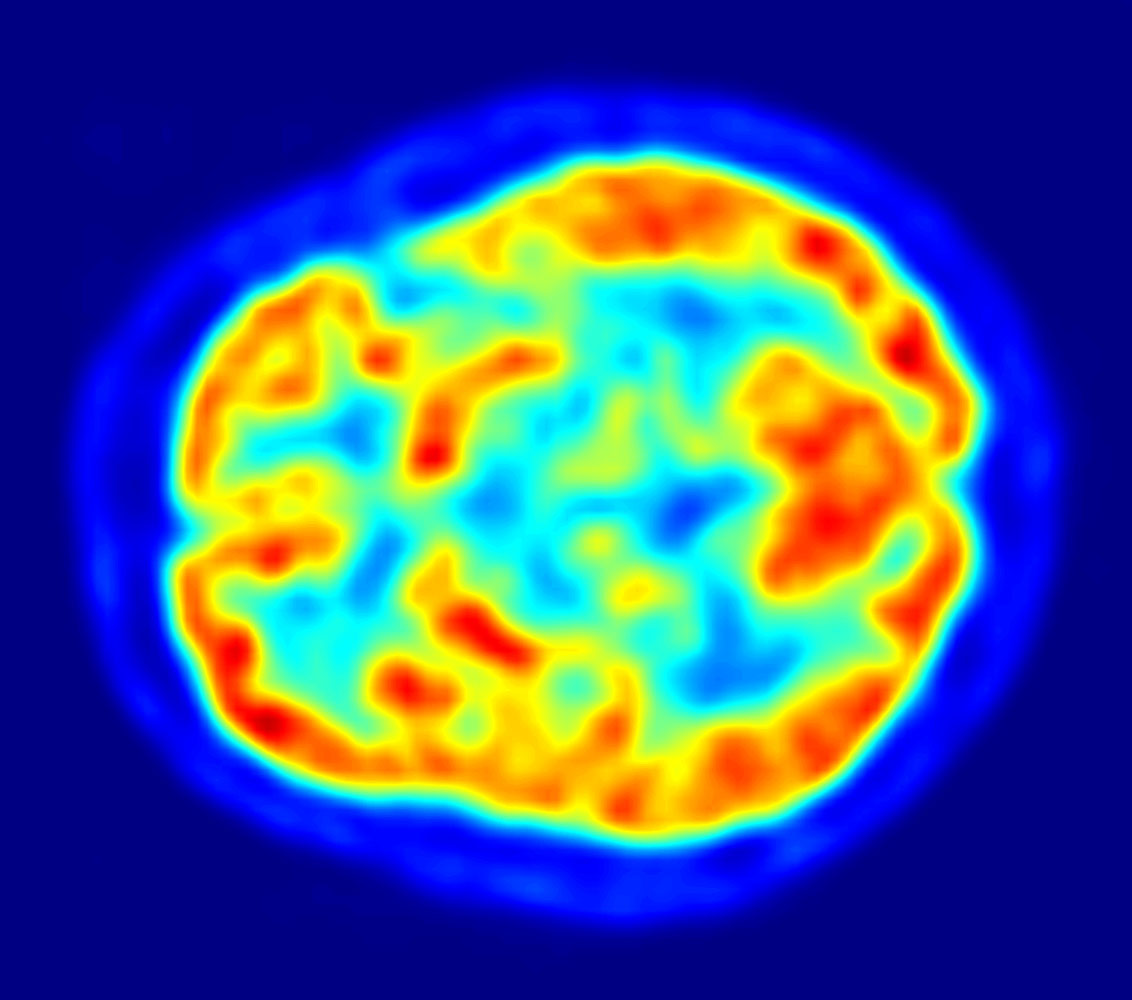
Brain Scans: ADHD Brain on Left, Normal on Right
We can also see how much of the brain gets used (source). Using PET or fMRI scans, we can watch a brain work. While not all of the brain is active all of the time, it's fairly active even doing the most simple tasks, like eating or sleeping. Even if all the neurons aren't firing, the glial and other support cells are active, and they make up a large percentage of the brain as well... far more than 10%. On top of that, damage to far less than 90% of the brain is incapacitating or fatal. Some proponents of the myth suggest that this is because only 10% of the brain is used for conscious functions, while the rest is subconscious. This isn't really supported by the data either, however; those same scans show that more of the brain "lights up" the more complex a task is occurring. Also, the idea that only 10% is conscious or active assumes the brain is very compartmentalized, that chunk of gray matter A does task A and only task A, and chunk B does something different. This isn't really accurate either. While some brain function is more or less focused in specific spots (the language center or vision center in the brain), it is not so black-and-white.

Besides simply being a major piece of misinformation, the 10% myth is important because it's a main argument of psychics and mediums. They flaunt this idea that the brain has huge untapped potential, and that scientists don't know how it works. Obviously, if you can just learn to turn on that unused portion, you too can have psychic abilities or superpowers. It's a comforting idea, to think that you can have more brainpower, in case of emergency. But from a scientific perspective, that's just not going to happen. The brain evolved to be used, not to sit dormant until magically being unlocked. The 10% claim is 100% myth.

This article was originally posted by me on Teen Skepchick, where I blog about science, skepticism, feminism, education, and more for the skeptical teen.


Image from Wikimedia Commons

February 28, 2011

Phantom Limbs and Mind Tricks

Ever wanted to be like Zaphod Beeblebrox*, and have a third arm attached? Well, according to recent research, this may be possible.

Each of us has a mental body image, which corresponds to our actual physical bodies. Thus, we experience having one head, two legs, two arms, etc. It seems likely that this body image is limited by the way our bodies actually are. Thus, an amputee can still "feel" the limb they're missing, but a person cannot "feel" a third arm. Or can they?

Neuroscientists at the Swedish Karolinska Institutet performed an experiment on healthy adult volunteers, in which they placed a realistic rubber right arm on a table next to the subject's real right arm, and covered it with a sheet, so the subject could not tell at a glance which arm was theirs at a glance. Then, as the volunteer watched, both of the right arms were rubbed with a small brush simultaneously. One would expect that a person would only feel one brush, the one touching their real hand. Instead, the brain gets confused, and resolves the issue by accepting both right hands as real. The person perceives having three arms, instead of two. They even reacted when either right hand was threatened with a kitchen knife, regardless of whether or not the hand was real.

It's a promising result for prosthetics and other medical applications, and those who are often at risk. If a limb can be accepted into the body image, as a person's own, then it can be controlled, theoretically, just as easily as a real limb. It's also just an interesting nuance to our understanding of how the mind interprets physical experiences. It's a fascinating demonstration of how little we really understand our own perception, and how flexible our brains can be.

Source: Science Daily-Scientists Create Illusion of Having Three Arms

*Apologies to those who haven't read Douglas Adams' Hitchhiker's Guide to the Universe, or who don't like it.

April 2, 2010

Untangling the Truth about Autism

There are a lot of claims made about autism. What causes it? How common is it? What are the common symptoms? Is there a cure? I can't go through every single claim ever made about autism here, but I'd like to take some of the common ones and sort out myth from fact, and explain why.
  • One out of every 110 children is affected by autism in the United States, including one out of every 70 boys. (source)
    This is fact, but a bit misleading. The data that the Autism Speaks report uses is from the CDC's autism report, found here. The study compares the autism rates of 15 different communities, and includes every instance of an autism spectrum disorder. This means that both a very mild case of Asperger's syndrome will be counted as a hit equally to a debilitating case of severe autism, so long as they are diagnosed. Thus, while the numbers are accurate, the statement would be more correct stated as: "One out of every 110 children is diagnosed with an ASD in the United States, including one out of every 70 boys."
  • Studies have shown that environmental toxins like mercury and pesticides can trigger autism. (source)
    This one is plausible. There is some evidence that autism prevalence rates are higher where there are higher concentrations of heavy metals and pesticides before birth. However, the results of these studies are still fairly preliminary, as far as I could find from my research, and more studies will have to be done before there is a true consensus on this.
    • Sources:
      DeSoto, M. Catherine, 2009. Ockham's Razor and autism: The case for developmental neurotoxins contributing to a disease of neurodevelopment. NeuroToxicology, 30(3):331-337
      Abstract at PubMed
  • There has been no study that has directly linked a pure genetics basis for autism. (source)
    False. Plain and simple. There are quite a few studies that link genetics to autism. For instance, this study provides a quite strong correlations between autism and a genetic mutation. This one provides a relatively complete summary of the genetic basis for autism. Even the DeSoto article I linked to above discusses how there is a genetic predisposition to autism, depending on how sensitive an individual is to the toxins. The genetic basis for autism is well-established scientifically.
  • Vaccines cause autism (source- note that this is implied throughout the whole "Vaccines" section of the website, but is never stated directly)
    False. This is by far the biggest autism controversy. Because of this, there has been a lot of scientific research. After all, if there was something to the claim, there would be major reason to change the vaccines given. But the consensus has come back with a definitive result: autism is not caused by vaccines. A really good summary of the current evidence can be found in this article. The one study that did show a link between the MMR vaccine and autism was retracted earlier this year, as it was shown to be a fraud. There is no cause for concern that vaccinating children will give them autism. Not vaccinating them is likely to cause them polio, measles, and other potentially deadly diseases, as well as spread those illnesses to other children (source). The risks of not vaccinating far outweigh those of getting the vaccinations.
  • Autism is reversible (source)
    While there are treatments available that can help lessen the symptoms of autism, this claim that autism is completely reversible is, as of this point in type, false. As I mentioned here, autism is a disorder, not a disease. A kid doesn't "get sick" and start acting autistic; instead, something is wired differently in their minds, whether due to a genetic mutation or to exposure to toxins during development. As stated on the Autism Speaks website:

    Most parents would welcome a cure for their child, or a therapy that would alleviate all of the symptoms and challenges that make life difficult for them. Just as your child's challenges can't be summed up in one word, they can't be remedied with one therapy. Each challenge must be addressed with an appropriate therapy. No single therapy works for every child. What works for one child may not work for another. What works for one child for a period of time may stop working. Some therapies are supported by research showing their efficacy, while others are not. The skill, experience and style of the therapist are critical to the effectiveness of the intervention.
This list of claims is far from comprehensive, but these are the five I hear most often, and that cause the most controversy. If you have other questions, feel free to send me an email using the link to your right. Or, better yet, do some research of your own. Talk to a medical doctor, preferably one who specializes in neuroscience; search for relevant studies on PubMed; gather knowledge to be able to sort out fact from fiction. Be aware that not everyone uses science-based medicine, and that even the most well-meaning people can give bad, and potentially dangerous, information. With a bit of skepticism and a little work, though, it is always possible to find good information to make the best choices you can, especially concerning things like autism.

If you want more general information on what autism is, take a look at What is Autism?

January 19, 2010

Scientific Unknowns: The Mind-Brain Dualism

Of the many interesting questions presented by psychology, the idea of the brain vs. the mind has some of the greatest impacts. The idea's been around for a long time: both Sigmund Freud and Emil Kraepelin proposed a difference between the mind and the brain, along with ways to study it. Even before that, Greek philosophers pointed out the problem of the relationship between the mind and the body.


The dualism basically states that, while the brain and the mind are clearly connected, the two are separate entities. The brain is easy to define. It is the physical bundle of neurons inside a person's head. It is capable of sending chemical signals to the rest of the body, allowing for movement and other functions. Even the simplest animals have some sort of brain. The mind, however, is not as easily explained. It is usually conceptualized as the consciousness, the "I" of a person. It is not something present, as far as we know, in any other species. There appears to be a connection between the two: for instance, if a person sustains brain damage from a disease or an injury, their mind also changes. They may have a different personality, lose memory, experience different emotions. But, research has not yet show exactly how the two are connected.

The impacts of this question are huge, however. It is a scientific, religious, philosophical, and practical question. It leads to questions such as these: If the mind/consciousness/soul is separate from the physical brain, then can it persist after death? If it is not separate, then is there even such a thing as a soul? Among the scientific community, there isn't really a consensus. According to a study by the University of Edinburgh and the University of Liege, over 1/3 of medical professionals regarded the mind and brain as separate entities. Despite this, however, in the same study a majority thought the mind and brain were not separable. Thus, there are really only questions at this point, rather than answers.

As David Tresan puts it, "In light of the prevailing scientific bias toward reductionism, how then are we to think about the relationship between mind and brain without on one hand simply reducing the former to the latter or without on the other invoking dualism and thereby abandoning altogether the quest for any such relationship?" In other words, how can we think about the mind and the brain as separate, yet connected? Only further advances in neuroscience and psychology will tell.

Sources: Mind-Body Problem: New Approaches
Articles below found through PubMed
"150 years of Freud-Kraepelin Dualism", Katharina Trede
"Dualism Persists in the Science of Mind", Athena Demertzi et al.
"Jungian metaphychology and neurobiological theory", David I. Tresan (full article found through EBSCO)