Causes


free debate


Showing posts with label Skepticism. Show all posts

February 27, 2013

Arguing from Authority (and doing it well)

Skeptical websites and podcasts are always quick to point out when people make the informal logical fallacy of arguing from authority. I have done this myself when talking about the Cottingley Fairies. On those same websites, however, you will likely be able to find appeals to the scientific consensus or scientists who are experts in a given topic. When you break apart the argument, both of these are appeals to authority. So the question then becomes is there a difference, or are skeptics not following their own advice?

The argument from authority is considered one of the informal logical fallacies. An informal fallacy is roughly speaking one which occurs when someone is making a non-deductive argument. But enough with the logic class. Why is an argument from authority bad? I think when we really break things down it is not arguments from authority that are bad, but instead arguments from false authority. As a student, I recently had this difference driven home to me in two of my classes.

It is not uncommon for upper division science classes for professors to invoke basic principals or ideas from other scientific disciplines. I think this is particularly true in two fields as intimately related as chemistry and astronomy. While this connection might not seem obvious at first, it is a deep connection and may be the topic of another post. This brings me to my introductory astrophysics course this last fall. We were deriving basic equations to describe the interior of stars and as a starting point we took the ideal gas law. I asked my professor under what circumstances the ideal gas law was valid and they replied by saying it is valid so long as the substance in question is a gas. If you do some research you can find that this is not quite true. For example under high pressures you need to use a more complex equation of state such as the van der Waals equation. Analogously, my chemistry professor at the start of the semester, when discussing the diversity between the planets, claimed that the Moon and Mercury both don't have days. This would mean that they both would have a light side and a dark side. "The dark side of the moon" is certainly a great rock album, but it is also one of the more common myths in astronomy. In reality the Moon as a diurnal period of about 30 days and Mercury's is about 178 days.

So what can we conclude from this? Should we simply say that my professors are bad authorities on which to base knowledge? I don't think this is the case. Instead I think that we need to take the more nuanced position and say that no one, no matter how educated, is an authority in everything. My astronomy professors are strong authorities in their sub-fields of astronomy but beyond that, they likely only have the knowledge of an informed non-expert. If we really want to understand something, we should look to the people who have devoted their life to studying that particular thing or better yet, try to find a general consensus of the scientists who work in that discipline. For as much as we would like to, I don't think we can ever truly escape arguing from authority. So instead of trying to avoid the matter altogether, let's use it as a tool to expand our own knowledge and teach those around us.


April 12, 2012

Adventures into Creationism: Russ Miller

As a college student, I spend most of my time doing math, physics, and more math. Every once and while, I am able to break free from the daily routine. Recently, when I did, what did I find but that a creationist, Russ Miller, was speaking on campus. I am huge promoter of hearing all sides of a debate, so I felt obliged to go. I went with a group of people who all are large supporters of science and reason, though I'm not sure we truly knew what we were getting ourselves into.

The talk started off with a local pastor introducing Mr. Miller and asking everyone to have an open mind. Not a bad start. Then Miller stepped up to the podium. He started by explaining how both creationism and "Darwinism" are both religious beliefs. In fact, from what I understood, by Mr. Miller's definition of a religious belief it is impossible not to have a religious belief. Of course, using such a broad definition fails to acknowledge that religious beliefs are not formed in the same way as scientific views. Religious views are centered on faith, while science works on constantly adjusting its views to fit the evidence at hand. To call them equivalent forms of knowledge does both a disservice.

What followed after that, I can really only describe as a maelstrom of bad evidence, bad arguments, and attacks on science. It would be impossible to recount every point he made and why it's wrong, so here are some highlights. He stated that fault lines are where the water shot out of the Earth at the start of Noah's flood. As if to try and top that, it was during this flood that all of the layers of strata that form such iconic beds as the Grand Canyon were laid down, all fossils formed, and all those sediments hardened into sandstone. After all this sandstone was formed, the Grand Canyon was cut out as the flood waters receded.

Next up was carbon 14 (C14). Carbon 14 is an unstable isotope of carbon with a half life that is about 5,730 years. C14 is used by scientists to date organic materials between about 11,000 and 50,000 years old. Russ postulated that after millions of years we should not expect any detectable amount of carbon 14 left in any samples we take and I think this is a good rule of thumb. Of course, nature is always a little more subtle and complex. The two main examples Mr. Miller used were carbon 14 in coal beds and in diamonds. As it turns out we do find noticeable amounts of C14 in some coal beds, particularly ones near large amounts of radioactive rocks. The reason these beds still have C14 in them is that as the surrounding rock decays the coal is bombarded by radiation producing the mysterious C14. For diamonds, the answer is actually is a little simpler. Usually only organic materials are tested for C14, so to even do this test they likely had to use higher temperatures to get the diamond to combust. Higher temperatures increases the amount of C14 you create just by testing a sample, in essence contaminating your result.

So after having bad philosophical arguments and using bad evidence to support his view of creation the next step was to attack legitimate science. His main focus was paleontology as it provides us with some of the most direct evidence of evolution. He explained how Piltdown man and Nebraska man were both hoaxes, a true statement. The problem is that he then didn't even pause to look at the myriad of hominid specimens that are not hoaxes. In an attempt to show how no species has ever evolved, he also made the claim that the famous (and awesome) transitional fossil Tiktaalik is really just a coelacanth. Personally I think the images of the two species are enough to show how ridiculous this is.
Tiktaalik
Image Credit: Nobu Tamura via Wikipedia
 Coelacanth
Image credit: Ballista via Wikipedia


To conclude his talk Mr. Miller simply reiterated his main points and walked off. There was no questions, no chance for clarification, or for dissenting opinions to be heard. This act alone I think encapsulated perfectly what Russ Miller was all about. He is not interested in engaging in a quest for the truth because he already has it. He wants to tell you what he thinks and if you disagree, well then he knows where you will go when you die. He uses the science when it is convenient and ignores it when its not.

Admitting you might be wrong is humility. Looking at the evidence that doesn't support your ideas is intellectual honestly. Taking questions after a talk is a sign of respect for your audience. Russ Miller's actions speak for themselves.

January 25, 2012

Book Review: Fads & Fallacies in the Name of Science

Second Edition Published by
Dover Publications
If you have an interest in telling reality from nonsense, I have found history to be one of the most insightful guides. UFOs, Scientology, and end of the world theories did not show up yesterday. Each of these has a long chronicle of claims and critics. Understanding that history is a window into the world of frauds, cranks, and the misinformed.

Fads & Fallacies in the Name of Science was written by Martin Gardner in 1952, with the second edition coming out in 1957. I have heard this book referred to as one of the first modern skeptical books. The book covers a wide rage of topics each in about 10 pages. As I read, I was surprised at how many of these ideas are still around today, only repackaged for a modern audience.

Personally, the most informative and frankly fun cases to read about were the UFOs. You have to keep in mind this book was written before the launch of Sputnik, so our understanding of the universe was very different. This was a time when most UFO were believed not to have come from other stars or galaxies but from Mars or Venus. The dropping of the first atomic weapons was still fresh in the public consciousness as well. This led a whole slew of explanations for why the aliens were visiting the Earth. Some were fairly straightforward, like the idea that the aliens wanted us not to destroy ourselves. Other explanations were outright bizarre, like the idea that beings the size of bees made from precious gems were piloting these UFOs because the atomic blasts were somehow disrupting the sun and threatening their home on Mars.

It is fun to look at these old ideas and see how ridiculous they are. But they also give us a very important cautionary tale. After all, Martin Gardner was not writing on these ideas simply to make fun of them. He wrote on these topics because these are things people believed. 60 years later, you could write basically the same book on a new set of weird beliefs that have cropped up. We need to be careful on what grounds we accept what we are told and carry on this legacy of informing those around us.

November 9, 2011

Happy Sagan Day!

Carl Sagan was hugely influential in getting me interested in science and more specifically, planetary studies. His book "A Demon Haunted World" is still probably the best all around skeptical book I have read. If you haven't read it already, you really should read it. I think the book is a great introduction to critical thinking because he is able to give you the tools to think, without beating you over the head with them. There are so many wonderful quotes I could pick out of this book but here is one that I think gets to the heart of skepticism and isn't often cited.
As I've tried to stress, at the heart of science is an essential balance between two seemingly contradictory attitudes- an openness to new ideas, no matter how bizarre or counterintuitive, and the most ruthlessly skeptical scrutiny of all ideas, old and new. This is how deep truths are winnowed from deep nonsense. The collective enterprise of creative thinking and skeptical thinking, working together, keeps the field on track.
Have a great day and take some time today to look for that wonder in the world Carl was so magnificent at sharing.


October 13, 2011

Don't Trust Me

When was the last time you read a professional UFO website? What about a creationism or intelligent design website? If you're reading this blog, it probably means you agree with most of what we write about. If that's not true, good for you. There is nothing wrong with reading articles you agree with; in fact, you should do so. This is how we learn about the topics we are interested in. I think there is a problem, though, when that becomes all we read.

A few years ago I was having a friendly debate with a creationist who was a good friend of mine. As we got deeper and deeper into the various topics (dating rocks, mechanisms of selection, etc.) we began to hit walls at the edge of our respective knowledge. This alone is not a problem and I have found to be quite common in verbal debates. Something else I think we both realized though was the we were not really very familiar with each others arguments. That debate ended in what was the best conclusion to a debate I have ever had, we both recommended each other books. I recommended Finding Darwin's God by Kenneth Miller and he pointed me towards The Case for a Creator by Lee Strobel. Even now, I have that book on my bookshelf and am proud to own it. So, why am I proud to own a book that I disagree with more often than not?

The skeptical movement prides itself on making decisions based on evidence. We promote evidence, rationality, and I think above all, an interest in understanding reality. The beautiful thing about reality is that it's there. It doesn't matter how many people believe something or hear of an idea, reality will still be doing its thing. When basically everyone on the planet thought the Earth was the center of the Solar System, that did not make it true. If we really want to understand this wonderfully complex and confusing universe we live in, learning about ideas you disagree with will only bring you closer to that goal. Just make sure you take all new ideas with a healthy dose of skepticism. Doubt, question, and ask what ideas are supported by the evidence.

There is another advantage to understanding the "other side" that I think is equally important. If you understand the reason someone else came to their conclusions you are going to be able to have much more productive debates. No one likes debating a straw man or characterization of their position, skeptic or not. If you understand what they are saying first, you are much more likely to change minds. Also, I think a lot of skeptics would be surprised at how much they have in common with people who may hold irrational beliefs. I have found that often the difference between skeptic and believer is a tiny difference in how they understand evidence or statistics. Again understanding this can lead to a much more enjoyable discussion for both parities even if you don't walk away in perfect agreement. So I challenge you all. Go read a book, a blog, or listen to a podcast that challenges you views. Try to come away from it more enlightened than when you went in.

September 23, 2011

Particles Travelling Faster than the Speed of Light: Not So Fast

"No testimony is sufficient to establish a miracle, unless the testimony be of such a kind, that its falsehood would be more miraculous than the fact which it endeavors to establish." -David Hume
The Internet is a-buzz as scientists from CERN research facilities in Gran Sasso National Laboratory, Italy are saying they have been observing neutrinos traveling faster than the speed of light. Neutrinos are low mass particles that can literally pass through light years of lead without interacting. These scientists are claiming that the particles arrived at the detector 60 nanoseconds faster than they should have at the speed of light. That may not sound like much, but the scientists running the project say their measurements are accurate to within 10 nanoseconds. So, if true what would this mean?

The speed of light as a cosmic speed limit is fundamental to Einstein's theory of relativity. Relativity is one of the most successful theories in all of physics. Undermining the speed of light as a cosmic speed limit undermines the foundation of much of relativity. I'm not going to go into all the detials here but if you want a better understanding I recommend Why does E=mc2? (And Why Should We Care?) by Brian Cox and Jeff Forshaw.

For me, it comes down to the David Hume quote above. As far as physics are concerned, this is a miracle. Could it be true, but before we accept it the evidence should be overwhelming. Right now we have a very interesting result. Also, I have to say these scientists are doing awesome work. This is not some crank on YouTube saying he proved Einstein wrong. I am really interested to see what happens as labs around the world try and replicate this effect. If the result is due to some error, we still learn something new; if not, physicists are going to have some serious work to do.

September 22, 2011

Ghost Hunting: How Not to Do It

In science, we look for multiple independent corroborating lines of evidence to prove any phenomena. We also want that evidence to of the highest quality we can get. Take evolution, for example. We have genetic analysis, morphological similarities, the fossil record, and biogeography (the distribution of living things across the globe) all pointing towards this one unifying idea. When it comes to ghost hunting, however these ideas on evidence seem to go out the window. Case in point is the Paranormal News article "Do It Yourself Ghost Hunting Part 1: Getting Started."

The first recommendation they have for finding ghosts is to get yourself a camera. The article says "The most important item would be a standard digital camera. Now, you don’t need to go all out and buy an expensive camera like a Canon PowerShot, most pictures that have evidence are from cameras that you can buy at any department store for a relatively cheap price." This statement should set off alarm bells galore. Why would you want to take a lower quality evidence? Of course, the author is correct to say that most ghost photos are from cheaper cameras. This is because most (if not all) ghost photos are due to flaws in the camera or mistakes by the photographer.

Next, they recommend you get an audio recorder. I have no problem with this suggestion as it stands, or even that maybe ghosts might somehow communicate to us by this means. To me, this is no weirder than ghosts existing the first place, but for both assertions we need evidence. Here is where we have an issue. If you record and listen to hours of white noise, it would be almost miraculous if your brain was not able to find something in that randomness that sounds like a human voice. We are wired to find patterns. So what might you do to separate out the noise?

Get more data!

For a moment as I read I thought this might be what the author was suggesting next. He says to bring a friend with you to not only make it more fun but also to build your credibility. This is a great suggestion. After all, if you could record the same voice at the same time on two different devices that is a much more interesting result. Imagine a ghost photographed from two different angeles at the same time. They may be on to something here. Oh wait...
There’s been some cases where we’ll have two audio recorders going on at once and they’ll catch two completely different results or one will catch something and another, running right next to it, will catch nothing at all. Cameras are the same way. When we were doing the investigation in Bethlehem, New Hampshire where Nicole caught the picture of the blue mist behind Nancy on the stairs (Photo on my website), I was taking photos as well, but where she caught something, I caught nothing on my camera.
What? I always understood that if you have two data points that contradict each other, that is a negative result. Taking a picture of the same spot with two cameras at the same time acts as a kind of control. If something is in one photo but not the other that screams of photographic error.

So if you want to go out on a ghost hunt, do it, but do it right. The Committee for Skeptical Inquiry (CSI) has a great article on this by renowned ghost hunter Joe Nickell that says...
The scientific approach to hauntings does not begin with the unproven, seemingly contradictory notion that entities are at once nonmaterial and quasi physical. Rather, in scientific inquiry one seeks to gather, study, and follow the evidence, only positing a supernatural or paranormal cause when all natural explanations have been decisively eliminated. Investigation seeks neither to foster nor debunk mysteries but instead to solve them.
 There are a lot of ways we can be fooled and we can fool ourselves but there are also still a lot of mysteries out there to solve. So get out there, have fun, and be skeptical.

September 5, 2011

What Not to Buy: Critical Thinking Applied

Time Moneyland has put together a great list of "12 Things you should stop buying now." This is a great application of critical thinking and has something for everyone. The list covers everything from new college textbooks to super high SPF sunscreen. One of the things I also really like about the way this is put together is that it includes the exceptions to the rule. For example, they rightly point out that some people with really fair skin may need very high SPF sunscreen, however the difference between SPF 30, and SPF 50 is much less then most people think. My personal favorite, though, was probably number 1.
Homeopathy

The pitch: Fight back against the aches, chills and other misery-inducing symptoms of the flu with herbs or vitamin supplements.

The truth: We’ll let the CDC handle this one. From the agency’s website: “There is no scientific evidence that any herbal, homeopathic or other folk remedies have any benefit against influenza.”

The exception: Chicken soup, especially if it’s homemade. No, it won’t cure anything, but if it makes you feel a little less crummy, slurp away.
If you are unfamiliar with homeopathy, it consists of diluting a substance until none of the substance remains and then calling it a cure. Nonsense is nonsense, no exceptions. And really who can argue with some nice chicken noodle soup when you're sick?

August 25, 2011

UFOs and the 2%

Being an amateur astronomer, UFOs are close to my heart. I have been asked by countless people what I think of UFOs. On the Internet, it is not hard to find claims that UFOs are evidence of a hostile alien invasion, benevolent beings here to save us from ourselves, or that there are multiple species all here competing with each other for our loyalty. It is clear people are truly seeing strange things in the sky and others report first hand encounters. So the question is 'what should believe?'

There is no denying that people see strange objects in the night sky on a regular basis. Someone recently told me a story of a object he had seen with a group of people that reportedly would move in one direction, stop, then completely change direction and continue moving along. Even I have seen a UFO. I was just starting out as an amateur astronomer.  It was twilight, and to my amazement I saw a bright object hovering over a nearby lake. The object was flashing white red and blue. I was completely taken aback and at a complete loss for an explanation.

There countless stories like the ones above. Still, I have heard even dedicated UFO proponents admit that probably 98% (or pick your own number) of sightings and encounters are hoaxes or misidentified normal phenomena. It is those 2% of sightings that we can't come up with a explanation for, that they believe represent the real encounters.

The problem with this argument is that you are moving from an unknown (hence unidentified flying object) to an answer (aliens exist) without any further evidence. Scientists work with unknowns all the time. They may have a hypothesis that they are trying to gather evidence for, but without that evidence, it remains an unknown. Law enforcement does the same thing. If a case can't be solved, they simply label it unsolved. They don't assume that aliens did it.


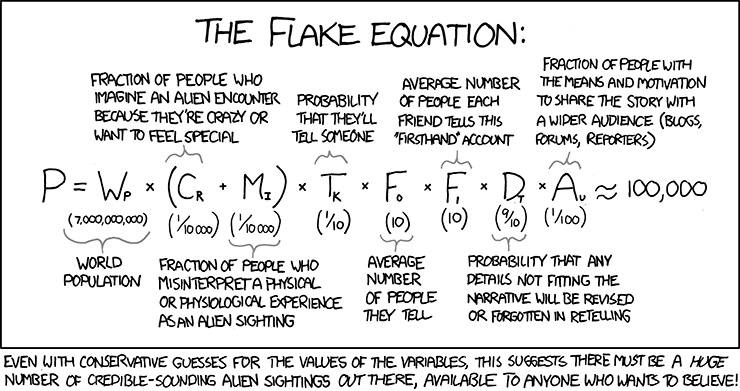
With that said, I want to look to see if there is any reason that this small percentage of cases might go unsolved if aliens are not visiting our planet. Some of them probably are hoaxes or hallucinations. As Randall Munroe of xkcd shows above, it doesn't take many people misunderstanding something they seen in the night sky to make a lot of UFO stories. In may other cases, we just don't have enough information to find any answer.


If you want to say aliens exist you need evidence. UFOs, even those cases that are never solved, just don't cut it. Take my story above. I see no fundamental difference between mine and many others out there, except I found out what it was. I stared at the object over the lake for hours off and on. As it slowly rose in the sky, its colors settled down into the bright familiar glow of the star Sirius. The wild colors were probably caused by a nearby fire or other air pollutants. Still if I had reported it as a UFO, without some key details, no one could have ever proven what that object was. I doubt we will ever solve all UFO cases but that doesn't bother me one bit. What gets me going is the trill of finding an answer, one I can explain and defend, and growing my understanding of how the universe really is.

August 19, 2011

Quantum Nonsense

Alright, I am back from my summer hiatus. Sorry for the lull. I was poking around trying to figure out what I wanted to write about when it struck me. I think no field of science is used more often to justify nonsense than quantum mechanics. For me, this leads to some interesting questions.

Before I get into the science, I think I need to make a disclaimer. I am not (yet) a physicist. The information I am going to provide below is what I have gathered from the science I read, discussed with actual physicists, and heard summarized. Quantum mechanics is arguably one of the most difficult disciplines of science to understand because it is so counter-intuitive. With that said, the information I provide below is not the nitty gritty of quantum, but the more fundamental concepts. This is all that is really necessary to understand the flaws in most of the unscientific arguments that use quantum mechanics. Now on to the meat.

What is quantum mechanics?

Quantum mechanics at its most basic level is the study of the smallest particles and energies in the universe. A "quanta" is actually a measure of the smallest amount of energy possible for a particle to have. Quantum mechanics at its heart is a mathematical description of how the various subatomic particles behave and interact with each other. The thing that really sets quantum physics apart from classical or Newtonian physics is the uncertainty.

If you shoot one pool ball at another, you can predict with a extraordinarily high level of certainty (assuming you know the relevant facts) what will happen when they collide. You can figure out what direction the balls will go, with what speed and where they will come to rest. When you are looking at a quantum system that is not necessarily the case. Instead, in a quantum system you can give probabilistic answers of where a certain particle will be or with what speed.

What effects has quantum mechanics proven? 

The implications of quantum mechanics are one of the most interesting, and probably most misunderstood aspect of this burgeoning science. The important thing to remember is that quantum mechanics deals with the subatomic, so except for in very rare cases, these effects do not apply to the macroscopic world we operate in. With that said, here are some highlights.

Spectra
It was well known long before anyone was considering quantum mechanics that if you excite a gas, by say running electricity through it, it will give off light at very specific colors or wavelengths. Astronomers use this to tell was very distant objects are composed of. What quantum mechanics gave us was an understanding to this phenomena. At the most basic level, what's happening is that as electrons in the atom lose energy they give off that energy as a photon. Because electrons can only lose energy in discrete amounts any particular atom can only give off photons that have that much energy. The amount of energy each photon has corresponds to what wavelength it has.

Entanglement
Entanglement is probably the most bizarre and least well understood effect of quantum mechanics. When two particles are created from a process they can be paired. What this means is that now matter how far you remove the particles from one another they will be in some ways linked. For example if you split one photon into two, one of the photons will be polarized vertically and the other horizontally. This is a really strange effect that we are still working to fully understand.

When quantum goes bad


It seems for every cool discovery made in quantum mechanics, there are ten cranks misusing it. If you google "quantum healing" you get just over a million results and "quantum jumping" has over five million. While each company puts its own spin on the theme I have found most of the misuses of this science fall into one of a few categories.

Micro VS. Macro
Quantum mechanical effects do not (except in extreme cases) apply to the macroscopic world. If this wasn't the case, billiards would be a game of chance and we there is no way we could launch a spacecraft with enough precision to get to a planet that is millions or billions of miles away. The reason for this is that all of the uncertainties that exist on the quantum level essentially cancel each other out on the macroscopic level where we live.


Information Communication
Many psychics or remote viewing claimants will invoke quantum mechanics as a way they gather information either from somewhere or somewhen else. While at first glance, quantum entanglement can seem to provide a justification for this, however the illusion quickly fades when you look at it. The problem is that entanglement cannot be used to transmit information. At most, if you have some entangled particles you can gleam some information on the state of the paired particles, nothing more and nothing less.

Quantum Unknowns
The last way that is used by all kinds of pseudoscience is just to say that some effect is due to quantum mechanics with no justification. This argument often goes "quantum mechanics proves there is still much we don't understand, therefore X". This reasoning amounts to nothing more than an argument from ignorance. Any good scientist will tell you there are things we don't understand- that's how they keep their jobs. If you want to say any phenomena exists you have to the evidence for it, not the lack of understanding somewhere else.

Conclusion


Quantum mechanics is really cool science. The new discoveries coming out of it are amazing. I am excited to be able to watch this field grow over my lifetime. This is weird stuff and if you feel like you don't understand it, join the club. The idea that there exists something so counter intuitive that we can't even conceptualize it, is incredible. Still, this does not mean we can use it to justify magic or pseudoscience. As weird as it may be, quantum mechanics belongs squarely in the court of science. What quantum does prove is that science is an exciting and every changing endeavor that is willing to accept even the most bizarre ideas. Just make sure you have the evidence.

May 16, 2011

Transcendent Science: Technobabble at its Finest

Surfing the Internet you will occasionally stumble upon a true gem, a website that makes you stop what you are doing and simply look on with awe. When I doing some research on ancient writing, I found a website that said nothing in more words than I ever could have. This was the website of the Institute of Transcendent Science.

If you travel to the "About ITS" page, you will find some of the finest technobabble I have seen. If you are unfamiliar with the term, technobabble is when someone using scientific language in a incomprehensible way. Here is a good example.
The contemporary Transcendent Analysis has evolved from and is revealed by the study and latest achievements of the sciences of Quantum-physics, Medicine, Psychiatry, Psychology, Philosophy, Theology, Linguistics, Anthropology, System Analysis, Methodology and others. It represents a central core in the emerging science, The Theory About Man - a basic tenet of Transcendent Science, which comprises the next level of development of all the modern branches of science in their multidisciplinary state of cohesion.
Any time you see that many unrelated fields of science brought together at once, alarm bells should go off. Scientists constantly bring in new ideas from related fields. At the same time though there is only so much one person can hope to learn in a lifetime. This is why scientists focus on one area of expertise and try to act as informed citizens in other areas. The other major red flag is the mentioning of "quantum-physics." They even expand on this later on the page.
As it is well known from Quantum Physics, the result of any scientific research platform and observation experiment, depends exclusively on the Observer in that experiment and its relative position and research definition. This means that the world which is being observed by a specific Observer, is quite different from the world, which is not being observed by the same Observer, and may become even “nonexistent” (in terms of the definition for “existence”) when no Observer exists, who could conduct an observation of that world!
Quantum mechanics (or as they are calling it quantum physics) is counterintuitive and confusing. I think even most scientists who work with quantum mechanics on a regular basis would agree with this. Still, that does not mean that you can use it to say anything is true. Without going into a deep explanation of the observer effect, I will just say they are wrong. Things exist all of the time without observers. Your refrigerator may break while no one is home to observe it. It is hard to see how it could break while it is non-existent. In astronomy we can also see events that happened before any observers could have possibly existed in the universe. You will see this misuse of quantum mechanics all over the Internet.

So where does that leave us? Apparently, you can’t trust everything you read on the Internet. I do think this website is good training for anyone learning to spot logical fallacies or if you just want a laugh. There is a sad side to this as well. They are taking people's money by selling their books and promoting irrational thinking. Still. I think the most appropriate response to this is that of Thomas Jefferson. "Ridicule is the only weapon which can be used against unintelligible propositions. Ideas must be distinct before reason can act upon them."

May 11, 2011

Light Relief: Flashy Lights and Deceptive Advertising

We have all seen infomercials for products that seem silly, if not useless. I went through a phase where I would actually watch infomercials for the sheer ridiculousness of the advertising. The advertising of some products however I think can cause harm such as in the case of a product called Light Relief.

I think the best way to review Light Relief is to go through the claims they make on their website. First, however, I want to describe their product. Light Relief is is a hand held unit that contains 59 Light Emitting Diodes (LEDs). The majority of these LEDs give off visible light the same way any handheld flashlight would. 24 of them are emitting infrared light. Infrared light is just another color of light which we can't see, but which we sometimes experience as heat. I would be quite surprised if the heat coming off those 19 LEDs would even equal that of a heating pad. So with that foundation let's move on to the real question: does it work? Light Relief makes two main claims on their website. I want to look at each of these individually.

Claim 1: "[Light Relief] relieves muscle and joint pain, improves flexibility"
Anyone who has used a hot pad knows that heat can relieve minor muscle and joint pain. This is nothing new to medical science. Light Relief, however, is unlikely to even work as well as something like a heating pad. The reason is infrared radiation actually covers a wide range of wavelengths of light. In order to get the effect they are claiming you would need to focus the LEDs to specific wavelengths. I have not found any evidence that Light Relief has done this.

Claim 2. "[Light Relief is] safe, non-toxic and FDA-cleared"
This one is a little more tricky. The language used in this statement could confused just about anyone who isn't at least a little familiar with how the FDA works. The FDA approves products for two separate things, safety and effectiveness. Light Relief has been approved for safety but not effectiveness. How do I know? At the bottom of their webpage, in small dark font on a dark background, are the words "These statements have not been evaluated by the Food and Drug Administration. This product is not intended to diagnose, cure or prevent any disease." These words are a huge red flag on any product. Imagine if a new drug entered the market and admitted that they had not show the FDA the product worked. This is an equivalent admission by Light Relief. I have little doubt that their product is as safe as a flashlight, but if it doesn't work, why should we care?

So in the end I am left with one question. How is Light Relief (~$80) different from a standard LED flashlight (~$10) or a heating pad (~$20)? I know flashlights that do more and heating pads have actually been studied and shown to work. My advice, if you want to spend some money to make light, get one of these.

April 8, 2011

Storm: An Introduction to Skepticism

Tim Minchin is a fantastic comedian/musician from Australia, and a few years ago came out with a 9-minute beat poem called "Storm." Since then, over the course of two years, an animation production team has worked diligently to animate this wonderful work. It's got a very strong skeptical slant throughout, and an inspirational message at the end. Some language might not be appropriate for little kids, but past that is absolutely fantastic. Absolutely worth a watch.


Tim Minchin's Website
Storm Movie Official Website

February 25, 2011

Is Evolution Bad?

When someone tells me they do not believe in evolution, I like to ask why. Answers can range, but recently I heard one that interested me: that evolution is bad. I had heard evolution called many things, but bad? To be clear, the person I was talking to meant bad as in evil. They saw evolution as being the inspiration and justification for various historical atrocities. Although it caught me off guard, it is not an uncommon criticism to hear, and it deserves some time to discuss here.

The skeptical community's first response to arguments like this is often to point out the poor logic of it. Calling evolution bad is actually a great example of the appeal to consequences. The appeal to consequences is when an argument asserts that because of the consequence of an idea, it is therefore true or false. This line of reasoning falls apart once you realize that there are realities of the universe that are not good for society and our species in general. For example, the fact that atomic weapons can be used to kill millions human beings does not mean they therefore do not exist. Knowing whether or not something is good or evil does not tell you if it is a reality.

You can point out logical fallacies in disagreements all day long, but without the proper delivery they often come off as hollow. Before you point out a logical fallacy to someone, first agree that logic is a necessary tool for finding the truth. Don't take for granted that everyone always agrees with logic, as this is simply not true. If you are debating in front of an audience, it can be effective to point out fallacies if you do it right, but often just comes off as snobbish. Being able to recognize logical fallacies is a useful skill but presenting them to someone who disagrees with you is a whole separate issue. If you do want to point out the logic do so by analogy. I would simply say something to this effect:

It could be possible that woman are smarter than men (or visa-versa) and the discovery of that could have major social consequences. Some of those might be positive and others negative but neither would make the original fact more or less true. The consequence of something is not what makes it true.
Find the style and analogies you like, but hopefully the idea is clear.

Back to my main point: so, the social consequences of evolution don't change whether it's true. But does evolution have negative social impacts? This question of evolution and morality is one I am actually very interested in. It is a matter of historical fact that evolution has been used to justify atrocities. Eugenics, the forced sterilization of a group of people that share certain undesirable traits, is the most obvious example of this. The justification is typically that evolution favors the strong and so we can improve or evolve the human race but artificially selecting for those traits. So what scientific merit does this have, if any?

None. Let me walk through the problems with this justification. The first problem is a widespread misunderstanding of the theory of evolution. According to the theory of evolution there is no such thing as 'more evolved' or 'higher evolved'. Humans are no more evolved than a bacteria, although we are more complex. Evolution by natural selection pressures all species to develop traits advantageous to their environment. Different environments require different traits. After all, bacteria can survive in many more environments than we can. This brings me to the second flaw. The idea that evolution is all about the 'survival of the strongest' is another mistake. Flies are not very strong, yet they are pervasive across the planet. The same is true of many other animals. Finally, natural selection favors genetic diversity. Natural selection forces some traits to remain constant in a certain environment. Outside of that, it is generally advantageous to diversify. This way, if the environment changes, it is more likely that some members of the species will be able to survive. So in the end, any attempt to "improve" human beings in terms of evolution is both meaningless and doomed to fail.

So can any morality be derived from evolution good or bad? Like the Earth going around the Sun, evolution is a fact. Facts should be used to inform morality, but I leave it to philosophers to debate where morality is derived from. What I will say is that evolution, when properly understood, tells of a connection with each other and nature which I would call spiritual. The idea that we share a distant ancestor with every living thing on this planet gives a new appreciation for the beauty of the world around us. It in no way dispels our responsibility to help one another. It may be that it instead extends that responsibility beyond our own species. Again, let me be clear that this paragraph is more my own personal thoughts on the issue. This is by no means universally accepted or a direct outcome of evolution. That said, I am not the only person who feels this way.

November 9, 2010

Sagan Day

Today is Sagan Day! While many of the celebrations took place this last weekend, today would have been Carl Sagan's 76th birthday. Carl Sagan has inspired me as well as many others to love science and use the lens it gives us to explore the world. This year I celebrate by watching a few episodes his famous television series, Cosmos. All I ask of each of you is to watch this short video clip. It is in my opinion on of the best essays ever written. No matter how many times I read and listen to it, I am struck. It is humbling and uplifting. I think it exemplifies the responsibility he saw us having not only to our planet, but also to each other.


"The size and age of the Cosmos are beyond ordinary human understanding. Lost somewhere between immensity and eternity is our tiny planetary home. In a cosmic perspective, most human concerns seem insignificant, even petty. And yet our species is young and curious and brave and shows much promise. In the last few millennia we have made the most astonishing and unexpected discoveries about the Cosmos and our place within it, explorations that are exhilarating to consider. They remind us that humans have evolved to wonder, that understanding is a joy, that knowledge is prerequisite to survival. I believe our future depends powerfully on how well we understand this Cosmos in which we float like a mote of dust in the morning sky" - Carl Sagan

On that note, Happy Sagan Day.

September 18, 2010

Was Galileo Wrong? Moden Geocentricism

So, apparently while I was busy over the summer, the world did not abandon irrationality. Too bad. But the one upside is there is still something to write about. In some ways it is fitting that as I was skimming the web I found an idea I thought died centuries ago: geocentrism. I don't think I can paraphrase what they say without someone thinking that I made this up, so here is a quote straight from the horse's mouth.
The Idea

Galileo Was Wrong  is a detailed and comprehensive treatment of the scientific evidence supporting Geocentrism, the academic belief that the Earth is immobile in the center of the universe. Garnering scientific information from physics, astrophysics, astronomy and other sciences, Galileo Was Wrong shows that the debate between Galileo and the Catholic Church was much more than a difference of opinion about the interpretation of Scripture. 
Scientific evidence available to us within the last 100 years that was not available during Galileo's confrontation shows that the Church's position on the immobility of the Earth is not only scientifically supportable, but it is the most stable model of the universe and the one which best answers all the evidence we see in the cosmos.
I am not going to waste time debunking what they say. If you need proof that the Earth goes around the sun find a Foucault pendulum or look at the many spacecraft we have sent out into the solar system. If our understanding of the solar system was this seriously flawed, the beautiful pictures we have wouldn't exist.

This is a special brand of biblical literalism, but to be fair, this is fringe even for creationists. All their material makes it sound like they are supported by the Catholic Church, but I would be shocked if this were true. The reason I think this is worth noting and discussing is because, no matter how fringe they are, the way they promote themselves is the same as the more popular pseudoscientists. The website is covered with names of "scientists" that have PhD's. I also find it amusing how they claim to use science to reject an idea that (for all intensive purposes) no scientist is questioning even in the slightest. The implication is that they have the logic and evidence that has escaped the most brilliant thinkers of the last four centuries.

I recommend you not waste too much of your life dwelling on this nonsense but remember the wonderful and exciting discoveries that are being made every day. I hope to have more time to be writing articles again (which may or may not happen). So until my next rambling, remember this stuff is still out there. Science and reason still need to be openly discussed, critical thinking taught, and sometimes, nonsense ridiculed.

This article posted in honor of Jean Bernard Léon Foucault who's 191st birthday is today.

September 14, 2010

Applied Skepticism: Mice and Cheese

I spent a large part of my summer in Middle-Of-Nowhere, WY, at a paleontological dig. I was lucky enough to be able to stay at a decent trailer in town, near the dinosaur museum. The only major problem with it was a past history of mice. So, along with a cat, there were numerous mouse traps set up all over the house. They'd been baited with peanut butter, which seems perfectly natural. While I was discussing this with another volunteer, however, we both mentioned the idea of baiting the trap with cheese instead. After all, everyone knows mice like cheese, right?

In steps my critical thinking skills. It's "common knowledge" that mice are attracted to cheese. But, in the wild, there's no substance anything like cheese. Wild mice like seeds, nuts, and berries. Baby mice, like other mammals, would drink milk, but adult mice wouldn't have access to it. So, why would house mice eat cheese?

As it turns out, they don't. A study back in 2006, by Dr. David Holmes at Manchester Metropolitan University in England, showed that mice prefer foods with high carbohydrates, such as pasta, foods with high sugars, like chocolate, and grains and fruits that fit their natural diet. Cheese is too rich a food, tailored for human taste. Mice won't eat it unless given no other option.

Anecdotes confirm this. The volunteer I discussed this with had been baiting mouse traps for years. He'd often caught mice with peanut butter: the sugars and nutty taste are an ideal attractant to mice. He'd never once caught a mouse in a trap baited with cheese.

So, it turns out this "common knowledge" is yet another urban myth. It's been around for a very long time, but was certainly popularized by the cartoon Tom and Jerry. I'd thought nothing of the idea for years, but a bit of skepticism showed to me, once again, that you can't believe everything you see on TV.

Dr. Holmes discussed the study in a Scientific American podcast; you can listen to it or read the transcript here.

July 19, 2010

Using Courts to Silence Science

John Adams famously said "Facts are stubborn things." In life and in science we sometimes get the answers we want, and sometimes we don't. When the facts don't go your way you only have a few options. Change your opinion, ignore them, or try to get rid of them. I'm sure we all have someone in our lives who is so stubborn they just won't change to new information. Our natural response as humans is usually to one of the latter two. Scientists strive to do the first even though it can be hard to give up a cherished idea. Personally, I like being right. This makes it hard to admit when I am wrong so I consciously work to override that gut reaction. Still there will always be those who refuse to accept those stubborn facts.

In 2008 Simon Singh wrote an article that said chiropractors were claiming to treat disease without the evidence to support those claims. In response the British Chiropractic Association (BCA) responded not by showing the evidence, not by responding with facts. Instead they tried to get rid of the facts by suing Simon for Libel. As the exposure of the trial grew it became more and more apparent that they did not have the evidence to back them at at one point they even advised chiropractors within their association to take claims off of their websites. It took almost before two years the BCA dropped the charges and only after Simon had spent over 200,000 Pounds (aprox. $307,500). The BCA couldn't change the facts, so they tried to get rid of them.

Now in the last month a similar series of events has begun here in the US. When I have questions or want information on quack or alternative medicine one of my first stops is Quackwatch.org. It is an excellent resource for these issues with well written articles that cite the scientific evidence and explain its significance on lots of issues. On June 18th this year the owner of Quackwatch.org, Dr. Stephen Barrett, was sued by Doctor's Data also for libel. They neglected to tell Dr. Barrett where he mistaken in his articles but that he must take them all down. Doctor's Data can't change the facts, so they are trying to get rid of them.

Now I fully admit that in such a short article I am leaving out lots of the complexity in each of these cases. I also need to point out that many cases of libel are legitimate. That said, using libel to science your critics is dishonest, deceptive, and unscientific. This approach of using the courts is not just used by alt. med practitioners but also creationists and other groups who don't have the evidence to play by the rules of science. I find attempts to science the evidence and facts despicable. I think the best thing to do in these cases is grow awareness. The more people know this is going on and its risk to the public, the less  effective it might be as a strategy.  Dr. Stephen Barrett and Simon Singh have the resources in court but many who criticize quacks and cranks do not. "Facts are stubborn things," but they can be buried in the absence of a vigilant public.

June 9, 2010

The Prestige and Dismissal of Science

Life has been really busy heading into summer. I love blogging but it simply eats up time. I'm not going to stop anytime soon and hopefully I can increase the amount of time I spend doing the research and writing. For now, here is a new article and plan to see more in the near future.

Scientific literacy in our society is a huge problem. Despite this, I think that science does entertain a level of prestige within our society. Science produces the goods from smartphones to modern computers. People can see this, even the anti-science community. This leads to some really interesting attitudes towards science from people who, for the most part, completely reject it.

The website Krishna.org may be one of the most anti-science sites I have come across. They claim their knowledge comes from the Vedic texts. These texts are most commonly associated with Hinduism; however, this people are not practicing any form of Hinduism I am familiar with. Their claims are extreme, ranging from denying evolution to saying that the Moon is farther from the Earth than the Sun. Their website states, "Of course the “scientists” put on a grand show and try to convince us they know everything about how the universe works. If you ask them any question they have an answer ready…... But when one closely analyses any field of science one finds nothing is really very “scientific” at all." That's about as anti-science as it gets, but then they will say things like this: "A large body of evidence is certainly there and it requires scientific study and the “Soul Theory” will enable this. Unless there are two separate entities, the body and the soul, out-of-body experiences would be impossible. But it seems they are not. This is compelling proof of the existence of the soul." So when the science supports their beliefs, they have no problem with it.

This inconsistency with regard to science is common on many pseudoscientific websites. Where science says their claims are improbable or flat out wrong, they ignore and fight it. On the flip side, when the science can be twisted to give them credibility, they will gladly accept it. This, maybe more then anything else, shows their dedication to their ideology over the evidence. They are trying to pick and choose the science they like, and get rid of the rest. Science just doesn't work that way This is a sloppy way of thinking. Still, it is surprisingly common. Whenever you are reading something, look to see if they are consistently respecting evidence. If not, why?

Science works. Few people would argue that and that's why science has the prestige it. Proponents of nonscientific ideas see that prestige and want to latch their idea to it. Science tests ideas against reality and is in that way bound to it. I think ideas based in reality better stand the test of time, then those ideas which are not.  Still, every generation has their superstitions whether they are new or morphed from previous generations. Science is a tool for discerning reality, from superstition.  Use it. Bask in the wonders it provides us. Just always be wary of when it may be misused.

May 24, 2010

Scientific Unknowns: Ball Lighting

Ball lighting is something I have wanted to write about now for a long time. I was first introduced to ball lightning in elementary school as just another form of lightning that moved across the ground. I never really questioned it until more recently, when I started to hear more about it. Ball lightning seems to be something that many people report seeing, but there is little in the way of physical evidence. Its a phenomena that lots of people accept without really knowing what it is, just as I did. So I decided to do some investigation on the subject.

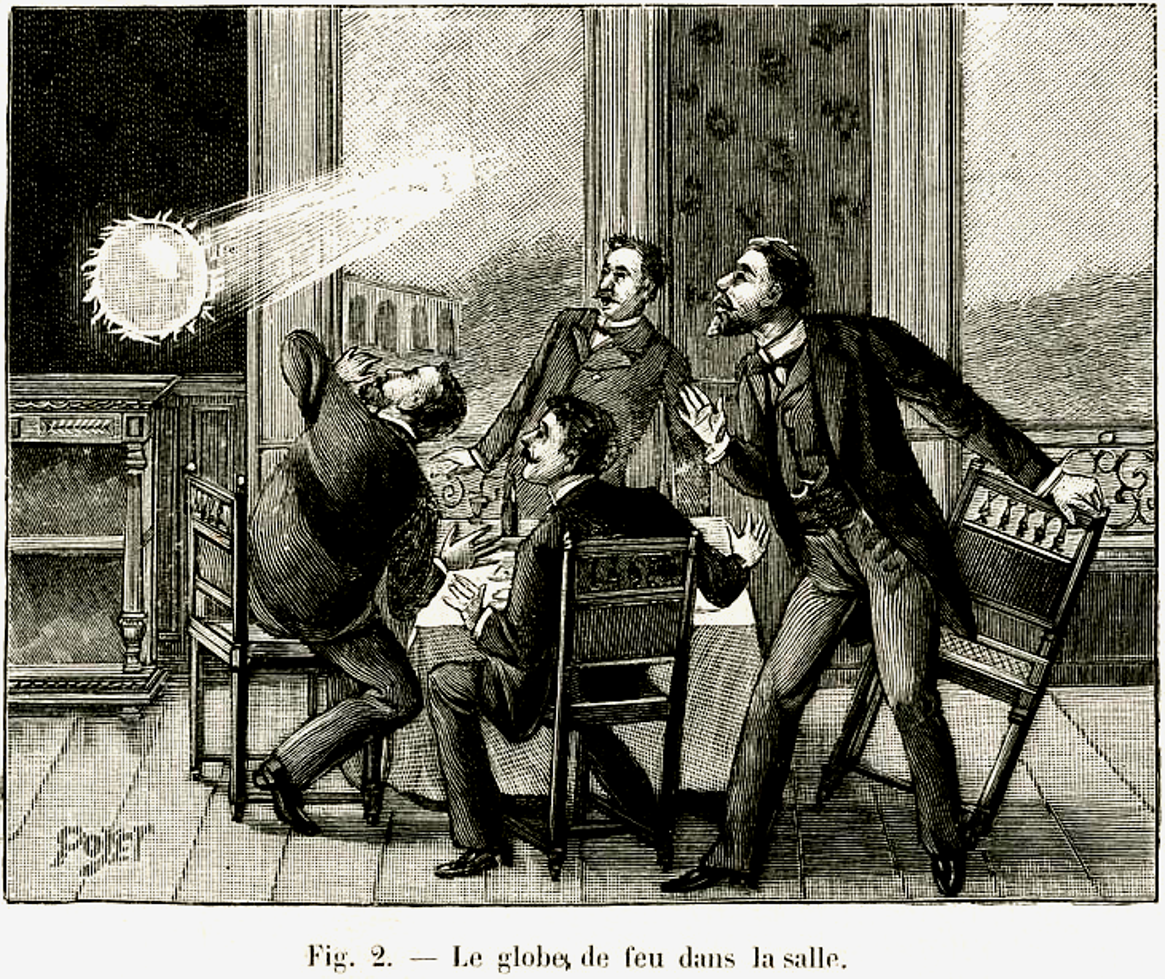
My first questions in researching this were 'what is ball lightning?' and 'does it exist?' To my surprise, finding answers these two questions was no simple task. The is a compilation of anecdotal stories of ball lightning on the Internet. As I read these, one thing became very clear: "ball lightning" is not one thing. The stories vary wildly for each person. Some of the stories are clearly astronomical objects like Venus and bright meteors. Other stories sound like they could have other plausible ordinary explanations as well. If we dismiss these stories, we are still left with some interesting accounts.

Of those accounts I couldn't immediately explain, there were few common threads. Some people saw a blue orb and others saw a red or orange orb. Many of the stories did take place during a lightning storm or there was some other source of electricity in the immediate area. Some people saw it hovering above the ground, others near the celling, and other reports say it was following a fence or wall. Sometimes it just disappeared peacefully and other times it crashed into objects and people, causing varying amounts of damage. Some common factors in all these stories seem to be that "ball lightning" is roughly a sphere in shape and it doesn't appear to have direct contact with object without disappearing. One thing that bothers me about these reports is that the vast majority of them are based on people's memories from usually over 10 or 20 years ago.

So what do I make of these reports? It's hard for me to say there's nothing at all going on here, but if there is, it is a very rare effect. Even if ball lightning does exist, it is very overblown. Our memories as humans degrade over time, so I am very wary of these older reports. Some reports were even second or third hand. The worst of them just assumed ball lightning as the cause of some electrical explosion. So I wasn't convinced ball lightning exists, but next I wanted to see if there was any plausible explanation to explain some of these stories.

There are some interesting explanations for how ball lightning might form. Explanations vary, but all of them tend to be really technical. Some involve complex ways of refracting light and others purpose floating balls of plasma. Another idea is that nano-particles kicked up by normal lightning strikes can hover and burn for a few seconds after a strike. None of the hypothesizes I found explain the diversity of ball lightning experiences. A new idea even suggested that ball lightning is a hallucination caused by electromagnetic fields interacting with the brain. I think that this is one of the main reasons none of them have become well accepted by the scientific community.

So what's the final word on ball lighting? Personally, I'm not convinced that ball lightning is a actual phenomena. Before we start a serious investigation of anything, we need to make sure there's something to investigate. Some cool science has been done on the subject, but not enough to prove anything conclusively. I attribute ball lightning to mistaken sightings of astronomical objects, known but rare atmospheric phenomena, old distorted memories, and hallucinations. Culture gives all this the name ball lightning.