


While sitting in the dining hall the other day, several other students at my table were discussing their nutritional preferences. One of the guys, in particular, was adamant about eating organic food, and was disgusted by the poor nutritional value and supposedly cheap quality of the dining hall food. Now, I am not going to claim my dining hall has the most amazing food ever, because it doesn't, but it's far from the worst I've had. And so long as you vary what you eat and try to keep a balanced diet, it's not difficult to stay healthy and well-fed without supplementing the meal plan. But, at least in this context, that was not the point. This student was truly upset by the fact that the food was probably "GM" and definitely not "organic."
According to the USDA, foods labeled "organic" must meet a set of criteria, which basically boil down to not using synthetic products, such as fertilizers or pesticides, as well as attempting to farm sustainably and maintain the biodiversity of the farmland. On the whole, I don't feel this is a bad idea. Sustainable, environmentally friendly farming practices are just smart: they allow the land to continue to be fertile and cause minimal disruption to the native ecosystem. The idea that no man-made products can be used is not a bad idea... I mostly see it as a silly one. All synthetic pesticides, fertilizers, and other products used in agriculture are regulated by the EPA and the FDA, for environmental and human safety. Even in industrial farming, it is becoming common practice to use man-made products as a last resort, both to protect the health of the farm and the consumer, but also to help the products to retain their potency. Like antibiotics, if pesticides are overused, the target creatures will become immune over time.
So, overall, organic food is not something I have a problem with as a whole. There are a few things that rub me the wrong way, though, which I've discussed in the past. For instance, the term "organic" is a bit of a misnomer; in the chemical sense, basically everything we eat, with the exception of salt, is organic. Also, the scientific studies suggest that there's really no nutritional or health benefit of "organic" food over "non-organic" food. If you think it tastes significantly better, and don't mind the higher price, then go for it. But the hype about organic food seems misplaced.
The fear of genetically modified food, however, is even more peculiar. Humans have been genetically modifying food ever since we settled down into agricultural societies. That's how we turned wild maize into the corn, wild peafowl into chickens, wild bananas into something easily edible. The only difference is that, at that point, we used artificial selection. Farmers would take two plants or animals that had characteristics they liked- say, larger ears of corn - and cross-breed them. In as few at 10 generations, the whole crop could have this characteristic. And, they could do this well before Darwin or Mendel came along to explain how it worked. However, understanding genetics, heredity, and evolution allowed farmers to more successfully manipulate their crops. Farms also started, at least with plants, using clones. If you take a clipping of a plant and replant it, it will often grow into a new individual, with the same genetics as the parent plant. You can do this over and over again, and don't have to get a new batch of seeds, with variable genetics and thus variable characteristics. A farmer knows every single plant in his field will have the same characteristics, which allow it to sell well.
The only thing different about "GM" crops, then, is that instead of repeating this process by trial and error, we can now go into the genes themselves and make tiny changes that result in even more precise output. Instead of it taking ten generations to made the corn kernels sweeter, for instance, it will take one. And, instead of the added sweetness resulting in fewer ears per plant, you can maintain the same number or even add a few more. It's a blessing in disguise. And, as with non-organic food, there's no scientific evidence that genetically modified foods are more harmful than the alternatives (which are also genetically modified, just in a more "natural" way). And, as before, they're highly regulated to make sure they do not harm humans or the environment.
Going back to the lunchroom conversation, I just can't see any scientific support for my classmate's claim that non-organic, genetically modified food is less good for you. If, for reasons of personal preference or ideology, he prefers to eat the "natural" alternatives, fine. There's no harm in them. But at the same time, it's unreasonable to hold the whole world to that standard. Because of agricultural innovations such as synthetic products and genetic modification, we are able to produce more than enough food to feed the rapidly growing human population (the distribution of that food is still an issue, but that's a topic for another day). The hype and fear-mongering is simply misplaced or untrue.
This post was written for Blog Action Day 2011.
Showing posts with label Environment. Show all posts
Showing posts with label Environment. Show all posts
October 16, 2011
April 26, 2011
A Visual Look at Radiation 25 Years After Chernobyl
Today is the 25th anniversary of the Chernobyl disaster. I don't want to delve into the details of what happened but with all the talk of radiation recently I thought it was important to again, put things in perspective. The image below was created a little while back but I think it is still a good visual way to understand radiation levels.
 |
| Click on image to enlarge |
The creator of this image is Randall Munroe, who is also the author of the web comic xkcd. If you haven't already, I recommend you give it a read.
April 22, 2011
The Potential of Algae
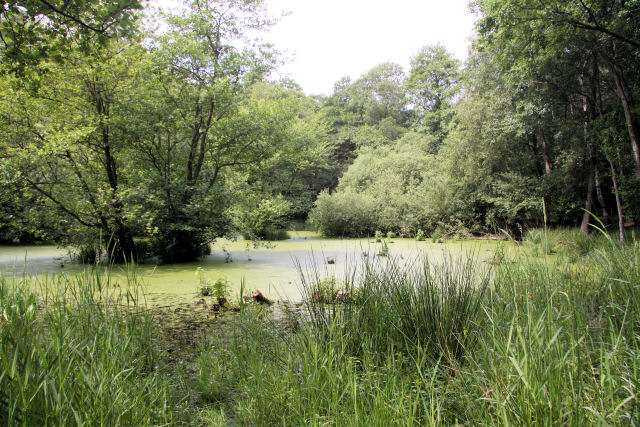
Every once in a while, I find a story on the potential of algae for biofuel or for waste cleanup. Back in 2009, I wrote about both the potential of "milking" oil from diatoms, and about hydrogen-producing algae, which could make hydrogen fuel cells a possibility. In 2010, a breakthrough suggested that we could pressure-cook algae to create crude oil, which would then be refined into gasoline, which is at least more sustainable than drilling and poses many fewer risks. By now, the hurdle is not can we create algal biofuels; the technology is there. The larger issue is how much we can reasonably produce. The one thing algae needs a lot of is water; it's planktonic pond scum. They also only live on the surface of water, so they require a lot of land. Algae farms, therefore, use up a lot of two important resources to create one. Is this a smart trade-off?
Enter Mark Wigmosta and other researchers at the Department of Energy's Pacific Northwest National Laboratory. They conducted a study on how much land and water algal farms would actually require, and where they are best located to minimize the inputs (land and water) and maximize the outputs (biofuel). As it turns out, algae could easily replace 17 percent of the oil currently imported. The land requirements aren't awful; it would require water surface approximately equal to the size of South Carolina, assuming only open, fresh water farms were used. As algae can be grown on salt water and in closed farms as well, there's a potential for reducing the amount of land surface used. The bigger problem is water: for every mile driven on a tank of algal biofuel, 8-50 gallons of water was used. While this is equivalent to current biofuels from corn and soybeans, it's much larger than the amount from drilled oil, which is about 0.5 gallons of water per mile driven. Still, on land use, algae is much more efficient than corn, producing 80 times as much oil per hectare than corn. Plus, people don't eat algae, so there's no competition between biofuel and food.
So, algae's still a definite contender in making our oil consumption sustainable, until alternative energy sources are set in place, such as wind, water, solar, and nuclear. Oh, and in case you're still concerned about nuclear power, particularly the waste, algae may help there, too: at least one species can specifically create biomolecules from strontium. While some tests still need to be run, there is a chance that these single-celled organisms could take up Strontium-90, one of the most radioactive waste products of nuclear energy, and convert it to harmless forms.
Basically, algae is proving more and more to be a key player in any of our alternative energy solutions. They may act as the transition between fossil fuels and sustainable, clean energy; they might create that clean energy; or they may help clean up any unwanted byproducts of sustainable energy. The potential of exactly how much pond scum can do is still being discovered, and will likely prove to be far more than anyone would have guessed. And on that note, Happy Earth Day!
 |
| Source: Wikimedia Commons |

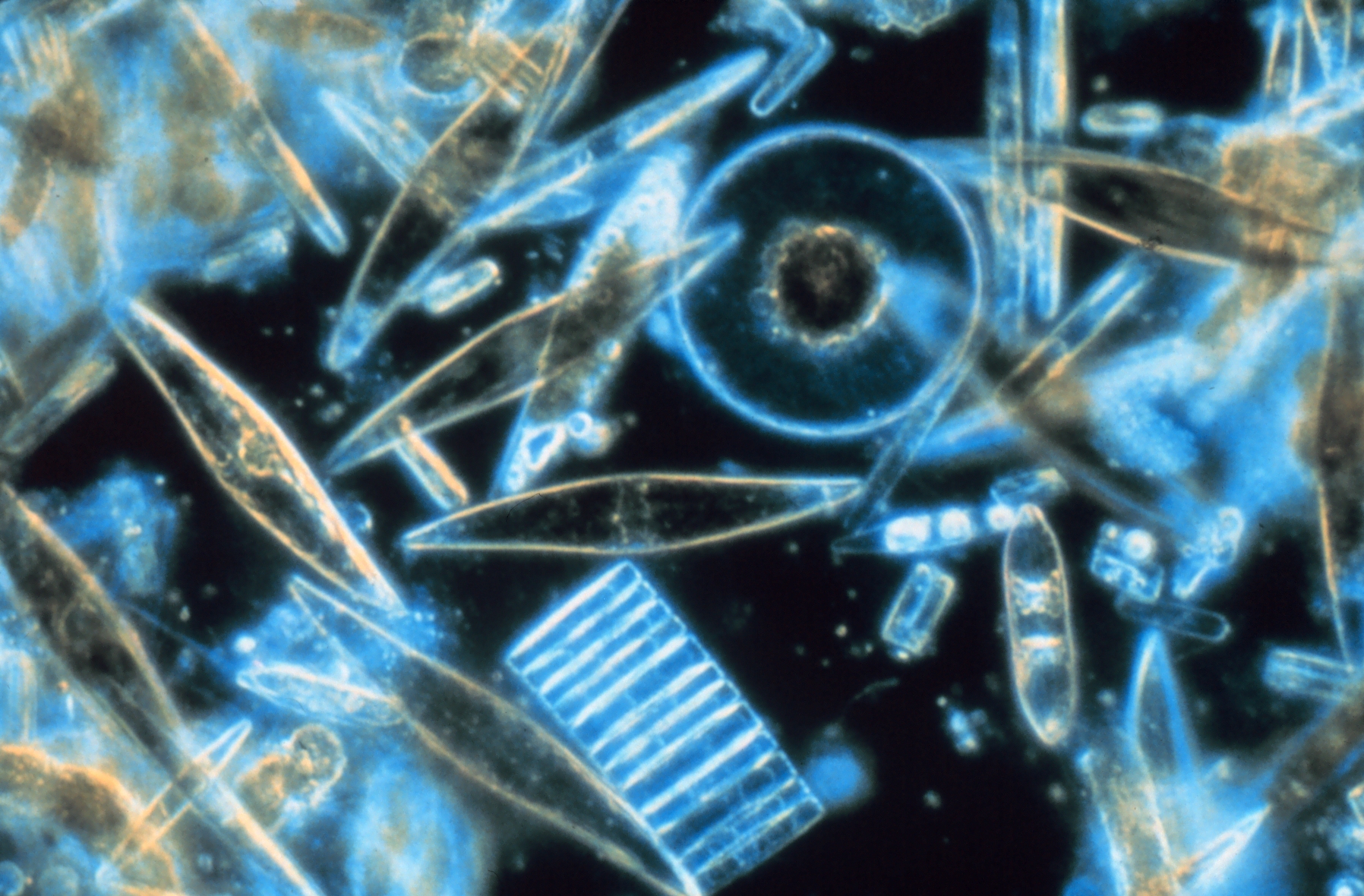 |
| Diatoms, a type of algae Source: Wikimedia Commons |

Basically, algae is proving more and more to be a key player in any of our alternative energy solutions. They may act as the transition between fossil fuels and sustainable, clean energy; they might create that clean energy; or they may help clean up any unwanted byproducts of sustainable energy. The potential of exactly how much pond scum can do is still being discovered, and will likely prove to be far more than anyone would have guessed. And on that note, Happy Earth Day!
October 6, 2010
The Census of Marine Life

The scale of this project was fantastic: over 2700 scientists, from more than 80 different countries, publishing 2600 papers over the course of a decade, spending countless hours on field expeditions and lab analysis. The recently published Census shows an impressive scale of oceanic diversity: 120,000 species, from plankton to whales and everything in between, were observed through the course of this project. Multiple maps were created to show where different organisms live.

Still, as impressive and large scale as this census of the oceans is, it's far from comprehensive. On the maps of organism ranges, there are places that show where the sea has yet to be explored. Dr. Ian Poiner, chair of the Census Steering Committee, claims that there are still at least 3/4 of a million species in our oceans that remain undiscovered. This is just a start to understanding our fellow creatures beneath the waves. There's a lot yet to learn. Space may be the final frontier, but the ocean holds tantilizing opportunities for exploration as well.
For more information on the Marine Life Census, and to explore the OBIS (Ocean Biogeographic Information System) database, visit the Census of Marine Life.
Source: Science Daily: First Census of Marine Life shows ocean life is richer, more connected, more altered than expected
September 8, 2010
A Summer Review and Return from Break
This summer has turned out to be extremely busy, so we've been on hiatus here at Scientifica. As school gets back into session, we'll get back onto a regular posting schedule. There's no summer break for science news, though, so here's a quick review of stories from this summer.
These are just a few of the highlights from the past few months. There were a ton other fascinating discoveries, studies, innovations, and ideas that popped up, some of which I'll discuss in more detail in the next few weeks. For now, I hope you find these stories as interesting as I did.
- Viruses Harnessed to Split Water: A neat application of solar energy, which uses viruses as the means to split water using sunlight. The hydrogren produced can be stored, and used as a clean energy source later on.
- Earth Fossil Find May Lead to Martian Discoveries: New microfossils found in gypsum give astrobiologists a new place to look for evidence of life on Mars and other planets.
- Mica Minerals Key to the Origins of Life: Another new idea on how life could have gotten started. Instead of a lightning spark or a geothermal soup, the thin, organized sheets of mica could have provided an ideal environment for the first living things to appear.
- The Moon is Shrinking: Scarps and ridges on the Moon's surface are changing, suggesting that the Moon is shrinking as its interior cools off.
- Oldest Material in the Solar System Found: A new test of a meteorite found in Morocco suggests that our Solar System may be as much as 2 million years older than previously thought.
- 'Dry Water': This peculiar combination of silica and water could be used to contain harmful industrial byproducts and greenhouse gases, or to kick-start chemical reactions.
- When Galaxies Collide- How the First Super-Massive Black Holes were Born: Computer models suggest that, within the first billion years after the Big Bang, young galaxies crashed into one another, and their central black holes merged into super-massive black holes.
- New Solar System Discovered: It has at least 5 planets, all about the size of Neptunes, and possibly another 2, one similarly sized to Saturn, the other closer to Earth in scale. It's the biggest exoplanet system found to date.
These are just a few of the highlights from the past few months. There were a ton other fascinating discoveries, studies, innovations, and ideas that popped up, some of which I'll discuss in more detail in the next few weeks. For now, I hope you find these stories as interesting as I did.
April 29, 2010
Algal Oil
Way back last June, I discovered an article suggesting that certain types of algae might be useful as an alternate source of oil. I wrote it up, here, and mentioned I hoped to see how it panned out. Most of these "breakthroughs" fade away after an initial media burst, however, so I rather expected this story to die out as well.
Instead, however, a research team at the University of Michigan is further investigating the idea, and has exciting preliminary results. They've discovered that pressure-cooking the algae could be a way to make crude oil in minutes, rather than millenia. According to Philip Savage, the principle investigator on the project, the process isn't terribly complicated. "We make an algae soup. We heat it to about 300 degrees and keep the water at high enough pressure to keep it liquid as opposed to steam. We cook it for 30 minutes to an hour and we get a crude bio-oil." With the type of primitive algae the team is using, this is enough to break down the plants and release natural oil, carbohydrates, and proteins.
Now, the method is far from perfect. The oil produced can't just be pumped into an automobile; it has to be refined and processed significantly first. It looks more like tar than gasoline when it comes out of the pressure-cooker. And it is still gasoline; there are lots of pollutants released by burning any oil, whether it came out of the ground or is recently squished algae. But there are a lot of advantages to the system.
First off, using biofuels is much more sustainable than using fossil fuels. We can always grow more algae; we can't magically continue to drill 70 million barrels of crude oil out of the ground every day. Second, it is somewhat better for the environment. Using algal biofuels is carbon-neutral. During their lives, the algae consume some amount of CO2, which is released again when the oil is burned. Technically, this is true for fossil fuels as well, but the CO2 they release has been in storage for millions of years, so the amount in the atmosphere increases. Biofuels are also much easier to clean up; chemical and biological processes can be used to take sulphur and nitrogen out.
This particular method is also a breakthrough among its competitors. It is a much more efficient method. Conventionally, to create an algal biofuel, one has to take a very oily algae, dry it out, and then extract the oil. It's a time-consuming, low-yield process, which makes it expensive and not likely to compete with drilling. The pressure-cooker method, however, is faster, has a higher yield, and produces much less waste. In fact, the researchers hope that, eventually, this technique can be used in waste-free refineries. It's a promising step. While there are many advantages to heading away from oil altogether, the technology just isn't in place yet. So, waste-free biofuel refineries would be a great intermediate step until hydrogen or electric technology is ready to take the place of oil.
Source: Science Daily- Pressure-cooking algae into a better biofuel
Crude oil data from the EIA.
 |
| A species of microalgae: Haematococcus pluvialis |
Now, the method is far from perfect. The oil produced can't just be pumped into an automobile; it has to be refined and processed significantly first. It looks more like tar than gasoline when it comes out of the pressure-cooker. And it is still gasoline; there are lots of pollutants released by burning any oil, whether it came out of the ground or is recently squished algae. But there are a lot of advantages to the system.
 |
| An Algae Farm |
This particular method is also a breakthrough among its competitors. It is a much more efficient method. Conventionally, to create an algal biofuel, one has to take a very oily algae, dry it out, and then extract the oil. It's a time-consuming, low-yield process, which makes it expensive and not likely to compete with drilling. The pressure-cooker method, however, is faster, has a higher yield, and produces much less waste. In fact, the researchers hope that, eventually, this technique can be used in waste-free refineries. It's a promising step. While there are many advantages to heading away from oil altogether, the technology just isn't in place yet. So, waste-free biofuel refineries would be a great intermediate step until hydrogen or electric technology is ready to take the place of oil.
Source: Science Daily- Pressure-cooking algae into a better biofuel
Crude oil data from the EIA.
December 28, 2009
Skepticism and Climate Change

Any issue that is highly politicized is hard to find good information on. We have discussed the issue of climate change a few times before on this blog (here and here) but I want to quickly review some of the science. There are several claims made with regard to climate change. The first is that the globe is, on average, warming. I think most people accept this fact. The debate is over the cause. The Earth is in a time period where we would expect to see temperatures rising naturally to a degree. The debate is over how much of the current warming trend is natural, and how much is caused by the human emissions of greenhouse gasses like CO2.
When we are dealing with an issue as complicated as climate change, we want to look at the scientific consensus. We don't want to look at the opinion of every scientist on the planet, but of those scientists who are doing work in relevant fields. The Intergovernmental Panel on Climate Change (IPCC) is a group composed of thousands of scientists from countries around the world. They have said in their most recent publication, "Most of the observed increase in global average temperatures since the mid-20th century is very likely due to the observed increase in anthropogenic GHG [greenhouse gas] concentrations." There is a growing amount of evidence that backs up this conclusion.
There is another debate on how we should react to climate change, but that is for a future post. My question here is what is the role of skepticism in regard to this evidence.
In science, opinions that go against the consensus play an important role. Grants will often go to people doing research that goes against the grain. I am glad that there are scientists that are working on finding problems with climate models and trying to poke holes in the other lines of evidence for climate change. This said, I think we have to remember this is a minority view. Skepticism is about forming views based on the evidence. So far, the evidence points strongly towards a human contribution for climate change. I think that regardless of our personal viewpoints we need to respect that. I have no problem with people like James Randi expressing doubts about the human influences on the climate. I have said before skepticism is not a set of views, but a process for forming ones own views about the world. I do think though that to be responsible, leaders like Randi need to be clear that they are disagreeing with the scientific consensus. There are sill places for their doubt. We are still are developing climate models, and their are error bars for the evidence (see the image above). I don't find these arguments convincing, but others do and that's where the dialogue should be.
I personally find the evidence for the human influences on climate change overwhelming. I always welcome people to disagree with me, but please do so with evidence and logic. Recognize that the scientific community has overwhelmingly showed their support for this view. I think it is unfortunate that there are people who disagree with me based solely on its implications or for other political reasons. I have have talked with scientists on both sides of this issue, and I think that the most reasonable thing to do is respect the conclusion of the majority of working climate scientists.
October 15, 2009
Climate Change: Science or Fiction? (Blog Action Day 2009)
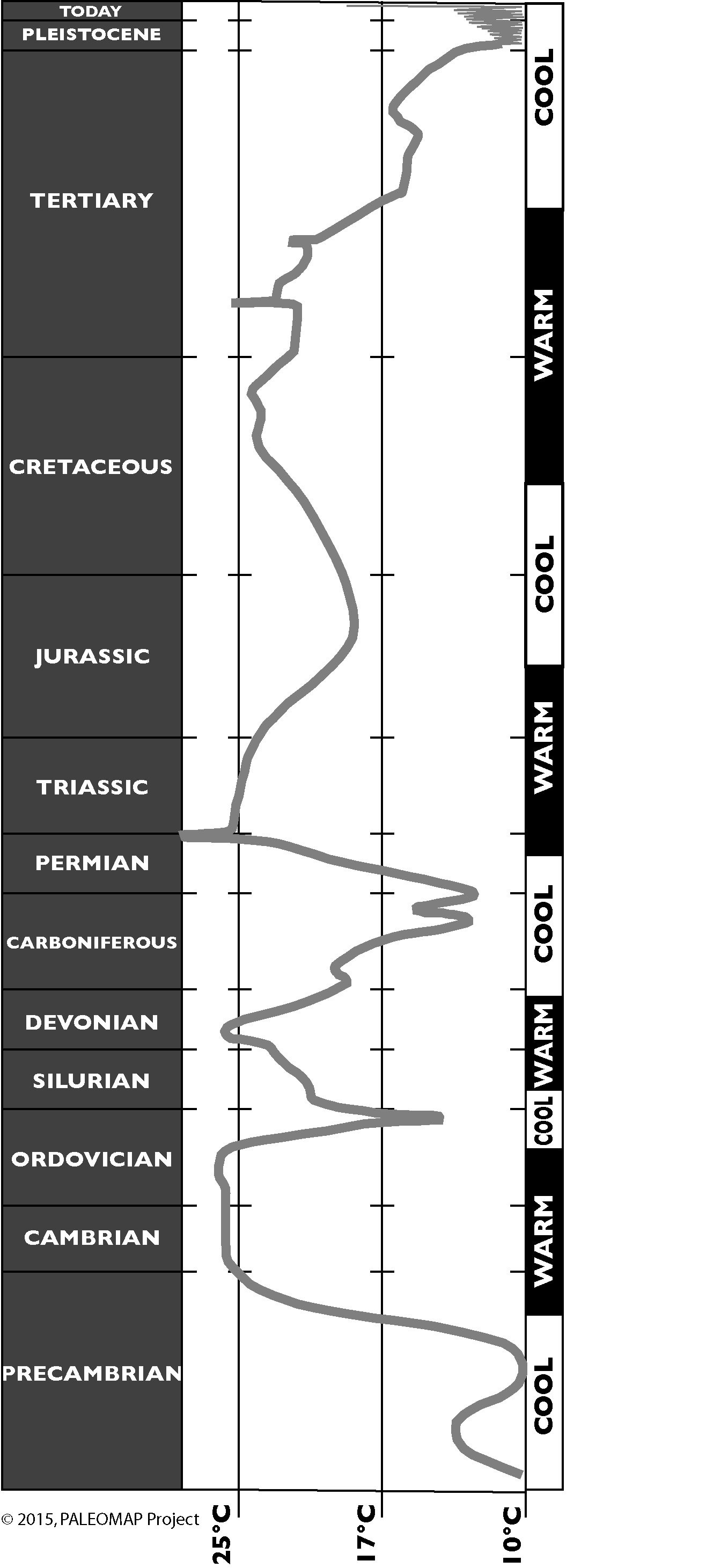
Over the course of the Earth's history, climate has changed dramatically. Some periods are extremely warm; in the Eocene, around 55 million years ago, there was a period of time, known as the PETM, where average global temperature was around 7o C warmer than it is today (13.39o C). We are currently in an "icebox" time. These are relatively rare, and are defined as points in time where there is ice at the poles. Because of this, the Earth would naturally warm again. Virtually no scientist disputes this; there is a solid base of evidence.
The controversy about climate change comes not from whether or not it exists, however. It's more a question of how much of an impact humanity has had on it. I'd like to take a moment and address a few of the myths and facts about climate change.
Myth #1a: The current warming trend is entirely natural.
Well, no. CO2, a major greenhouse gas, is stored in fossil fuels: natural gas, oil, and coal. These fuels are compressed, ancient organic matter, which is full of CO2. Burning these fuels puts lots of CO2 into the atmosphere. CO2 traps heat energy and reflects it back at the planet. So, when we put carbon dioxide in the atmosphere, we do contribute to the warming of the planet, especially when you consider the rate at which we add this gas to the atmosphere.
Myth #1b: The current warming trend is entirely man-made.
This is a popular converse to #1a. No, humans are not entirely responsible for climate change. The planet undergoes climate changes on a fairly regular cycle, and we are nearing a warm stretch anyway. The rate is what is different; the fact that the Earth is beginning to warm again is not.
Myth #2: Carbon Dioxide is the only greenhouse gas. So, if we can get rid of that, then the Earth will cool back down.
Nice try, but no. If we could remove all greenhouse gases from the atmosphere, we'd need to get rid of a lot more that just CO2. Methane (CH4), nitrous oxide (N2), and water vapor (H2O) are all greenhouse gases as well. In fact, water vapor has the strongest of these greenhouse gases. We could not possibly remove all the water from the air, and doing so would be far worse to life than climate change. The water cycle keeps water vapor from being too large of a problem, with respect to climate.
Also, simply removing greenhouse gases wouldn't fix the warming trend. There are other factors, such as the solar cycle and changes in Earth's orbit. Airborne particles and aerosols can also affect climate change.
Myth #3: Climate change would be great! It's way too cold where I live.
This one is especially tempting to those living in places like Minnesota, the Dakotas, or anywhere else where the average winter temperature is below 0. Unfortunately, it's not necessarily true. The term "global warming" is incredibly misleading in this respect. The Earth will not uniformly warm up by 5o C. Some areas will get warmer, sure. Others will get colder. The entire planet, land and sea surface, is warming, on average. This is not a promise of South Dakota becoming the new Arizona.
Myth #4: The Earth is warming faster each year, especially over the last decade.
Factually wrong. 2008 tied with 2001 for being the 8th warmest year on record. It's certainly still warmer than, say, 100 years ago. However, it's not exponential growth of the annual global temperature.
Myth #5: The weather's weird this year. It's global warming!
The weather is weird this year. But, no, it's not due to climate change. The unusual weather patterns this year (for instance, the repeated afternoon rainshowers early this summer in areas like Colorado) are due to the El Niño. It's an interesting weather phenomenon, but it a much shorter cycle than the climate cycle.
There is a hint of truth in this one, though. Weather patterns will change, causing drought, flooding, and other changes in weather globally.
Climate change is a complex issue. It's definitely science: it's occurring, and we can't stop it. We couldn't prevent it, no matter what we did. It's a natural process. However, we have had some impact on the speed that the warming trend has occurred. So far, it's not the fastest climate change: the PETM was a larger jump. in 10,000 years. We haven't had that long for this one yet, so it has yet to be seen if this is the fastest climate has changed. However, on the bright side: life didn't die out during the PETM. Instead, they flourished. The fact that we have polluted the air with so much carbon dioxide is problematic, but not as much as the other pollutants we've released. The Earth will survive and recover from any human impacts on climate change. A bigger question is how we humans will adapt and ride it out.
Thanks to Blog Action Day for posing the question about climate change, human impacts, and what action we need to take.
Graph credit: Paleomap Project
Credit for the annual temperature data to Science Daily.
August 12, 2009
Talking Dolphins
When people talk, we tend to use short words as much as possible. For instance, I've never heard anyone say, "May I have permission to obtain a dessert composed of milk, sugar, and several additional ingredients?" However, "Can I go get an ice cream?" is a very common question at my house. This rule of communication is known as the law of brevity. Both the listener and the speaker want to put in as little effort to get the point across. As it turns out, dolphins also use the law of brevity when they communicate.
Dolphins use about 30 non-verbal behaviors to communicate. In a recent study, ecologists David Lusseau and Ramon Ferrer-i-Cancho broke up these behaviors into simple units. Jumping and turning are considered individual units. Butting heads, on the other hand, is made up of four units: both dolphins jumping, and then both dolphins using their heads. The team analyzed the behavior of the dolphins and determined that they used simple, one unit behaviors more frequently than the complex behaviors with more units.
This is the first time scientists have seen evidence of the law of brevity in non-human communication. However, with this evidence of it's use among dolphins, many suspect that it is common in other species as well. While it doesn't prove that another species is using language, it is one of the first steps to finding evidence of language outside of humans. And the possibilities that opens are staggering.
Credit: Discovery News- Dolphin Speak Relies on Brevity
Dolphins use about 30 non-verbal behaviors to communicate. In a recent study, ecologists David Lusseau and Ramon Ferrer-i-Cancho broke up these behaviors into simple units. Jumping and turning are considered individual units. Butting heads, on the other hand, is made up of four units: both dolphins jumping, and then both dolphins using their heads. The team analyzed the behavior of the dolphins and determined that they used simple, one unit behaviors more frequently than the complex behaviors with more units.
This is the first time scientists have seen evidence of the law of brevity in non-human communication. However, with this evidence of it's use among dolphins, many suspect that it is common in other species as well. While it doesn't prove that another species is using language, it is one of the first steps to finding evidence of language outside of humans. And the possibilities that opens are staggering.
Credit: Discovery News- Dolphin Speak Relies on Brevity
July 8, 2009
The Wonders of GM Crops
Genetically Modified (GM) foods get a lot of bad press and are often linked with many negative health effects. The reality is that there is no scientific evidence against GM food. They are also some of the most rigorously tested food products. This doesn't stop groups like Green Peace from adamantly fighting against GM food.
The basic idea is they have found a way to create plants that filter out the salt in the roots. The world's population is not getting smaller. With a growing population we are going to need genetically modified foods more and more. It is really important that people understand that GM food is not the villain our culture sees. GM food is a hero in disguise.
The reason GM food is so widely used is because it is made to have advantages. GM crops often require less fertilizer, less pesticides, and are less demanding on the soil. Science Daily announced today that scientists in Australia have come close to creating GM crops that could grow in areas with high salt concentration. "Salinity affects the growth of plants worldwide, particularly in irrigated land where one third of the world's food is produced. And it is a problem that is only going to get worse, as pressure to use less water increases and quality of water decreases," says the team's leader, Professor Mark Tester.
The basic idea is they have found a way to create plants that filter out the salt in the roots. The world's population is not getting smaller. With a growing population we are going to need genetically modified foods more and more. It is really important that people understand that GM food is not the villain our culture sees. GM food is a hero in disguise.
Source- Science Daily
June 20, 2009
Defining Climate Change
We've heard it all over the news and the web. "Humans are causing global warming." "We'll make ourselves, and everything else on the planet, go extinct!" These doomsayers claim that only immediate action will save our planet from ending up like this:
 However, a lot of these websites claiming doom and destruction just refer to "scientists" providing claims or cite CO2 as an exclusive cause for "global warming." In truth, though, the situation is more complex.
First off, "global warming" is an extremely inaccurate term. The planet Earth is not uniformly warming up. Some areas will get warmer, while others will get cooler. Therefore, in referring to the changes in global temperature, the term is "climate change," not "global warming."
Second, climate change is nothing new to the planet. Throughout the planet's history, the temperature has changed. In the Cretaceous, for instance, there were no polar ice caps. The Earth regularly warms and cools for various reasons, including:
In the next installment: the Human Factor
Credit: EPA
However, a lot of these websites claiming doom and destruction just refer to "scientists" providing claims or cite CO2 as an exclusive cause for "global warming." In truth, though, the situation is more complex.First off, "global warming" is an extremely inaccurate term. The planet Earth is not uniformly warming up. Some areas will get warmer, while others will get cooler. Therefore, in referring to the changes in global temperature, the term is "climate change," not "global warming."
Second, climate change is nothing new to the planet. Throughout the planet's history, the temperature has changed. In the Cretaceous, for instance, there were no polar ice caps. The Earth regularly warms and cools for various reasons, including:
- Eccentricity: As the Earth orbits the sun, the shape of the orbit, as well as the tilt of the planet, change somewhat. Because of this, the amount of heat reaching the planet changes, which can cause ice ages, based on a theory by Milutin Milankovitch.
- Sun Intensity: This is pretty self-explanatory. As the sun fluctuates, it may be more or less powerful for a period of time. This can also cause changes in the global temperature of the planet.
- Volcanic Eruptions: The release of particulate matter and greenhouse gases into the atmosphere when volcanoes erupt can also affect climate temporarily. A time interval with a lot of volcanic activity can push a more lasting shift in the climate.
- Ocean Currents: A large conveyor belt of circulation in the oceans moves cool water from the poles to the equator, and warm water from the equator to the poles. As global temperature shifts, this current may become weaker, changing climate regionally.
- Greenhouse Gases: And this is the one everyone is concerned about. Gases like carbon dioxide (CO2), methane (CH4), water vapor (H2O), and nitrous oxide (N2O) all can capture infared radiation and prevent it from escaping the atmosphere. This leads to a build-up of heat, the greenhouse effect.
In the next installment: the Human Factor
Credit: EPA
Giving the Night Sky a Little Treatment
 Light pollution is wasted light. If you have a outdoor light of any kind that doesn't direct the light towards the ground, where is the light going? It's lighting up the sky. In some cases you can be wasting over half of the energy you put into the lightbulb. We put light fixtures out at night to light up roads and sidewalks, so why are we lighting up the sky?
A lot of the reason is laziness and a lack of understanding. Most people don't even know that this problem exists. This leads to light pollution wasting energy and money. In 2002, the city of Calgary in Canada changed all of their lighting fixtures to direct their light at the ground. Since then, they have been saving an estimated 1.7 million dollars every year. The AMA calculates that over 10 billion dollars are wasted by bad lighting practices every year. That's more then half of NASA's annual budget! There are also other effects on wildlife and safety that can be improved simply by changing these lighting fixtures.
There's also another reason to care about light pollution. If you have seen the night sky in a big city, and from a remote spot in the middle of nowhere, you know the difference. If you haven't, the difference is a few thousand stars. The wasted light in a city washes out the fainter stars making them impossible to see with the naked eye. This is one of the reasons new observatories are often built in very remote locations. By improving the types of lighting fixtures we use we can greatly improve our view of the universe.
Just five days ago (on June 15th) the American Medical Association (AMA) passed a resolution regarding light pollution. The resolution has 3 parts.
RESOLVED, That our AMA support light pollution reduction efforts and glare reduction efforts at both the national and state levels.
RESOLVED, That our AMA support efforts to ensure all future streetlights be of a fully shielded design or similar non-glare design to improve the safety of our roadways for all, but especially vision impaired and older drivers.For all of us amateur astronomers this is great news. One of the main reasons for the AMA's involvement is the growing link between light pollution and breast cancer. The AMA has a lot of power and influence in this country. It is inspiring to see such a large group support science, and help to make a more energy efficient society.
For more Information about light pollution check out the International Dark-Sky Association (IDA).
Source- Universe Today
Image Credit- NASA
Subscribe to:
Posts (Atom)