


A few times in the past I have written about how astronomers use light in various ways to learn about objects millions of miles away. Spectroscopy is simply one of the fundamentals of astronomy, but the other day I had someone ask me what the more everyday uses for spectroscopy are. Why is spectroscopy important to the everyday person? As we sat and talked, we came up with more and more ways it's used.
Spectroscopy is the study of light. In astronomy, we use it to find everything from composition, to temperature, to velocity, to extrasolar planets, and the list goes on. But how does this affect us? One of the first things that came to mind was communication. Our cell phones use radio waves to communicate with cell towers. These are the same radio waves we use to study the earliest moments of the universe. The microwaves that we use to cook our food are also part of the radio spectrum.
Healthcare is another area where examples are plentiful. X-rays and CT scans are both used in hospitals on a regular basis. They are also used to help us understand some of the most energetic places in the universe. You can get a sunburn because of ultraviolet light that penetrates our atmosphere. This same form of light gives us insight into the structure of the clouds of Venus.
Gamma rays are the highest energy form of light and are used by geologists to find minerals or other materials under the earths surface. Infrared, a much lower energy form of light, is used by weather satellites to help us know the forecast tomorrow.
All of these technologies are things we have come to rely on, and none of them would be possible without this obscure part of physics.
Showing posts with label Weather. Show all posts
Showing posts with label Weather. Show all posts
February 25, 2010
February 17, 2010
Dynamic Earth: Introduction to Weather
Where I grew up, there was a common saying regarding the weather: "If you don't like it, wait a few minutes. It will change." While not precisely true, it did seem that the weather changed quite a lot. It could be snowing in the morning and 65 and sunny by the afternoon. We've all experienced many forms of weather, and so have a general understanding of what it is. However, there are more precise ways to define the weather.
 What is weather?
Weather is defined by meteorologists as the state of the atmosphere at a given point in time. Typically, they are only referring to the troposphere, the lowest layer of the atmosphere. The weather is determined by 7 main factors: air temperature, air pressure, cloud type, precipitation type, precipitation amount, wind speed, and wind direction. As an example, the full weather report of where I live right now is: 29.8o F; 30.02 in pressure; cumulus clouds; light snow; up to 2 in; 1.0 mph winds, from the south-east.
Weather vs. Climate
Weather is not the same thing as climate. This is a really common misconception with all the news about "global warming" and "climate change." Weather is local and short term. It is snowing here right now, but it was sunny yesterday. Also, it's probably not snowing all over the Midwest, just here. Climate, on the other hand, is long-term and broad, covering regions to the entire planet. Thus, on average, over much of the planet, annual temperatures over the past 100 years have been getting warmer. A freak snowstorm does not mean climate change is not occurring, nor is it necessarily caused by climate change. The two are related, but are not directly connected. So, as much as people like to claim that this bitter cold winter disproves global warming, that's simply not how it works.
That's basically all there is to weather. It's a local set of atmospheric conditions. For sounding so simple, and even boring, however, there's a lot of unpredictability in weather, which can lead to some pretty terrifying phenomena.
More on weather.
Weather is defined by meteorologists as the state of the atmosphere at a given point in time. Typically, they are only referring to the troposphere, the lowest layer of the atmosphere. The weather is determined by 7 main factors: air temperature, air pressure, cloud type, precipitation type, precipitation amount, wind speed, and wind direction. As an example, the full weather report of where I live right now is: 29.8o F; 30.02 in pressure; cumulus clouds; light snow; up to 2 in; 1.0 mph winds, from the south-east.
Weather vs. Climate
Weather is not the same thing as climate. This is a really common misconception with all the news about "global warming" and "climate change." Weather is local and short term. It is snowing here right now, but it was sunny yesterday. Also, it's probably not snowing all over the Midwest, just here. Climate, on the other hand, is long-term and broad, covering regions to the entire planet. Thus, on average, over much of the planet, annual temperatures over the past 100 years have been getting warmer. A freak snowstorm does not mean climate change is not occurring, nor is it necessarily caused by climate change. The two are related, but are not directly connected. So, as much as people like to claim that this bitter cold winter disproves global warming, that's simply not how it works.
That's basically all there is to weather. It's a local set of atmospheric conditions. For sounding so simple, and even boring, however, there's a lot of unpredictability in weather, which can lead to some pretty terrifying phenomena.
More on weather.
February 10, 2010
Volcanic Lightning Show
Lightning and volcanoes are two of my personal favorite forces of nature. Both are capable of a lot of destruction, and are pretty unpredictable. A combination of the two would be terrifying, and spectacular. Perhaps something like this:

What is picture shows is a potentially new type of lightning, detected over the Redoubt Volcano in Alaska. The bolts you see are very small and very fast: each is only about a yard (3 feet) long and lasts only a couple milliseconds (for reference, a human eye blink lasts around 350 milliseconds). Even cooler, the lightning only occurs during the volcanic eruption. In fact, it is one of three types of volcanic lightning: these "tiny sparks", a "natural fireworks" (large, spectacular bolts), and an intermediate type, between the other two. The bigger bolts are caused when water and volcanic ash meet, causing a sudden thunderstorm. How the smaller sparks form, however, is still unknown. Now that they have been confirmed, researchers know how to look for them, and will be able to gain more data, which will in turn help us learn what causes this new volcanic lightning.
Source: National Geographic- New Lightning Type Found Over Volcano
What is picture shows is a potentially new type of lightning, detected over the Redoubt Volcano in Alaska. The bolts you see are very small and very fast: each is only about a yard (3 feet) long and lasts only a couple milliseconds (for reference, a human eye blink lasts around 350 milliseconds). Even cooler, the lightning only occurs during the volcanic eruption. In fact, it is one of three types of volcanic lightning: these "tiny sparks", a "natural fireworks" (large, spectacular bolts), and an intermediate type, between the other two. The bigger bolts are caused when water and volcanic ash meet, causing a sudden thunderstorm. How the smaller sparks form, however, is still unknown. Now that they have been confirmed, researchers know how to look for them, and will be able to gain more data, which will in turn help us learn what causes this new volcanic lightning.
Source: National Geographic- New Lightning Type Found Over Volcano
August 27, 2009
Lightning's Twin
And here I thought normal lightning was cool.
As it turns out, lightning has a twin above the clouds. It's known as a gigantic jet. The name is pretty accurate, too; where normal lightning fits into a 6-inch channel and travels up to around 4.5 miles, gigantic jets have multiple channels and can travel as much as 40 miles, and enter the ionosphere (which is the boundary between the atmosphere and outer space).
Because of their location, and their short duration, there are only 5 photographs of these gigantic jets. One of the most recent of these was caught nearly on accident. Steven Cummer, of Duke University in North Carolina, had equipment set up to photograph sprites, another sort of electrical discharge in the upper atmosphere. Their equipment was in just the right place at the right time, to capture a 1 second image of a gigantic jet.
 This new data will be very useful as scientists study these gigantic jets more closely. Right now, very little is known about them. Scientists have no idea what types of storms or conditions are necessary to produce a gigantic jet. Cummer is planning to set up a high-speed, low-light, color camera, to attempt to capture more images of this upward lightning. This will help determine chemical process, temperature, discharge patterns, and much more. For now, we have a couple cool pictures and videos, and hopefully more are on the way.
Credit: Science Daily- Lightning's Mirror Image... Only Much Bigger
As it turns out, lightning has a twin above the clouds. It's known as a gigantic jet. The name is pretty accurate, too; where normal lightning fits into a 6-inch channel and travels up to around 4.5 miles, gigantic jets have multiple channels and can travel as much as 40 miles, and enter the ionosphere (which is the boundary between the atmosphere and outer space).
Because of their location, and their short duration, there are only 5 photographs of these gigantic jets. One of the most recent of these was caught nearly on accident. Steven Cummer, of Duke University in North Carolina, had equipment set up to photograph sprites, another sort of electrical discharge in the upper atmosphere. Their equipment was in just the right place at the right time, to capture a 1 second image of a gigantic jet.
Credit: Science Daily- Lightning's Mirror Image... Only Much Bigger
July 24, 2009
Lightning, Life, Cosmic Rays, and Climate
 Of all weather phenomena, lightning is one of my favorites. It's amazing that electricity can build up in the air, then release in a sudden burst of light and sound. It can ignite forests, and melt dirt or sand into a clump, called a fulgurite. Lightning is terrifyingly powerful, and really neat to watch.
I recently ran across a couple of articles about lightning. The first discusses new findings in the way life developed. Many bacteria have a gene that allows them use phosphite, a rare compound created almost exclusively by lightning strikes. When life first developed, around 4 billion years ago, however, phosphite was more common. It was introduced by meteorites, as well as lightning, and was more easily avaliable than the common phosphate. Today, phosphite is so rare that it is no longer metabolized. But many bacteria, like E. coli, still have the vestigial ability to use it.
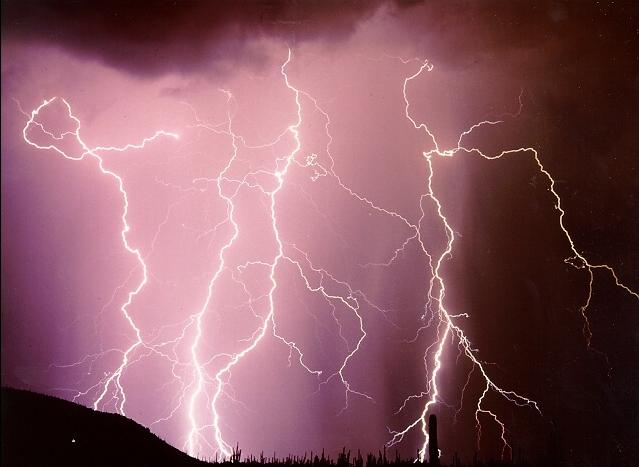 The other article discussed how cosmic rays could influence lightning, and how that, in turn, could influence the climate. Researchers in Portugal suggest that the occurance of lightning is related to the solar cycle. When there is a lot of solar activity, there are fewer charged particles in the Earth's atmosphere, causing more lightning. When the Sun is quiet, there is more cosmic ray flux, more charged particles in the air, and so fewer lightning storms.
This relates to climate change in an unusual way. Because of how the greenhouse effect works, the amount of cloud cover affects global temperature, as well as the amount of greenhouse gases. Thus, when solar activity is up, there is more cloud cover and more lightning along with it. This increase would about cancel out the effect of greenhouse gases during that short period of time.
The impacts of lightning are varied, and can be quite significant. And the occurence of lightning itself is amazing. There is nothing quite like seeing a lightning strike. It is terrifying, but also mesmerizing. It's one of the most interesting forces in nature.
Subscribe to:
Posts (Atom)