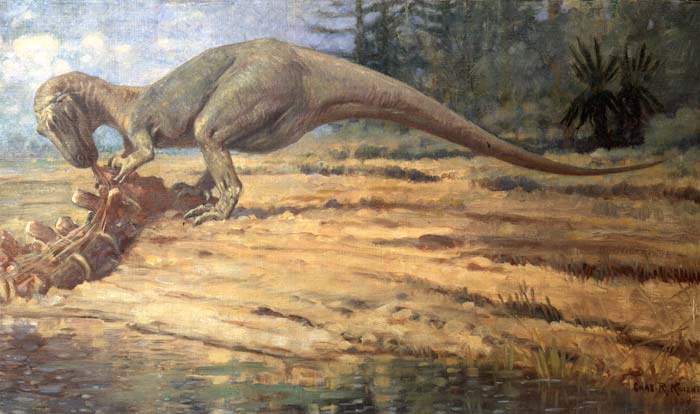
Along with most soft tissue, color, and a host of other features of prehistoric life, the sounds those long-gone creatures made are lost through the depth of time. While we make inferences about the sounds made by Parasaurolophus, Tyrannosaurus rex, the earliest birds, and the other animals living at the time, those projections are just just guesses, based on an approximation of acoustic and air flow properties. If those creatures had vocal chords, or any soft-tissue mechanism for creating sound, then we today have no way of recreating those noises.
However, there are some animals that don't use soft tissue and complex skull structure to create sound. Modern crickets, katydids, and other insects in the Orthoptera order create sound by running a row of "teeth" on one wing across the other, similar to a violinist running a bow across the strings. These fine details, however, very rarely preserve in the fossil record. It was not until a very detailed specimen, from North China, was discovered that Dr Fernando Montealegre-Zapata and Professor Daniel Robert, experts in biomechanics, were able to determine how ancient crickets made noise, and what they would have sounded like. This 165 million-year-old cricket had similar stridulating organs (the mechanism used to make sound) to modern species, something that's never been seen before in a fossil. The team built a reconstruction of that structure, and compared it to many modern species, to determine what it sounded like. In fact, the fossil was so detailed that they could fully recreate the song of this species, named Archaboilus musicus. You can listen to it here.
Unless the laws of physics suddenly allow us to build a time machine to the past, we will never know exactly how the Jurassic landscape sounded. The discovery of A. musicus, and hopefully more insects like it, along with understanding the sounds made by amphibians, mammals, dinosaurs, and reptiles, based on what information we can glean from the fossils and what we know of modern creatures, will help us to slowly piece together a more dynamic landscape of the past, engaging not just the eyes, but the ears as well.
For some, an interest in science shows up in college, or later. For others, it starts young. I was one of those very young science kids: if you mispronounced a dinosaur name around me, I would come right up to you and correct you. To this day, I still cringe whenever someone mispronounces Dienonychus* or Diplodocus**. As I've grown older, I've met lots of other kids who are excited about paleontology, like these two:
I love encouraging this type of interest in science in general, and paleontology in particular. Sometimes, though, I meet a kid who just completely blows me away with how passionate and excited they are. Thanks to the Internet, I've recently discovered several of these amazing kids. All of them are 7 or 8 years old, and how passionate and enthusiastic they already are about science blows me away.
The first is Aaron, an 8 year old time traveler who, with his trusty computer pal INO, wanders through prehistory in search of his favorite dinosaurs and other creatures. He documents his travels in short podcasts, most of which focus on a particular dinosaur or other prehistoric animal. He takes time to share facts about each dinosaur as he tracks it, and to answer questions about paleontology, specific dinosaurs, and his own interests, sent in by other kids. His podcast story is on its second season now, traveling through the Cenozoic instead of the Mesozoic. You can find him at Aaron's World.
Another is a vlogger, rather than a podcaster. Riley the Paleontologist is 7 years old, from Alabama. Much of the Southern U.S. could learn from him; he's clearly got the concept of "science" all figured out. He brings a miniature version of every dinosaur he discussed to his show, and discusses the basic facts paleontologists have found about each dinosaur. You can watch his first episode below, and find him on Youtube.
And the third "paleokid" I've discovered is Art, of Life Before the Dinosaurs. He is a blogger, and unusual in that, unlike many kids who love paleontology, his obsession isn't dinosaurs. Instead, he loves Paleozoic invertebrates, the weirder the better. This happens to be my favorite time period as well, and I learn something new with every one of Art's posts... which, considering this is what I'm studying in college right now, is quite impressive.
It's inspiring to find kids like these, taking initiative and, with their parents' help, sharing their love of science with the world. It gives me hope for the future of science. And these are just a couple of the paleokids. I am always finding other children and teens who, against the cultural norm, love science and spread that love to anyone willing to listen. If you know of any others, please send them my way!
Here's the third video in my summer introduction to paleontology course. This time, we look at how to do field work. If you haven't seen them, you can watch previous installments.
Here's the second video in my summer introduction to paleontology course. This time, we look at how to do field work. If you haven't seen them, you can watch previous installments.
Leave any questions or suggestions in the comments below!
Note: It may be a while before the next video is uploaded... I'm experimenting with a new way of recording these. The next installment, on lab work, should be in the next few weeks once I get that worked out.
Over this summer, I am teaching a six-week introduction to paleontology course to several interns at the paleontology lab I work at. As an experiment, I've been recording the classes as well, and uploading them for the viewing pleasure of everyone. Here is the first installment of that series:
Identifying fossils is a more complicated task then you'd think. There are lots of different kinds of rocks, which can have their own unique patterns in them. Some of these patterns are the remains of ancient life; others are abiotic structures, chances of mineralization or later erosion that lead to pseudofossils. A reader emailed me a few weeks back with a question about some "fossils" he'd found.
While out hiking, he had found "some designs on rock that looked like fern frond fossils" or "like something bacteria have left." From just that description, I had some ideas about what these "fossils" could be, but asked for a photograph anyway. This is what he sent me:
"Fossil" from Nevada
This is actually a really, really common thing to find, so I recognized it right away. While these pretty, leaf-like designs look like ferns, they're actually not fossils at all. Instead, they are a type of pseudofossil, a manganese-oxide mineral stain. These stains almost always form this type of dendritic (tree- or fern-like pattern) in the bedding planes of the rock. They often occur in sandstone, as it does in the example above. For comparison, here is another examples of dendritic mineral stains.
While these aren't fossils, they're still cool. They form as water seeps through the sandstone. This water has dissolved minerals in it, including manganese or sulfides. As the water gets filtered through the pores in the rock, the minerals are left behind, precipitating into manganese oxide or pyrite (depending on the type of minerals dissolved in the water). The way these minerals crystallize, they form elegant branching dendrites along the bedding planes (lines within the rock, formed when the rock was deposited as parallel layers of sand) of the rock. In my own rock collection, I have quite a few dendrites, because they're one of the prettiest pseudofossils, and have such an interesting story behind their formation.
Thanks to Claude A., for permission to use this example.
Much of the fossil record is confusing. There are tons of fossils that look a lot like normal rocks, and quite a few normal rocks that look like fossils. This makes a paleontologist's job tricky, with any fossil in any time period. However, the most challenging are microfossils. Microfossils are fossilized single-cell organisms or colonies: bacteria and algae, usually. Prior to the explosion of multicellular life in the Cambrian, microfossils are all paleontologists find. To date, the oldest bacterial fossils that have been discovered are about 3.5 billion years old.
However, microfossils are particularly controversial because they are microscopic and often lack much detail. There are several geologic processes that create structures that look a lot like these microfossils. There is also a risk of contamination: modern bacteria can slip into cracks in the rock and die there, looking for all the world like a fossil.
One of the oldest fossils discovered were 3.5 billion year old cyanobacteria in the Apex Chert of Australia. At least, that's what the research team thought they were. Other raised questions, though. In some places, the fossil had strange branching structures, that seem inconsistent with life. Analysis suggested the structures were carbon-based, which also suggests life... but graphite and organic compounds could leave similar structures without life. And that's assuming the initial analysis was correct. A more recent look, by Craig Marshall and his collegues at the University of Kansas, suggests that the "fossils" are actually just crystal-filled fractures. The original research team is planning to respond to this study, so there's certainly no solid conclusion yet. Ancient microfossils are still an active, highly debated, and very important, field of study.
Now, if you read this blog regularly, some of the things above might sound familiar. "Cyanobacteria", preserved in ancient rock, suggesting origins of life, but could easily be a case of misinterpretation... it's very similar to the debate over the alien meteorite. That's because they pose the same problems. Here on Earth, we know from other lines of evidence that cyanobacteria, or something similar, first appeared around 3.5 billion years ago. That's when free oxygen first starts to appear, and cyanobacteria are the only organisms on Earth that can produce that free oxygen. So, it's reasonable to try and find fossils of them. In space, though, we have no such evidence that cyanobacteria, or any other type of life, has developed. It's certainly possible, but it will take a lot of proof to be accepted as fact. If we can't even verify that microfossils are real microfossil on Earth, we have a long way to go before we can accept extraterrestrial microfossils.
New fossil species are discovered all the time. Each individual specimen provides new information to the scientific community. Sometimes, these fossils are of species we've seen before. Other times, we find things that are totally new. There have been a couple new species published over the past couple of weeks, that I find fascinating and bizarre, that I'd like to share.
Easter's in about a month. Instead of your common bunny rabbit, how would you like Naralagus rex for the Easter Bunny? This new species of rabbit, found in Spain, weighed in at an estimated 26 pounds (12 kilograms), and would have been about 6 times the size of the common European rabbit. It had no natural predators, which allowed it to get so big. It also didn't look or act much like a rabbit; due to its stiff backbone, it would have been unable to hop about. It also had very short ears, making it look more like a giant guinea pig than a rabbit. It lived about 4 million years ago, and likely went extinct due to changes in climate and environment.
Now, as weird as gigantic rabbits are, they still look somewhat like their modern cousins. The other bizarre new find looks like nothing alive. The so-called "walking cactus," discovered in China, looks exactly like its nickname.
Diania cactiformis has a long, thin, spiky body and jointed legs. It is these legs that are particularly exciting; most creatures 500 million years ago, at the start of the Cambrian period, had fleshy "legs", not rigid jointed structures. The legs of the walking cactus resemble a crude form of the arthropod leg, exemplified in modern crabs and insects. This strange animal could be the ancestor of all bugs and crustaceans today.
Finding weird creatures like these are part of what makes me excited about paleontology. It reveals the unexpected, the bizarre, and the wonderful history of life on Earth, and how much this planet has changed over the past 4.6 billion years. We live in a tiny snapshot of this ever-changing world, and so cannot pretend that this is how it has always been and will always be. If discoveries like these two teach us anything, it is that the world is far stranger, and more spectacular, than we can ever guess.
It's a common misconception that art and science are totally separate fields: scientists aren't interested in "pretty things" outside of their field of study, and "artsy" people are simply not interested in science. From my own experience, though, this is totally false. There are whole branches of art that devote themselves to science. One in particular that I am familiar with is paleoart, or art about prehistoric creatures and the distant past of planet Earth.
Scientific Illustration of a Trilobite
(c) AB Paleoart
Most paleoart falls into two main categories: scientific illustration, and reconstruction. Both of these are extremely valuable, but for very different reasons. (Continued below the break...)
The Thermopolis Archaeopteryx
One of the most amazing fossils ever found
Today marks the first annual National Fossil Day. Sponsored by the National Park Service and the American Geological Institute, this holiday of sorts is designed to promote the scientific and educational value of fossils. There's events going on nation-wide, sharing the wonder of fossils with the public and showing how they need to be protected and preserved, so that we can continue to learn from them and so that everyone can enjoy the wonder they create.
Paleontologist-in-Training
National Fossil Day is part of Earth Science Week, October 10-16. This year, the theme of Earth Science Week is Exploring Energy, a very important topic in today's world. A huge percentage of our energy comes from fossil fuels, such as oil, coal, and natural gas. These resources, just like any other fossil, took hundreds of millions of years to form, and will take hundreds of millions more to recharge. It's a sobering issue, that certainly needs attention.
So, take a look at Earth Science Week, National Fossil Day, and the USGS Energy Information. Go learn what a trilobite, a Tully Monster, a cycad, and a Protoceratops are. Visit your local natural history museum. And enjoy National Fossil Day!
Dinosaurs are some of the most fascinating creatures to have ever lived. The past month has further reinforced this, with the discover of not one, but four, truly bizarre new species of dinosaur.
Horns galore
Related to Triceratops, the Kosmoceratops is a truly peculiar creature. It lived between 99 and 68 million years ago, on a land area known as Laramidia. Today, this land mass is the Western US, including Utah, where this dinosaur was discovered. Kosmoceratops takes the prize for most elaborate "horned face": it has a horn on its nose, a horn over each eye, and 10-12 additional horns along the frill. As cool as it looks, though, how much use would all these horns be? Dr. Scott Sampson, the lead researcher, suggests that the horns would have been too delicate and awkward for self-defense; instead, they may have been just for show, to attract a mate and intimidate the competition. Giant Rhino?
Another ceratopsian, Utahceratops, was also found. It's larger than Kosmoceratops, and not nearly as ornate. It does, however, have a massive horn on its nose. According to one of the study's authors, it resembles a "giant rhino with a ridiculously oversized head."
The Hunchback of Cuenca Imagine a camel. Now imagine a camel's hump on a 20-foot long carnivorous dinosaur, covered in protofeathers, hunting for small dinosaurs, mammals, and crocodiles. That's about what Concavenator corcovatus looks like. This weird dino lived in what's today central Spain. The researchers aren't sure what the hump was for. One idea is that it was used to store fat, like a camel's hump; another is that it was a display feature; a third is that it was used for temperature regulation. It also had quill-like feathers on its arms, perhaps another display feature.
The Stocky Dragon
Last, and least in size, is another European dinosaur, this one closely related to Velociraptor. Unlike Velociraptor, though, this Romanian cousin, Balaur bondoc, has two killer claws on each foot. It has stocky, fused legs and feet, and massive muscle attachment points. This "dragon" was likely built for strength over speed, and may have hunted creatures larger than itself.
These four new species of dinosaurs add greater diversity, and more questions, to the field of vertebrate paleontology. New discoveries of this sort are always exciting, and these are so bizarre, they just beg to be shared with the world.
Most of the fossil evidence paleontologists analyze is what they can see. This is why so many of the fossil specimens are bones, shells, and other hard tissue: it's not as easy to decompose, so it preserves well in the fossilization process. However, soft tissue does sometimes preserve. Fossil feathers are a good example of this. The Burgess Shale fossils are another example. At a first look, these soft tissue fossils look like imprints on the rock. A new analysis technique reveals this isn't true, though. In exceptional soft tissue fossils, the imprint is also chemical.
The Thermopolis Archaeopteryx
Normal Color
The Thermopolis Archaeopteryx
False Color under Synchrotron
Using the Stanford Synchrotron Radiation Lightsource, at the Department of Energy's SLAC National Accelerator Laboratory, a team of paleontologists shot a focused beam of high-intensity X-rays at the Thermopolis Archaeopteryx specimen. Similar sorts of experiments had been run before: CT scans and low-intensity x-rays, for instance. However, these were not ideal to triggering and detecting the fluorescence of the chemicals in the fossils. The Sychrotron was. It efficiently formed a detailed scan of the fossil, and revealing an incredible secret of the fossil. At least a half-dozen different chemicals were found that aren't native to the rock or some fluke of the preservation process. These are trace elements from the animal itself! Of these elements, the most important of the findings was the high concentration of phosphorous in the feather imprints. Modern birds have a high phosphorous concentration in their feathers as well. This adds yet another thread to the tapestry of evidence tying birds and dinosaurs together. Original zinc and copper was found in the bones as well.
Close-up of the Archeopteryx Color Scheme: Green- zinc;
Red- calcium; Blue- Manganese
So far, the synchrotron analysis technique has only been applied to the Thermopolis Archaeopteryx. Given the exciting results, though, I expect that other well-preserved fossils, such as the ones I mentioned earlier from the Burgess Shale, or even dinosaur skin impressions, could be analyzed this way. The chemical signature gives clues to evolutionary tracks, and may eventually help in determining other characteristics, like color, for creatures that haven't walked this planet for millions of years.
One of the problems with studying extinct species is that... well, they're extinct. With fossils, especially, it is difficult to learn much about a creature besides what its skeleton tells us. This is why the idea of extracting fossil DNA is so exciting. With strands of fairly intact DNA, scientists could analyze different genes in an extinct creature, giving some clue to things like coloration, evolutionary lineage, etc. If there was enough really well preserved DNA, it could even be possible to bring extinct species back to life.
Elephant Bird Skeleton and Egg
There's a major problem with extracting DNA from fossils, though. DNA is an extremely fragile molecule; it does not take long for it to degrade once a creature dies. Even the best preserved fossil bones have partial DNA at best. While this does prevent a lot of ethical questions, like whether we should bring extinct creatures back if we could, it makes understanding those creatures much more challenging.
A recent article published in the Royal Society journal offers a new possibility in recovering fossil DNA, however. Scientists looked, not to bones, but to eggshell to try and extract DNA. They successfully recovered genetic material from the eggshell of Aepyomis, the elephant bird of Madagascar, for the first time. They were also able to get DNA from New Zealand duck and moa eggshells, and Australian emu and owl eggshells, the oldest of which was 19,000 years old. Because eggshells are pretty resistant to decomposition, it makes sense that they would preserve the DNA better than bone.
This is an exciting step towards perhaps getting a fuller understanding of extinct species. It's still no where near dinosaurs, but it provides a new way to look. It will be interesting to see where this sort of research takes the studies of zoology and paleontology in the future.
The question of what wiped the dinosaurs out has been around since... well, pretty much since dinosaurs were first identified. I discussed some of the theories previously, here.
Science, however, being the ever-changing field that it is, has now given us a solid consensus on this issue. Just yesterday, an international panel of paleontologists announced that it was, indeed, an asteroid impact that lead to the K-T boundary extinction. 41 top researchers from around the globe reviewed 20 years worth of evidence pointing to the cause of this mass extinction. Their conclusion? Approximately 65.5 million years ago, a meteor 9.32 miles (15 km) across slammed into the Gulf of Mexico just off of Chicxulub, in Mexico. This lead the a general global catastrophe. There were huge forest fires; tremendous earthquakes, which dwarf the recent ones in Haiti and Chile; continental landslides; massive tsunamis; and so much material was shot into the atmosphere that the planet was plunged into a global winter.
So, why an asteroid? What about the volcanic activity at the Deccan traps? The paleontolgists had several lines of evidence for this decision.
Shocked quartz, from Chicxulub
Shocked quartz: This is a rare form of quartz, that exists only at nuclear explosions and meteor impact. It is found world-wide through the layer of ash that marks the K-T boundary. This is a huge failing for the volcanic idea. There is simply no way any amount of eruption would create shocked quartz.
Iridium layer: In that same layer of ash that the shocked quartz is found in, there is a huge spike in the iridium content. Iridium is a very rare element on the earth's surface, but shows up in asteroids fairly commonly. Some is also found in the earth's mantle, but not enough for volcanism to cause such a large spike.
Speed of the extinction: In geologic time, the K-T boundary is an eyeblink. Dinosaurs and their compatriots, which had survived for 160 million years, were just gone. Poof. No more. Extreme volcanic activity would have significant short-term effects on climate, but it would have taken longer. The researchers found little evidence that many Mesozoic species were on the decline before the asteroid struck.
All this leads up to one conclusion: the Cretaceous-Tertiary mass extinction was caused by an asteroid. The evidence is overwhelming, especially upon reevaluation. One question, answered. Only infinitely many more to go.
Right on the tail of Sinosauropteryx, researchers have determined the colors of a second feathered dinosaur. A team from Yale took a fossil of Anchiornis huxleyi, a four-winged feathered dinosaur from China, and studied it in precise detail. Like the team studying Sinosauropteryx, the Yale team looked at the microscopic melanosomes in the fossil feathers. Unlike the Sinosauropteryx team, however, they looked at every single feather, to determine the full coloration of the dinosaur. They came up with this:
It's amazing. Between Sinosauropteryx and Anchiornis, we have a far more interesting view of dinosaurs than the drab greens and grays used only a decade back. It's also another piece of evidence tying birds back to their dinosaurian ancestors. It makes sense that many birds are brightly colored, if the dinosaurs were too. I expect we'll only see even more discoveries that solidify the colors of feathered dinosaur. I can't wait to see what we find.
A few months back, I talked about how they had found evidence of iridescence in fossil feathers. At the time, that was a huge step forward. We still didn't know what colors dinosaurs were, but we could find out something from microscopic structures in well-preserved feathers. Now, we've got something even cooler. Using a similar technique, scientists have discovered that at least one type of dinosaur, Sinosauropteryx, had ginger-colored feathers and a striped tail.
To the right is a picture of the Sinosauropteryx fossil. You can see the banding on the tail pretty clearly. But how did scientists determine that the dark bands were ginger? Using an SEM (a scanning electron microscope), they searched for tiny structures called melanosomes. The shape of a melanosome determines color. Dark colors - dark brown, black, and grey - are determined by long, skinny melanosomes. Lighter colors, primarily russet and ginger, are characterized by ball-shaped melanosomes. In Sinosauropteryx feathers, the melanosomes are primarily the round variety. It's a really cool discovery, that gives paleoartists the chance to draw this:
It's not just an educated guess as to this dinosaur's color. This is most likely what Sinosauropteryx really looked like. This discovery raises the possibility of examining other fossil feathers (and perhaps even fossil skin?) to learns, once and for all, what color the dinosaurs were.
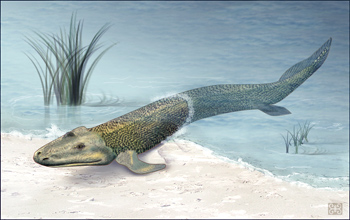
Earth, 400 million years ago. It's not the sparkling gem of blue and green we see from space today. The oceans are still there, but the continents are mostly barren: plants emerged from the oceans only 30 million years ago. They are still concentrated along the coasts and in wet areas. Taking a closer look, we find a few arthropods have crept out of the water too. Sea scorpions pick up dead fish along the coasts, and a few insects buzz among the ferns. Most life is still in the water, though. This is the Devonian period, and something's about to change. 380 million years ago, the first vertebrates, amphibians, came out of the water. Fossils like Tiktaalik show the transition between the fins of fish and the feet of land vertebrates. They are some of the most incredible fossils, and provide a lot of information about the track life took on the early Earth.
A new fossil discovery adds a new twist to this story of life. A new -actually, a very, very old- set of fossil footprints has been discovered. They are obviously those of a vertebrate, rather than an arthropod. Just the fossil itself is exciting, but the twist is that it is 18 million years older than Tiktaalik and similar tetrapods. Even in geologic time, that's significant. That means that amphibians evolved, not in the middle of the Devonian around 380 million years ago, but 395 million years ago at the beginning of the Devonian. Also, these footprints aren't small; researchers estimate that the creature that made them was up to 3 meters (nearly 10 feet) in length. Thus, tetrapods and their predecessors, like Tiktaalik, had evolved much earlier than originally thought. Also, it means that the intermediate creatures were more successful than scientists had previously thought.
This discovery is exciting because it fundamentally changes the beginnings of land vertebrate, which later led to most of the animals we are familiar with today. I expect that this discovery will be followed up by not only more footprints, but by skeletal evidence as well. After all, we know what to look for now. As was the case with Tiktaalik, the fossil record suggested that there should be a specific type of creature between fish and amphibians in a pretty small range of rocks. Paleontologists looked there, and found it. This enlightening discovery will probably be followed up in a similar manner. It's an exciting example of how science is always changing.
Like the warm versus cold blooded debate, this argument has been around since the first dinosaurs were identified. It's pretty easy to tell when the dinosaurs went extinct: dinosaurs are found in rocks older that 65.5 million years, and are not found in rocks younger than 65.5 million years (with the exception, of course, of birds. But, for the purpose of this post, assume that dinosaurs are non-avian dinosaurs). But what killed them is a much more challenging question. There are several popular hypotheses, with varying scientific support, as to the cause of this mass extinction.
Today, it's easy to tell if a creature is "cold-blooded" (ectothermic) or "warm-blooded" (endothermic). Reptiles, fish, and amphibians all slow down when the temperature is too cold. They do not produce their own body heat. That's why snakes coil up in the middle of the road: that's the warmest surface, and ideal to heat themselves up. Mammals and birds, on the other hand, are warm-blooded. They don't rely on their surroundings for body warmth; they stay at a warm, pretty constant temperature. Therefore, if you pet a dog, it's nice and warm.
But what about dinosaurs? Were they more reptilian, like the creatures they evolved from? Or were they more like their later descendants, the birds of today? This debate has been going on in the paleontology community for decades. A new study points towards the "warm-blooded" model, and the implications help change how we think of dinosaurs.
Obviously, today, we can watch animal behavior to determine if a creature is ectothermic or endothermic. We can also use morphology. Endothermic animals use more energy to move around than ectothermic creatures. The length of an organism's legs is directly related to this energy usage. Fossils give us this information beautifully. Thus, in the study, the hip heights of various dinosaur species were measured. The scientists also used some musculature reconstructions to help approximate the energy each creature would have used to walk. The results? Most, if not all, dinosaurs were most likely warm-blooded. In fact, this trait might have developed in the earliest dinosaurs, making it older than previously thought. It certainly presents a different view of the Mesozoic world.
The Cold-Blooded View
Take a trip back to the Jurassic. You end up in a fern-meadow, with a few trees scattered about. It's a cool morning, but the day will be warm. A herd of Diplodocus are lying in the sun, warming up. A lone Allosaurus is around near some trees. It is tearing hunks off of a dead juvenile Diplodocus. Based on the insects and decay, it's been dead for a while. While the carnivore looks impressive, it lumbers slowly, and is probably not intelligent enough to take down a even a juvenile. One of the more intelligent dinosaurs would have been little Compsognathus, which was only the size of a chicken. As you watch, it catches a dragonfly.
The Warm-Blooded View
Through the benefits of imagination, the scene blurs and changes. You're still in the same fern-meadow, on the same day. The behavior of the dinosaurs has changed radically, however. You find yourself between two very different hunts. The Compsognathus has climbed up onto a tree stump, and is intently watching a hole in the ground. A small lizard darts out. Before it gets more than a foot, however, the Compsognathus pounces on it, grabbing it in long-fingered hands. The lizards struggles feebly, before the dinosaur decapitates it. Meanwhile, the Diplodocus herd has been walking through the meadow, whip-like tails drawing patterns in the air. A young one is limping near the outside of the herd. The Allosaurus is standing motionless in the shadow of a tree, watching it. Suddenly, it stumbles, and the creature springs to life. It springs out, along with two other Allosaurs, quickly biting on the the Diplodocus. One bites its neck, while another tears a chunk out of the already injured leg. The third guards, snapping at an adult to distract the herd from the little one. In a matter of minutes, the ambush is over. The juvenile is motionless, and the two Allosaurs are dragging it away, while the third retreats and rejoins the pack. The Diplodocus herd lets out some bellows, and reconfigures. All the young ones are now concentrated in the center, protected by adults. They will not be caught off-guard again.
As you can see, the warm-blooded idea of dinosaurs makes them far more intelligent (and possibly more interesting) creatures. It's been a controversial idea since it was first proposed by Robert Bakker in the early 1970's, however, and the debate is still going on today. It is evidence like this study which allows us to finally solve this question.
For years, Archaeopteryx has been considered the oldest bird on record. Because it is a transitionary fossil, several scientists have suggested that Archaeopteryx is a hoax. Astronomer Fred Hoyle, for instance, suggested in 1985, that the Archaeopteryx specimens are actually Compsognathus fossils with feather imprints carved in a thin layer of cement. Most of these arguments are ridiculous, and based off of a poor understanding of geology. The calls against the authenticity have never shaken Archaeopteryx's claim of earliest bird.
A new evaluation of the bones has, however. Since the first Archaeopteryx was discovered, there have been 10 more found, including a juvenile. Bone samples were taken from this fossil, and looked at on a microscopic level. Surprisingly, the bone structure did not match that of a fast-growing bird; instead, the bone was dense, and apparently took several years to grow, matching dinosaurs.
However, Archaeopteryx does have well-developed wings, something that only makes sense if this ancient creature could fly. So, the question is: Was Archaeopteryx a bird, or just a feathered, avian dinosaur? The team suggests that, because Archaeopteryx has a similar growth pattern to the dinosaurs it evolved from, that it is not actually a true bird. Despite this, it does still show the transition from dinosaurs to birds, and is a fascinating fossil.
Scientifica Phenomena is a site dedicated to exploring science. We look at the new discoveries, and discuss the basic concepts. We want to make science accessible to everyone, not just those who already have a passion for it.
If you have a question about any science topics, or just comments/questions/suggestions in general, leave a comment or use the Contact Us form.