Causes


free debate


October 19, 2009

Glymetrol, and the Dangers of Alt Med

I teach thousands of students a year. Many of those students have diabetes. Diabetes can be fatal if not properly controlled. Luckily, with modern medical advances, we can control diabetes. The students I see live good lives. A new supplement threatens their health and quality of life.

Diabetes is caused by problems with pancreas. Without a properly working pancreas, your body can't properly control your blood sugar levels. Let me say now that unregulated diabetes can be fatal. This is not something to mess around with. Some cases of diabetes can be controlled with changes in diet, and others require injections of insulin. With these careful measures, people affected by diabetes can live fairly normal lives; without them, they can die.

The other night, I was watching TV and saw an ad that is incredibly dangerous. The ad was for a supplement called Glymetrol. They are making a few simple claims: that it is safe and effective, and that you will receive the first bottle free. I want to review these clams, and try to make it clear why this ad frustrates me so much.

First, let's look at "safe and effective." Glymetrol is catching the wave of the natural medicine fad. One of the underlying fallacies throughout the advertisement of Glymetrol is the "all-natural" fallacy. The idea is that if it's natural, it's good for you, or at least better than processed items. This is just wrong, arsenic is natural too. Whether or not it's natural bears no relation to its safety or effectiveness. The bottom line on this note is that no one knows if Glymetrol works or not. It has not been tested clinically. There is some plausibility to some of the ingredients, but we need to remember we are dealing with a life-threatening disease. Because there is no clinical data, it could be helpful... or just as easily harmful. If you are going to be relying on anything to regulate your diabetes, it should be shown to work, and to work safely. "Safe and effective?" We have no idea.

The other really despicable part of this whole deal is who they are marketing it to. They say you get your first bottle free, and that it is part of a "market trial offer." When I was watching the commercial, I thought that market trial offer meant that it was part of a study. The fine print let me know otherwise. Unless you read those tiny letters at the bottom of the screen, you could easily be tricked into thinking that Glymetrol was being tested in a clinical trial. The first bottle is also not quite free. Again, the problem is in the fine print.
If you are enjoying the product and loving the results after 30 days, do nothing. Only then will your credit card be automatically billed 1 easy payment for the 2 bottles at just $49.99 PER bottle.
So after the thirty days you not only get charged for the first bottle, but for a second bottle as well. Bottom line, this is a complete scam.

I could go on and on about the other claims in their FAQ areas, and about similar products. For me this highlights the reason I am so against alternative medicine. They are asking people with a life-threatening disease to rely solely on them for treatment. Beyond that, they are making deceptive marketing claims to lure people into purchasing their product. Medicine needs to be shown to a reasonable extent that it is both effective and safe before it is sold to the general public. Just look back to radioactive water. I can't stand of thought of the diabetic kids I work with being without their insulin. I want them to be able to live healthy lives, and have the information they need to avoid scams like this.

For a more detailed breakdown I recommend this article.
http://www.everydayhealth.com/blog/zimney-health-and-medical-news-you-can-use/glymetrol-a-scam-targeting-people-with-diabetes/

October 16, 2009

Archaeopteryx Revisited

For years, Archaeopteryx has been considered the oldest bird on record. Because it is a transitionary fossil, several scientists have suggested that Archaeopteryx is a hoax. Astronomer Fred Hoyle, for instance, suggested in 1985, that the Archaeopteryx specimens are actually Compsognathus fossils with feather imprints carved in a thin layer of cement. Most of these arguments are ridiculous, and based off of a poor understanding of geology. The calls against the authenticity have never shaken Archaeopteryx's claim of earliest bird.

A new evaluation of the bones has, however. Since the first Archaeopteryx was discovered, there have been 10 more found, including a juvenile. Bone samples were taken from this fossil, and looked at on a microscopic level. Surprisingly, the bone structure did not match that of a fast-growing bird; instead, the bone was dense, and apparently took several years to grow, matching dinosaurs.

However, Archaeopteryx does have well-developed wings, something that only makes sense if this ancient creature could fly. So, the question is: Was Archaeopteryx a bird, or just a feathered, avian dinosaur? The team suggests that, because Archaeopteryx has a similar growth pattern to the dinosaurs it evolved from, that it is not actually a true bird. Despite this, it does still show the transition from dinosaurs to birds, and is a fascinating fossil.

Credit: Science Daily- Archaeopteryx Was Not Very Bird-Like: Inside the First Bird, Surprising Signs of a Dinosaur
Image Credit: Wyoming Dinosaur Center ; Science Daily

October 15, 2009

Climate Change: Science or Fiction? (Blog Action Day 2009)


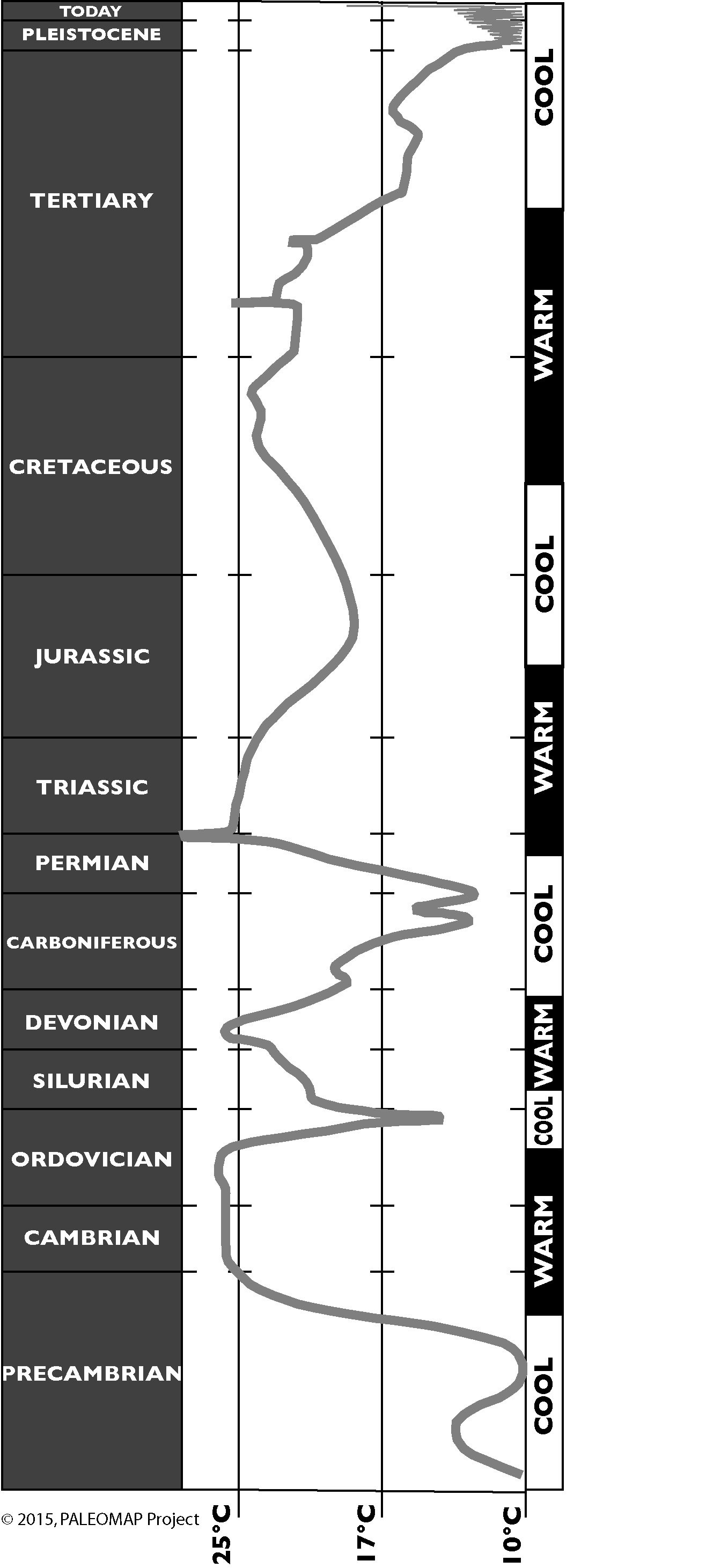
Over the course of the Earth's history, climate has changed dramatically. Some periods are extremely warm; in the Eocene, around 55 million years ago, there was a period of time, known as the PETM, where average global temperature was around 7o C warmer than it is today (13.39o C). We are currently in an "icebox" time. These are relatively rare, and are defined as points in time where there is ice at the poles. Because of this, the Earth would naturally warm again. Virtually no scientist disputes this; there is a solid base of evidence.

The controversy about climate change comes not from whether or not it exists, however. It's more a question of how much of an impact humanity has had on it. I'd like to take a moment and address a few of the myths and facts about climate change.

Myth #1a: The current warming trend is entirely natural.

Well, no. CO2, a major greenhouse gas, is stored in fossil fuels: natural gas, oil, and coal. These fuels are compressed, ancient organic matter, which is full of CO2. Burning these fuels puts lots of CO2 into the atmosphere. CO2 traps heat energy and reflects it back at the planet. So, when we put carbon dioxide in the atmosphere, we do contribute to the warming of the planet, especially when you consider the rate at which we add this gas to the atmosphere.

Myth #1b: The current warming trend is entirely man-made.
This is a popular converse to #1a. No, humans are not entirely responsible for climate change. The planet undergoes climate changes on a fairly regular cycle, and we are nearing a warm stretch anyway. The rate is what is different; the fact that the Earth is beginning to warm again is not.

Myth #2: Carbon Dioxide is the only greenhouse gas. So, if we can get rid of that, then the Earth will cool back down.
Nice try, but no. If we could remove all greenhouse gases from the atmosphere, we'd need to get rid of a lot more that just CO2. Methane (CH4), nitrous oxide (N2), and water vapor (H2O) are all greenhouse gases as well. In fact, water vapor has the strongest of these greenhouse gases. We could not possibly remove all the water from the air, and doing so would be far worse to life than climate change. The water cycle keeps water vapor from being too large of a problem, with respect to climate.
Also, simply removing greenhouse gases wouldn't fix the warming trend. There are other factors, such as the solar cycle and changes in Earth's orbit. Airborne particles and aerosols can also affect climate change.

Myth #3: Climate change would be great! It's way too cold where I live.
This one is especially tempting to those living in places like Minnesota, the Dakotas, or anywhere else where the average winter temperature is below 0. Unfortunately, it's not necessarily true. The term "global warming" is incredibly misleading in this respect. The Earth will not uniformly warm up by 5o C. Some areas will get warmer, sure. Others will get colder. The entire planet, land and sea surface, is warming, on average. This is not a promise of South Dakota becoming the new Arizona.

Myth #4: The Earth is warming faster each year, especially over the last decade.
Factually wrong. 2008 tied with 2001 for being the 8th warmest year on record. It's certainly still warmer than, say, 100 years ago. However, it's not exponential growth of the annual global temperature.


Myth #5: The weather's weird this year. It's global warming!
The weather is weird this year. But, no, it's not due to climate change. The unusual weather patterns this year (for instance, the repeated afternoon rainshowers early this summer in areas like Colorado) are due to the El Niño. It's an interesting weather phenomenon, but it a much shorter cycle than the climate cycle.
There is a hint of truth in this one, though. Weather patterns will change, causing drought, flooding, and other changes in weather globally.

Climate change is a complex issue. It's definitely science: it's occurring, and we can't stop it. We couldn't prevent it, no matter what we did. It's a natural process. However, we have had some impact on the speed that the warming trend has occurred. So far, it's not the fastest climate change: the PETM was a larger jump. in 10,000 years. We haven't had that long for this one yet, so it has yet to be seen if this is the fastest climate has changed. However, on the bright side: life didn't die out during the PETM. Instead, they flourished. The fact that we have polluted the air with so much carbon dioxide is problematic, but not as much as the other pollutants we've released. The Earth will survive and recover from any human impacts on climate change. A bigger question is how we humans will adapt and ride it out.

Thanks to Blog Action Day for posing the question about climate change, human impacts, and what action we need to take.

Graph credit: Paleomap Project
Credit for the annual temperature data to Science Daily.

October 12, 2009

Wikipedia's Evil Cousin, Conservapedia


I am in college, and this semester I am taking some online classes.  Like most teachers, my astronomy professor said that we could not use Wikipedia as a source in class assignments.  So, in a recent group project, one fellow student linked to a site that is about a million times worse: Conservapedia.  I had heard of Conservapedia before, but I had never visited the site.

The link my classmate posted was to the article about Europa, one of the most interesting moons in the Solar System. The first thing that made me cautious was the section titled "Problems for Uniformitarian Theories." Uniformitarian is the idea that natural process over long periods of time shape the universe as we see it today.  The most famous example of this is the Colorado River carving the Grand Canyon over hundreds of years.

Their argument is that Europa's young surface means that Europa is actually young, when its orbital character implies an old age.  To any astronomer, this argument is ridiculous. Europa is a old world (it was formed with the rest of the solar system 4.6 billion years ago) with a young surface because of the ice. We date surfaces based on the number of craters, more craters = older surface.  Europa's surface is constantly being reshaped by ice moving, cracking, and stretching.  This, over time, erases craters and viola, young surface.


The other atrocious bit was their section call "Speculation about Life."  My real problem with this was they make is sound like Richard C. Hoagland is the only person considering the idea that there is life on Europa.  The reality is that we have no idea whether or not there is life in the oceans of Europa, but there is reason to think life could exist.  And then there is the endorsement of Hoagland.  This is the face on Mars guy, whom I have written about before.  Not only is Hoagland not a real scientist, but there are other legitimate scientists who are looking into the plausibility of life on Europa.

Yes, any Wiki is going to have bad articles. The problem is that horrible information is the standard on Conservapedia.  If it at all disagrees with their political and ideological views, it won't make the final edit.  While they accuse "Darwinists" of censoring the scientific literature, they simply ignore any evidence that conflicts with their sacred cows.  Sometimes Wikipedia is wrong. Conservapedia is outright deceitful.

October 6, 2009

More Pond Scum Energy

Back in June, I discussed the potential of getting oil from algae. You can read that article here.

This is sort of a follow-up. While I haven't seen anything new about oil from algae, there is a new potential for gaining an alternative energy from algae. There's an enzyme in green algae that causes the organism to produce hydrogen. However, oxygen attacks this enzyme. Since oxygen is by-product of photosynthesis, it is often in high concentrations near the enzyme. Scientists have used complex electro-kinetic methods and X-ray spectroscopy to learn how oxygen attacks the enzyme, damaging it and shutting off the hydrogen production.

Initially, this sounds like bad news. After all, if the hydrogen production relies on an enzyme that oxygen destroys, but the algae is constantly producing oxygen, it seems unlikely that these algae could be useful as hydrogen factories. However, the team feels that this obstacle is not hard to overcome. Understanding how the oxygen attacks the enzyme allows them to look for more oxygen-resistance enzymes that produce oxygen. It also gives them some idea how to prevent oxygen from attacking the enzyme. While there is a lot more research that needs to go into this technique, it is a promising source of a major alternative energy. Algae has a lot of potential for meeting the needs of our technological world.