Causes


free debate


Showing posts with label Climate Change. Show all posts

December 28, 2009

Skepticism and Climate Change


Recently there has been a lot of discussing regarding climate change within the skeptical community. Famous skeptic James Randi and science educator Johnny Ball, have both expressed their doubts as to the effect humans are having on climate change. The was a media storm as some embarrassing private e-mails between climate scientists were made public. This has raised several questions including what is the evidence for climate change and what is the role of skepticism in this issue.

Any issue that is highly politicized is hard to find good information on. We have discussed the issue of climate change a few times before on this blog (here and here) but I want to quickly review some of the science. There are several claims made with regard to climate change. The first is that the globe is, on average, warming. I think most people accept this fact. The debate is over the cause. The Earth is in a time period where we would expect to see temperatures rising naturally to a degree. The debate is over how much of the current warming trend is natural, and how much is caused by the human emissions of greenhouse gasses like CO2.

When we are dealing with an issue as complicated as climate change, we want to look at the scientific consensus. We don't want to look at the opinion of every scientist on the planet, but of those scientists who are doing work in relevant fields. The Intergovernmental Panel on Climate Change (IPCC) is a group composed of thousands of scientists from countries around the world. They have said in their most recent publication, "Most of the observed increase in global average temperatures since the mid-20th century is very likely due to the observed increase in anthropogenic GHG [greenhouse gas] concentrations." There is a growing amount of evidence that backs up this conclusion.

There is another debate on how we should react to climate change, but that is for a future post. My question here is what is the role of skepticism in regard to this evidence.

In science, opinions that go against the consensus play an important role. Grants will often go to people doing research that goes against the grain. I am glad that there are scientists that are working on finding problems with climate models and trying to poke holes in the other lines of evidence for climate change. This said, I think we have to remember this is a minority view.  Skepticism is about forming views based on the evidence. So far, the evidence points strongly towards a human contribution for climate change. I think that regardless of our personal viewpoints we need to respect that. I have no problem with people like James Randi expressing doubts about the human influences on the climate. I have said before skepticism is not a set of views, but a process for forming ones own views about the world. I do think though that to be responsible, leaders like Randi need to be clear that they are disagreeing with the scientific consensus. There are sill places for their doubt. We are still are developing climate models, and their are error bars for the evidence (see the image above). I don't find these arguments convincing, but others do and that's where the dialogue should be.

I personally find the evidence for the human influences on climate change overwhelming. I always welcome people to disagree with me, but please do so with evidence and logic. Recognize that the scientific community has overwhelmingly showed their support for this view. I think it is unfortunate that there are people who disagree with me based solely on its implications or for other political reasons. I have have talked with scientists on both sides of this issue, and I think that the most reasonable thing to do is respect the conclusion of the majority of working climate scientists.
October 15, 2009

Climate Change: Science or Fiction? (Blog Action Day 2009)


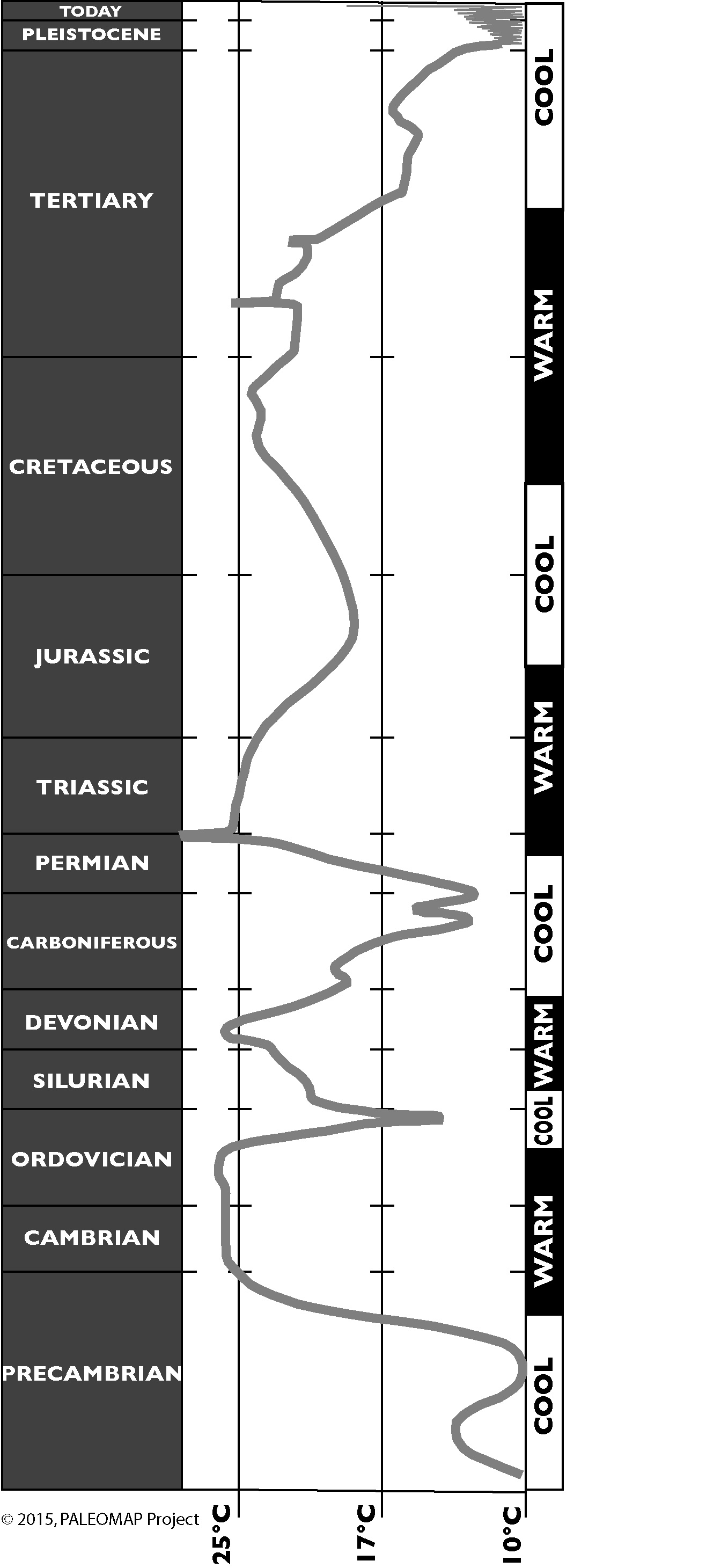
Over the course of the Earth's history, climate has changed dramatically. Some periods are extremely warm; in the Eocene, around 55 million years ago, there was a period of time, known as the PETM, where average global temperature was around 7o C warmer than it is today (13.39o C). We are currently in an "icebox" time. These are relatively rare, and are defined as points in time where there is ice at the poles. Because of this, the Earth would naturally warm again. Virtually no scientist disputes this; there is a solid base of evidence.

The controversy about climate change comes not from whether or not it exists, however. It's more a question of how much of an impact humanity has had on it. I'd like to take a moment and address a few of the myths and facts about climate change.

Myth #1a: The current warming trend is entirely natural.

Well, no. CO2, a major greenhouse gas, is stored in fossil fuels: natural gas, oil, and coal. These fuels are compressed, ancient organic matter, which is full of CO2. Burning these fuels puts lots of CO2 into the atmosphere. CO2 traps heat energy and reflects it back at the planet. So, when we put carbon dioxide in the atmosphere, we do contribute to the warming of the planet, especially when you consider the rate at which we add this gas to the atmosphere.

Myth #1b: The current warming trend is entirely man-made.
This is a popular converse to #1a. No, humans are not entirely responsible for climate change. The planet undergoes climate changes on a fairly regular cycle, and we are nearing a warm stretch anyway. The rate is what is different; the fact that the Earth is beginning to warm again is not.

Myth #2: Carbon Dioxide is the only greenhouse gas. So, if we can get rid of that, then the Earth will cool back down.
Nice try, but no. If we could remove all greenhouse gases from the atmosphere, we'd need to get rid of a lot more that just CO2. Methane (CH4), nitrous oxide (N2), and water vapor (H2O) are all greenhouse gases as well. In fact, water vapor has the strongest of these greenhouse gases. We could not possibly remove all the water from the air, and doing so would be far worse to life than climate change. The water cycle keeps water vapor from being too large of a problem, with respect to climate.
Also, simply removing greenhouse gases wouldn't fix the warming trend. There are other factors, such as the solar cycle and changes in Earth's orbit. Airborne particles and aerosols can also affect climate change.

Myth #3: Climate change would be great! It's way too cold where I live.
This one is especially tempting to those living in places like Minnesota, the Dakotas, or anywhere else where the average winter temperature is below 0. Unfortunately, it's not necessarily true. The term "global warming" is incredibly misleading in this respect. The Earth will not uniformly warm up by 5o C. Some areas will get warmer, sure. Others will get colder. The entire planet, land and sea surface, is warming, on average. This is not a promise of South Dakota becoming the new Arizona.

Myth #4: The Earth is warming faster each year, especially over the last decade.
Factually wrong. 2008 tied with 2001 for being the 8th warmest year on record. It's certainly still warmer than, say, 100 years ago. However, it's not exponential growth of the annual global temperature.


Myth #5: The weather's weird this year. It's global warming!
The weather is weird this year. But, no, it's not due to climate change. The unusual weather patterns this year (for instance, the repeated afternoon rainshowers early this summer in areas like Colorado) are due to the El Niño. It's an interesting weather phenomenon, but it a much shorter cycle than the climate cycle.
There is a hint of truth in this one, though. Weather patterns will change, causing drought, flooding, and other changes in weather globally.

Climate change is a complex issue. It's definitely science: it's occurring, and we can't stop it. We couldn't prevent it, no matter what we did. It's a natural process. However, we have had some impact on the speed that the warming trend has occurred. So far, it's not the fastest climate change: the PETM was a larger jump. in 10,000 years. We haven't had that long for this one yet, so it has yet to be seen if this is the fastest climate has changed. However, on the bright side: life didn't die out during the PETM. Instead, they flourished. The fact that we have polluted the air with so much carbon dioxide is problematic, but not as much as the other pollutants we've released. The Earth will survive and recover from any human impacts on climate change. A bigger question is how we humans will adapt and ride it out.

Thanks to Blog Action Day for posing the question about climate change, human impacts, and what action we need to take.

Graph credit: Paleomap Project
Credit for the annual temperature data to Science Daily.

July 24, 2009

Lightning, Life, Cosmic Rays, and Climate

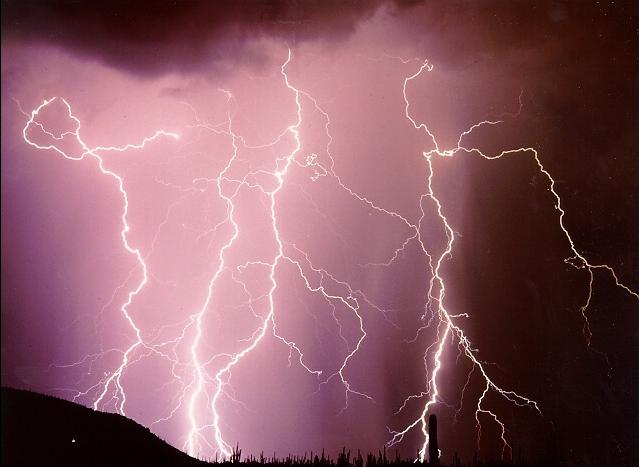
Of all weather phenomena, lightning is one of my favorites. It's amazing that electricity can build up in the air, then release in a sudden burst of light and sound. It can ignite forests, and melt dirt or sand into a clump, called a fulgurite. Lightning is terrifyingly powerful, and really neat to watch.

I recently ran across a couple of articles about lightning. The first discusses new findings in the way life developed. Many bacteria have a gene that allows them use phosphite, a rare compound created almost exclusively by lightning strikes. When life first developed, around 4 billion years ago, however, phosphite was more common. It was introduced by meteorites, as well as lightning, and was more easily avaliable than the common phosphate. Today, phosphite is so rare that it is no longer metabolized. But many bacteria, like E. coli, still have the vestigial ability to use it.
The other article discussed how cosmic rays could influence lightning, and how that, in turn, could influence the climate. Researchers in Portugal suggest that the occurance of lightning is related to the solar cycle. When there is a lot of solar activity, there are fewer charged particles in the Earth's atmosphere, causing more lightning. When the Sun is quiet, there is more cosmic ray flux, more charged particles in the air, and so fewer lightning storms.
This relates to climate change in an unusual way. Because of how the greenhouse effect works, the amount of cloud cover affects global temperature, as well as the amount of greenhouse gases. Thus, when solar activity is up, there is more cloud cover and more lightning along with it. This increase would about cancel out the effect of greenhouse gases during that short period of time.

The impacts of lightning are varied, and can be quite significant. And the occurence of lightning itself is amazing. There is nothing quite like seeing a lightning strike. It is terrifying, but also mesmerizing. It's one of the most interesting forces in nature.

June 20, 2009

Defining Climate Change

We've heard it all over the news and the web. "Humans are causing global warming." "We'll make ourselves, and everything else on the planet, go extinct!" These doomsayers claim that only immediate action will save our planet from ending up like this:
However, a lot of these websites claiming doom and destruction just refer to "scientists" providing claims or cite CO2 as an exclusive cause for "global warming." In truth, though, the situation is more complex.

First off, "global warming" is an extremely inaccurate term. The planet Earth is not uniformly warming up. Some areas will get warmer, while others will get cooler. Therefore, in referring to the changes in global temperature, the term is "climate change," not "global warming."

Second, climate change is nothing new to the planet. Throughout the planet's history, the temperature has changed. In the Cretaceous, for instance, there were no polar ice caps. The Earth regularly warms and cools for various reasons, including:
  • Eccentricity: As the Earth orbits the sun, the shape of the orbit, as well as the tilt of the planet, change somewhat. Because of this, the amount of heat reaching the planet changes, which can cause ice ages, based on a theory by Milutin Milankovitch.
  • Sun Intensity: This is pretty self-explanatory. As the sun fluctuates, it may be more or less powerful for a period of time. This can also cause changes in the global temperature of the planet.
  • Volcanic Eruptions: The release of particulate matter and greenhouse gases into the atmosphere when volcanoes erupt can also affect climate temporarily. A time interval with a lot of volcanic activity can push a more lasting shift in the climate.
  • Ocean Currents: A large conveyor belt of circulation in the oceans moves cool water from the poles to the equator, and warm water from the equator to the poles. As global temperature shifts, this current may become weaker, changing climate regionally.
  • Greenhouse Gases: And this is the one everyone is concerned about. Gases like carbon dioxide (CO2), methane (CH4), water vapor (H2O), and nitrous oxide (N2O) all can capture infared radiation and prevent it from escaping the atmosphere. This leads to a build-up of heat, the greenhouse effect.
So, in a nutshell, that's what climate change is, and what causes it.
In the next installment: the Human Factor

Credit: EPA