Causes


free debate


Showing posts with label Get Involved. Show all posts

September 20, 2011

Using Gaming for Good

Video games have become one of the go-to activities to kill time and fight boredom in our digital age. They come in all flavors and varieties; some prefer first person shooters, while others (myself included) would rather play exploratory RPGs. There are concerns and research on the effects of those games, but that's a story for a different day. Instead, let's focus on the purpose of video games. Most are just games, with no purpose outside of entertainment. But a few help progress science, such as one that modeled an HIV enzyme in just three weeks, where the best computer models failed.

...[A] microscope gives only a flat image of what to the outsider looks like a plate of one-dimensional scrunched-up spaghetti. Pharmacologists, though, need a 3-D picture that "unfolds" the molecule and rotates it in order to reveal potential targets for drugs.

This is where Foldit comes in.

Developed in 2008 by the University of Washington, it is a fun-for-purpose video game in which gamers, divided into competing groups, compete to unfold chains of amino acids -- the building blocks of proteins -- using a set of online tools

....

Cracking the enzyme "provides new insights for the design of antiretroviral drugs," says the study, referring to the lifeline medication against the human immunodeficiency virus (HIV).

It is believed to be the first time that gamers have resolved a long-standing scientific problem.

This to be awesome, in my opinion. I've played with Fold.It a little bit, but not enough to really give a review of the game.  But the fact that it is being used to do this sort of research is fantastic, and I look forward to seeing what other discoveries can be made with it, as well as what applications those discoveries may have in the medical field.

May 2, 2011

Rethinking Thought: A Day at TEDx

I was lucky enough to attend the inaugural TEDx UChicago conference a few weeks ago. I've been incredibly busy, but am finally catching up, and wanted to share my experience there. For those that don't know, TED (Technology, Entertainment, Design) is a nonprofit dedicated to the spread of ideas. They ask speakers to give a speech in 20 minutes about a topic they study or their philosophy about the world. TED also lends its name and prestige to independently run events, called TEDx events. These are not official TED events, but have the same spirit of spreading important and powerful ideas.

The theme at the TEDx event I attended was "Reinventing the Life of the Mind." There were 14 different speakers, from around the world and from every different background: a artist-turned-paleontologist, a former president of Bolivia, a double amputee, a cyborg, a blind architect, and more. Each of the talks discussed our current perception of aspects of the world, and ways of rethinking them. It was a very long event, lasting from 8 am when registration opened to 5 pm when the last speakers finished. Because of this, I'd like to give you just a quick recap of what I thought were the highlights and take away messages.
[Read more....]

November 15, 2010

Free Software Tools for Astronomy

I have been in the astronomy education world for about a half decade now. In that time, I have found many very cool pieces of software that are great to explore on your own and teach with. So, if you have a few extra minutes, poke around, explore, have fun, and maybe learn something along the way.

Want to know what stars and planets are going to be above your head tonight? Stellarium will tell you that and more. With it you can also see what the sky was like a thousand years ago, or in Antarctica. This program will get you acquainted with the constellations and is really easy to use. I have used Stellarium to give students a idea of what to look for in the night sky, and I use it myself on a regular basis.

NASA released a new piece of software recently that, while still in beta, I have been thoroughly impressed with. Eyes on the Solar System is a absolutely spectacular tool for exploring planets, moons, and spacecraft. I was flying around the solar system within minutes of visiting the site. Its ease of use sets it apart from many other such tools, and the graphics are well done.

Third on my list is probably the best known. Google Earth is hugely popular, but one of its best kept secrets is its ability to take you off the planet it is named for. Google Sky lets you look up at constellations and see exquisite images from telescopes. Google Moon and Mars let you explore in much the same way you explore the Earth. To get to these features, press the button with the picture of Saturn on the tool bar and select the option you desire. This is great for showing anyone the wonders of another planet. Such a thing should be made available for every planet. Enjoy your travels.

The programs above I use and love. There are others, such as World Wide Telescope  and Celestia, that I have not been able to master and effectively use. I know other people who make these programs do wonderful things so they are worth your time. If you are interested, I recommend that you give them a try. I hope you more luck than I have had.

If you found this useful, let me know and I can do more similar posts in the future.

January 18, 2010

3 Ways You Can Support Science and Reason (for Free)

I have been passionate about science for many years now. Stemming from this passion is my desire to be involved in active science, and spread the amazing world science reveals. While donations can always be used help to spread good critical thinking, there are many things you can do even if you are strapped for cash.

1. Talk about it

It may not seem like much, but one of the best things you can do is just to share your passion with friends and family. If you see a science story that catches your eye, tell people about it. People are generally interested in science to varying degrees, so share what you know. The more people are talking about science, the more it will be a part of the public conciseness.

2. Join a Citizen Science Project

There are lots of projects out there where all the scientists need is a little of your time and help. A perfect example of this is the Galaxy Zoo project which I have mentioned several times before. Because of their success they have now expanded into Zooniverse. This includes 4 research projects you can help with watching everything form supernova to our own sun. You could also help with the mystery of the star Epsilon Aurigae with Citizen Sky. These are just a few examples from my own field of interest, but you can find projects across many other disciplines with just a little looking.

3. Volunteer at a Local Science Museum

This is a really fun way to spread excitement about science. There is nothing better than showing a child a simple demonstration and having their eyes light up. This is also a great way to meet other people who share your interest. As you teach people about science, you will probably find your own knowledge of science growing. Teaching any subject is a great way to solidify, and expand, on your own understanding.

These are by no means the true end to the list, but I want to keep it short for now. Maybe I will expand on this list in the future. In the meantime, feel welcome to put anything you have done to support science in the comments below.

January 14, 2010

Dynamic Earth: Haiti


I'm sure most of you have heard about the massive earthquake in Haiti by this point. It was a devastating quake. The first shock was a magnitude 7.0, out of a scale of 10. It has been followed by numerous aftershocks, ranging from 4.0 to nearly 6.0. In the face of such a distaster, it's easy to ask why the earthquake occurred. I've seen three such explanations. The first two of these are completely ridiculous.

The first is a rather bizarre idea this was not a natural earthquake, but rather a weather weapon aimed at Cuba that missed. It claims that the fact that there was a little earthquake in California (presumably a test of the weapon?) followed by a huge earthquake in Haiti is too suspicious, and not coincidence. (source: NowPublic News)

The second is given by Reverend Pat Robertson. He believe that this earthquake was punishment, for Haiti's pact with the devil.
“They were under the heel of the French, uh, you know Napoleon the 3rd and whatever, and they got together and swore a pact to the Devil. They said, 'We will serve you if you'll get us free from the French. True story. And so the Devil said, 'Okay, it's a deal.’ And, uh, they kicked the French out, you know, with Haitians revolted and got themselves free. But ever since they have been cursed by, by one thing after another, desperately poor. That island of Hispaniola is one island. It’s cut down the middle. On the one side is Haiti on the other side is the Dominican Republican. Dominican Republic is, is prosperous, healthy, full of resorts, etcetera. Haiti is in desperate poverty. Same island." (Source: ABC News)

Both of these explanations are uninformed, poorly articulated, and make the Haitian earthquake someone's fault. In fact, the Haitian earthquake was caused by a slip-strike fault, between the North American and Caribbean plates. These two plates slide along each other at a rate of 7 mm per year. Tension has been building up in the fault, and it finally snapped on Tuesday. Along with being a strong quake at magnitude 7, it's source was only about 6 miles down. This means that the crust could not absorb and diffuse the shock. The ground shook at Port-au-Prince for as much as a minute, which is very long for an earthquake. The fact that there is so much devastation, therefore, isn't a surprise. (source: USGS)

Right now, the people of Haiti don't need condemnation or conspiracy theories. There is no evidence whatsoever for a working weather missile even existing. Plus, earthquakes aren't weather; they're a geologic force. And, earthquakes happen frequently in California: the whole state is caught on the boundary between two of the largest pieces of the puzzle. Any supposed pact with Satan occurred in 1803. The people there today are not being punished for something 200 years ago. Condemning them, saying this is their own fault, is not going to help their condition at all.

Haiti is the poorest country in the Western Hemisphere; at least 80% of their population is below the poverty line. Disease is a major problem, and will only get worse with the destruction. Children there were literally living off of mud pies; now, food will be even harder to come by. (source: CIA World Factbook) And, while the earthquake itself killed over 100,000 people, many more will die if they don't get help. We live on an indifferent planet. It is neither benevolent or malicious. These natural events will occur whether people are  there or not. But when it does hit a populated area like Haiti, we, as a species capable of supporting one another, can help. Please donate to one of the organizations below, if you haven't done so already.

Support Doctors Without Borders in Haiti

More on earthquakes and plate tectonics.

November 6, 2009

Sagan Day


Carl Sagan was one of the greatest science educators of the last few decades. He inspired many people, including myself, to explore through the world though the tools of science. November 9th would have been his 75th birthday. In honor of this, Broward College is hosting the first-ever "Sagan Day." I think this is a great idea. They have some excellent speakers lined up, including Phil Plait (The Bad Astronomer) and James Randi.

A similar event has been growing over the last few years as well, called "Darwin Day."  I think that events like these are great ways to spread enthusiasm about science. While this event is on November 7th, I will try to do something on the 9th (maybe some star gazing). Spread the word and maybe do a small gathering of your own.

October 23, 2009

Happy Mole Day!

Happy Mole Day 2009!!!
So, unless you're familiar with a lot of chemistry, you're probably wondering what on earth I'm talking about. It's a "holiday," of sorts. October 23rd is recognized as mole day. This does not refer to the little furry animals, or to birthmarks. A mole is a unit of counting, like a dozen. In fact, you might say a mole is a chemist's dozen.

One mole of something is an Avogadro's number of individual parts. Avogadro's number is equal to 6.0221x10²³. This is a huge number on a macroscopic scale. However, we don't typically use Avogadro's number to count things like cars or people. We use it to count the number of molecules in a sample. So, say you have... a tank of helium, to fill your Mole Day balloons. There's 5 pounds (approximately 2268 grams) of helium in the tank. So, how many moles of helium do we have? And how many molecules is that?

Well, the molar mass (number of grams in a mole) for helium is 4.00 g/mole. So, we have:

2268 g x 1 mole/4.00 g = 567 moles
567 moles x Na (this is the abbreviation for Avogadro's number) = 3.41x1026 molecules of helium
That's a very large number of molecules. Yet, we only have 5 pounds of the gas. Avogadro's number, and the mole, help scientists to work with molecules on a scale we can comprehend. We can fill balloons with 5 pounds of helium. If we had to collect each of 3.41x1026 molecules, we'd never finish filling even one. That's what makes the mole such an important concept.

And why today? Well... 1023, 10/23. There's no better day to celebrate the mole.

For more on Mole Day, you can look at the National Mole Day Foundation site.

October 15, 2009

Climate Change: Science or Fiction? (Blog Action Day 2009)


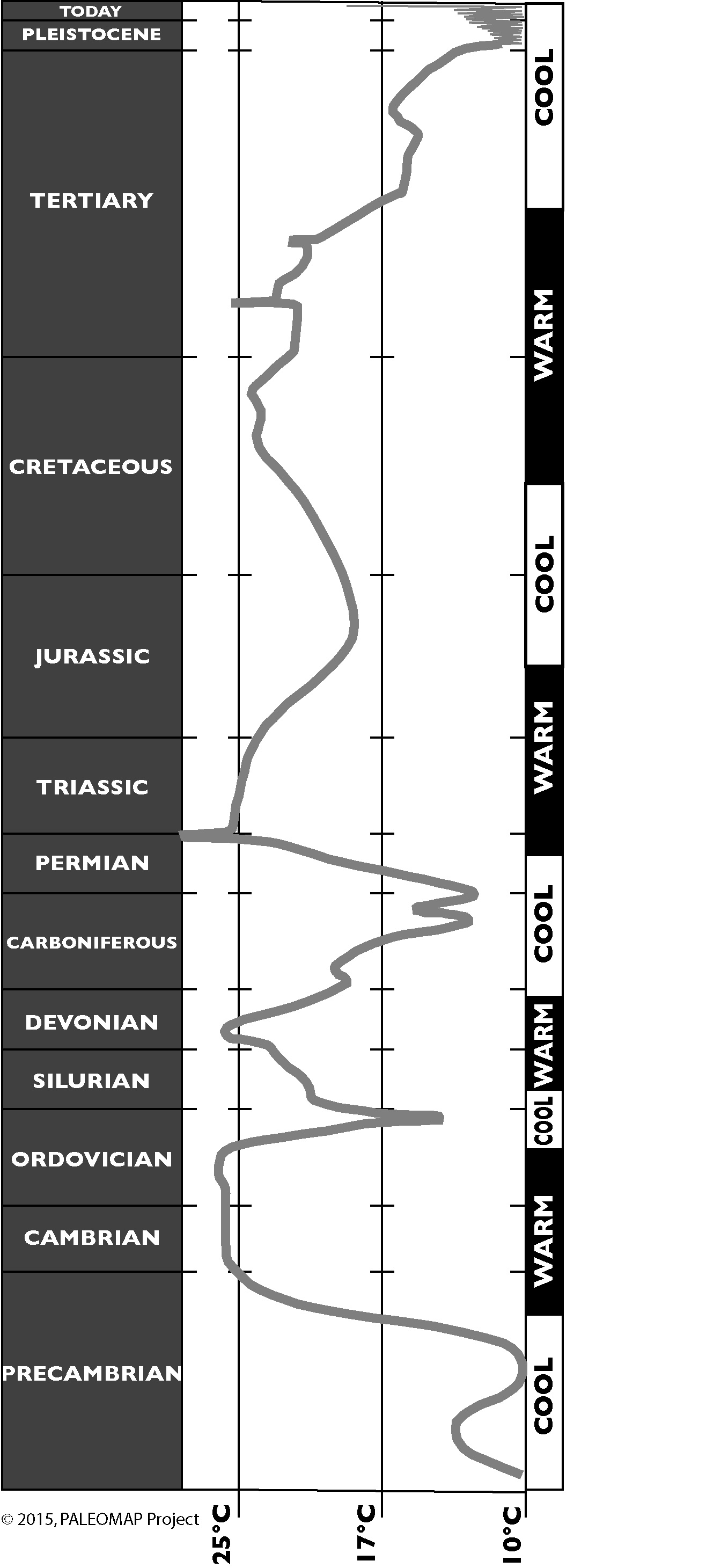
Over the course of the Earth's history, climate has changed dramatically. Some periods are extremely warm; in the Eocene, around 55 million years ago, there was a period of time, known as the PETM, where average global temperature was around 7o C warmer than it is today (13.39o C). We are currently in an "icebox" time. These are relatively rare, and are defined as points in time where there is ice at the poles. Because of this, the Earth would naturally warm again. Virtually no scientist disputes this; there is a solid base of evidence.

The controversy about climate change comes not from whether or not it exists, however. It's more a question of how much of an impact humanity has had on it. I'd like to take a moment and address a few of the myths and facts about climate change.

Myth #1a: The current warming trend is entirely natural.

Well, no. CO2, a major greenhouse gas, is stored in fossil fuels: natural gas, oil, and coal. These fuels are compressed, ancient organic matter, which is full of CO2. Burning these fuels puts lots of CO2 into the atmosphere. CO2 traps heat energy and reflects it back at the planet. So, when we put carbon dioxide in the atmosphere, we do contribute to the warming of the planet, especially when you consider the rate at which we add this gas to the atmosphere.

Myth #1b: The current warming trend is entirely man-made.
This is a popular converse to #1a. No, humans are not entirely responsible for climate change. The planet undergoes climate changes on a fairly regular cycle, and we are nearing a warm stretch anyway. The rate is what is different; the fact that the Earth is beginning to warm again is not.

Myth #2: Carbon Dioxide is the only greenhouse gas. So, if we can get rid of that, then the Earth will cool back down.
Nice try, but no. If we could remove all greenhouse gases from the atmosphere, we'd need to get rid of a lot more that just CO2. Methane (CH4), nitrous oxide (N2), and water vapor (H2O) are all greenhouse gases as well. In fact, water vapor has the strongest of these greenhouse gases. We could not possibly remove all the water from the air, and doing so would be far worse to life than climate change. The water cycle keeps water vapor from being too large of a problem, with respect to climate.
Also, simply removing greenhouse gases wouldn't fix the warming trend. There are other factors, such as the solar cycle and changes in Earth's orbit. Airborne particles and aerosols can also affect climate change.

Myth #3: Climate change would be great! It's way too cold where I live.
This one is especially tempting to those living in places like Minnesota, the Dakotas, or anywhere else where the average winter temperature is below 0. Unfortunately, it's not necessarily true. The term "global warming" is incredibly misleading in this respect. The Earth will not uniformly warm up by 5o C. Some areas will get warmer, sure. Others will get colder. The entire planet, land and sea surface, is warming, on average. This is not a promise of South Dakota becoming the new Arizona.

Myth #4: The Earth is warming faster each year, especially over the last decade.
Factually wrong. 2008 tied with 2001 for being the 8th warmest year on record. It's certainly still warmer than, say, 100 years ago. However, it's not exponential growth of the annual global temperature.


Myth #5: The weather's weird this year. It's global warming!
The weather is weird this year. But, no, it's not due to climate change. The unusual weather patterns this year (for instance, the repeated afternoon rainshowers early this summer in areas like Colorado) are due to the El Niño. It's an interesting weather phenomenon, but it a much shorter cycle than the climate cycle.
There is a hint of truth in this one, though. Weather patterns will change, causing drought, flooding, and other changes in weather globally.

Climate change is a complex issue. It's definitely science: it's occurring, and we can't stop it. We couldn't prevent it, no matter what we did. It's a natural process. However, we have had some impact on the speed that the warming trend has occurred. So far, it's not the fastest climate change: the PETM was a larger jump. in 10,000 years. We haven't had that long for this one yet, so it has yet to be seen if this is the fastest climate has changed. However, on the bright side: life didn't die out during the PETM. Instead, they flourished. The fact that we have polluted the air with so much carbon dioxide is problematic, but not as much as the other pollutants we've released. The Earth will survive and recover from any human impacts on climate change. A bigger question is how we humans will adapt and ride it out.

Thanks to Blog Action Day for posing the question about climate change, human impacts, and what action we need to take.

Graph credit: Paleomap Project
Credit for the annual temperature data to Science Daily.

July 29, 2009

Do you want to get involved in Real Science?

If so, this is your opportunity. A group called Citizen Sky is looking for volunteers to help them study a very interesting and bizarre star system. Regardless of where you live or your background knowledge, they want your help.

Just for a little background: Citizen Sky is studying a star called Epsilon Aurigae. Don't be scared off by the name, because this is a really interesting star system. Just as planets orbit a star, stars can also orbit stars. These are called binary star systems. When one of the stars passes in front of the other, we get an eclipse. When this happens, we see the brightness of the total star system dim. In the case of Epsilon Aurigae we see an eclipse about once 27 years. The really weird thing is that when scientists looked at the spectrum they could only see the light from one star. Since this was discovered, the question has been what is eclipsing this star.

This is where Citizen Sky needs your help. The next eclipse is predicted to start this August. They are looking for people to help them with everything from making the observations (which you don't need any special equipment for) to studying the data and doing outreach. Citizen Sky will give you all of the skills you need to help them out, so no background knowledge or experience is necessary. Projects like this is a great way to really understand the process, and sheer joy of science.

For more information I recommend the July 7 episode of the 365 Days of Astronomy
To get involved go to www.citizensky.org